Topics
Gut

Same capsule, opposite result: what makes a probiotic work
120 overweight adults, 12 weeks: heat-killed L. plantarum did nothing on average. Only the least varied guts lost weight. Why that is a lead, not proof.
IBS pain is not in your head: enzymes poke the gut's nerves
Stool fluid from IBS patients made gut nerve networks fire far harder than fluid from healthy people, a 2026 Gut study found. What it shows — and does not.
Actinomycetota: the phylum that guards infants and causes TB
Actinomycetota, formerly Actinobacteria: the phylum of Bifidobacterium and of tuberculosis. Where it lives in your body, what it does for and against you.
Bacillota (once Firmicutes): the 'fat bacteria' that aren't
Bacillota (once Firmicutes) feeds your gut butyrate and houses C. difficile. What the studies show, and why the 'fat ratio' on a stool test can't diagnose you.
Bacteroidota: starve it of fibre and it eats your gut lining
Bacteroidota, formerly Bacteroidetes: what this huge gut bacterial group digests for you, when it turns dangerous, and what the named studies found.
Bifidobacterium is not automatically a good bacterium
Bifidobacterium rules the gut of a breastfed baby. What it does for us, what it does against us, and exactly where the evidence stops.
Carrying C. difficile can lower your risk of C. difficile
Clostridioides difficile, formerly Clostridium difficile: what it is, where it lives, why it harms — and why silent carriage goes with less diarrhoea.
E. coli is your gut resident, not just a food poisoning bug
Escherichia coli lives in the gut of more than 90 % of people. What it does for us, what it does against us, and where the honest evidence stops.
Helicobacter pylori: carcinogen, yet linked to less asthma
Half the world hosts it. It causes ulcers and gastric cancer, yet goes with less asthma and less oesophageal (gullet) cancer. Proven harm, unproven benefit.
Lactobacillus: the yogurt bug that barely lives in your gut
What Lactobacillus is, where it actually lives in the body, what the trials show it can and cannot do, and why the genus was split into 25 genera in 2020.
Pseudomonadota: the 'bad' bacteria a healthy gut carries
Pseudomonadota, formerly Proteobacteria: what this bacterial phylum does for us, what it does against us, and why a healthy gut keeps its share low.
Yes, but not all of it: your gut after antibiotics
Twelve healthy men, three last-resort antibiotics, six months of samples: the community came back near baseline in 1.5 months. Nine species did not.

Do probiotics survive acid? That's the wrong question
Stomach acid does kill most swallowed bacteria, and spores and coatings change the odds — but a probiotic that survives the trip may still never settle in you.

Why the probiotic worked for your friend, not you
Three things differ between you and your friend: the strain (the exact named variety, not the species), the dose and duration, and the gut you started with.

More CFU is better? Not when 100× changed nothing
A bigger CFU count — more live bacteria per dose — sells probiotics. Trials disagree: doubling once helped, a hundredfold jump changed nothing.
Three days will change your gut. Then it changes back
A three-day gut reset is sold everywhere. The measurements say your gut bacteria shift in one day, revert in two, and keep 60 % of their strains for years.
Nine species still missing: what to eat after antibiotics
Your gut is near baseline 1.5 months after a course, but nine species were undetectable in most men at 180 days. What the food and probiotic trials show.
Fermented foods: the microbes you eat aren't the point
Stanford put 36 adults through a 17-week trial, half on six servings a day: gut diversity rose and 19 inflammatory proteins fell — not from the microbes.
Not all fibre feeds your bacteria, and more isn't better
Fermentable fibre feeds your gut bacteria; viscous and coarse fibre do other jobs. How much the trials measured, and how to add it without bloating.
Mouth

The carcinogen your own mouth makes out of ordinary sugar
Mouth microbes from cancer patients turned sugar and alcohol into acetaldehyde — a carcinogen ranked with tobacco. Plaque hid the rest until enzymes opened it.
Bad breath isn’t dirt. It’s one bacterial gene doing its job
A 2026 lab-dish and rat study turned down the bacterial gene behind bad breath. Here is the mechanism, the numbers, and everything the study did not show.

Bacillus coagulans: a spore passing through, not a resident
Bacillus coagulans (also Heyndrickxia coagulans — one bug, two names): what this spore-forming probiotic does for mouth and gut, and where the evidence stops.
Why the 'colon cancer bacterium' is normal in your mouth
Fusobacteriota (formerly Fusobacteria) is a normal phylum — a whole branch — of mouth bacteria. One small clade is linked to colon cancer; most of it is not.
Porphyromonas gingivalis: gum suspect healthy mouths carry
What Porphyromonas gingivalis is, where it lives, what it does for us and against us — mechanism first, every number traced to a named study.
Streptococcus mutans: the cavity germ that only wins if fed
What Streptococcus mutans is, where it lives, how it turns sugar into plaque and acid, what it does for and against you — every number with a named study.
Streptococcus salivarius: helpful microbe, rare dark side
What Streptococcus salivarius does on your tongue, what its probiotic trials actually show, and the rare infections it causes — every source named.
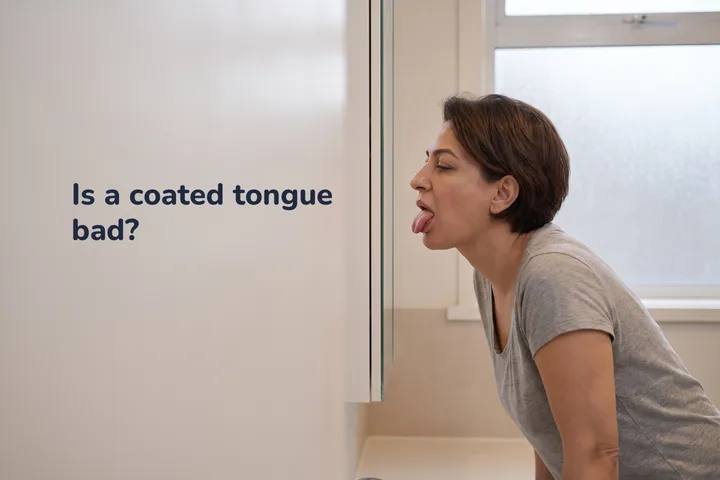
What that coating on your tongue is actually made of
A white film on the tongue is mostly your own shed cells and bacteria. What it is made of, why it smells, when it is normal, and what trials show reduces it.
Mouthwash kills the microbes your blood pressure needs
Is killing more mouth bacteria always better? A 2013 trial says no: seven days of antiseptic rinsing cut oral nitrite by 90 % and nudged blood pressure up.
Bad breath from the stomach? One case in a hundred
A breath clinic measured 491 patients: the mouth explained 87 % of bad breath and the digestive tract only 1 %. Where the sulfur smell is really made.
Immunity
Long covid may be driven from the gut, not from the lungs
A 2026 study in Gut traces inflammation far from the gut to flagellin, the protein of the bacterial swimming tail, via TLR5, IL‑15 and arachidonic acid.
Air should kill a baby's first microbe. It breathes instead
A Cell study reports one membrane fat lets Bacteroides fragilis — a microbe air should kill — outlast the oxygen of a newborn gut, and tunes immune cells.
Vitamin A doesn't reach your immune cells on its own
In mice, gut bacteria run a three-day relay that carries dietary vitamin A to immune cells. Cell Host & Microbe 2026 — and what it did not show.
Faecalibacterium prausnitzii: the microbe that fears air
Faecalibacterium prausnitzii is over 5 % of your gut bacteria and feeds the colon lining. What the named studies show — and what they do not.
Metabolism

The gut microbe that raised GLP‑1 — and missed its target
2026 Gut Microbes trial, 142 adults: heat-killed Akkermansia missed its main goal, insulin sensitivity — yet raised the body's own GLP‑1 after a glucose drink.
Akkermansia muciniphila: the microbe that eats your mucus
A gut bacterium that feeds on your own mucus lining — and may protect your metabolism. What the named studies show, and where they stop.
Verrucomicrobiota: the mucus eater you want in your gut
Verrucomicrobiota, formerly Verrucomicrobia, is the gut phylum of Akkermansia muciniphila. What the mucus eater does for you, and against you.