
What that coating on your tongue is actually made of
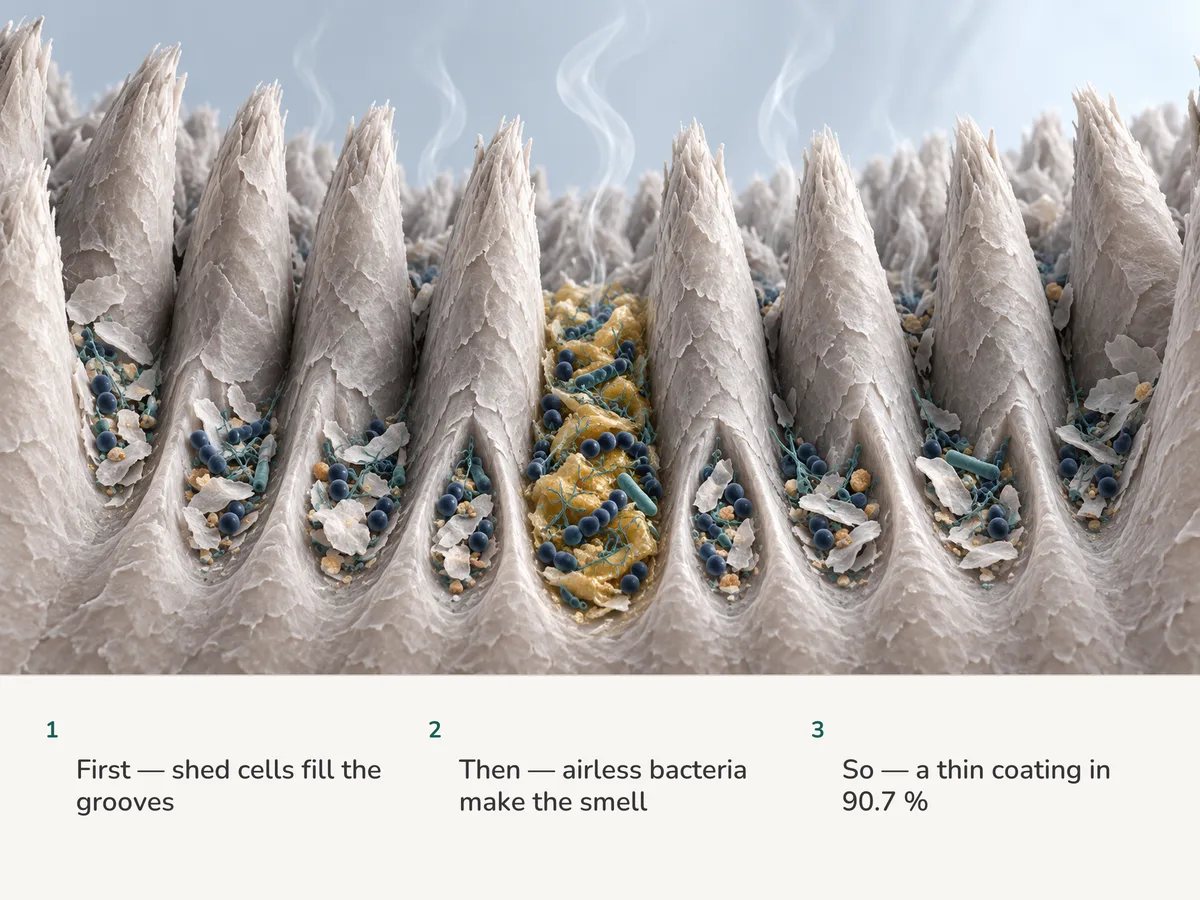
Mostly it is normal. The film is shed cells, food remnants and airless-loving bacteria caught between the papillae. In young adults a thin coating at the back, white or yellowish, is the usual finding, not a warning. Three things change that: it thickens, it wipes off leaving raw tissue, or the mouth has gone dry.
 Written by: Magnus Larsen · Microbiologist · Science bloggerPublished: Facts checked: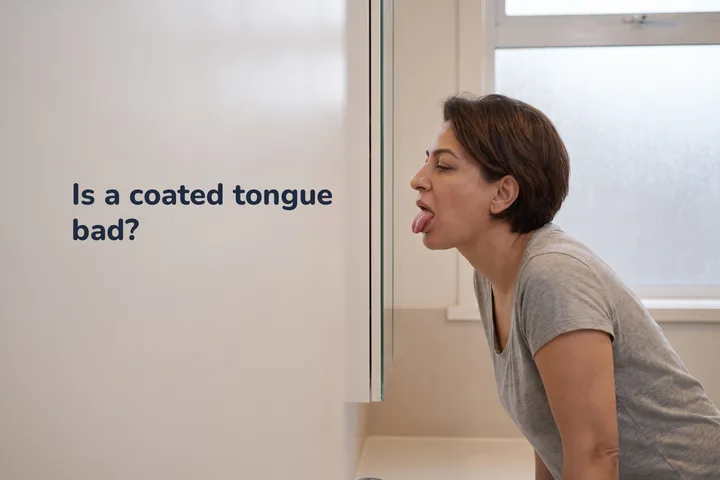
You looked in the mirror, saw a pale film across the back of your tongue, and you want to know whether that is dirt, disease, or simply what a tongue looks like. Answer first, evidence after: for most people, most of the time, it is what a tongue looks like. What deserves your attention is not the film but what it is made of — because the composition explains both why it smells and the few cases where it stops being ordinary.
What the coating actually is
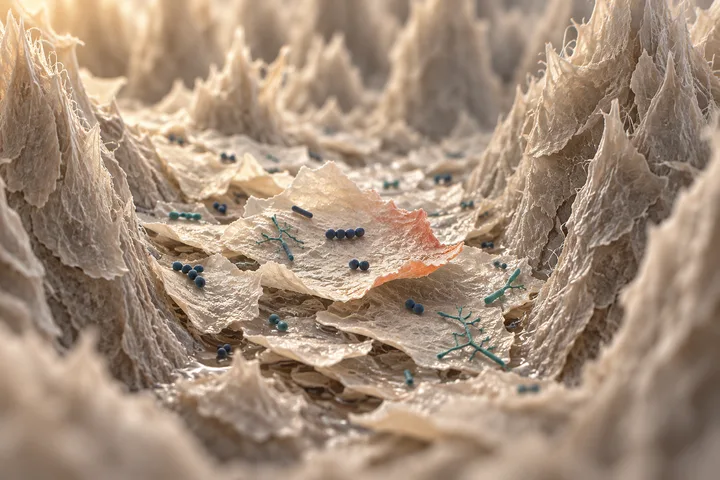
It is not one substance. Bollen and Beikler, reviewing halitosis across specialties, describe the dorsum of the tongue as roughly 25 cm² of irregular surface — an ideal niche — accumulating food remnants, desquamating epithelial cells and anaerobic bacteria 1. Read that list again: most of what a scraper lifts off your tongue is you — your own shed surface cells, plus the community growing on them.
That community is neither small nor simple. Bordas and colleagues sampled the tongue dorsum of 19 volunteers and recovered 10⁶–10⁸ CFU per sample across four categories at once — total anaerobes, Gram-negative anaerobes, sulphur-compound producers and Streptococcus salivarius 3. When Bernardi and colleagues characterised tongue biofilm by culture and by cloning together, the two methods turned up more than 80 species 7. A coated tongue is a habitat, and habitats are supposed to be occupied.
Why it smells
The smell is chemistry, not dirt. Bacteria on the tongue putrefy peptides from those shed cells and food remnants; cysteine, cystine and methionine are the predominant substrates, and the volatile sulphur compounds they yield — hydrogen sulphide, methyl mercaptan and dimethyl sulphide — are what someone standing close to you notices 1. Seerangaiyan and colleagues, reviewing tongue coating specifically, put it plainly: coating and periodontal disease are the two main sources of those compounds, and coating is the main cause of intra-oral halitosis 12.
Which species are present matters as much as how many. Bernardi's comparison found Actinomyces graevenitzii significantly associated with the halitosis condition, while Streptococcus salivarius and Rothia mucilaginosa were found more often in healthy volunteers 7. That is one study with a modest sample, so hold it loosely — but it fits the pattern across the mouth: the problem is usually a shifted community, not the presence of one.
When a coated tongue is just a tongue
Here is the number I would keep. Van Gils and colleagues visually scored tongue coating in 268 systemically healthy young adults, grading thickness and colour separately. A thin coating was the heaviest thickness score recorded for 92.7 % of the men and 87.4 % of the women — 90.7 % of the whole group; only 7.1 % reached a thick coating anywhere on the tongue. Colour was more mixed than the folklore suggests: white was the top discolouration score for 50.2 % of participants, yellow or light brown for 48.0 %, brown for 0.7 %. Most of the coating sat at the back of the tongue 2. In the same study, coating thickness and discolouration showed no relationship to the plaque index 2.
So a thin film at the back of a healthy young adult's tongue — white, or a shade of yellow — is the ordinary finding, not a sign of neglect, and not something to scrub down to bare pink.
When the coating is pointing at a problem
A white layer that wipes off and leaves raw, red or sore tissue underneath is not tongue coating in the sense above; that is the classic look of pseudomembranous candidiasis, which is one of the tongue conditions clinicians are trained to separate from ordinary coating 11. Elongated papillae that look brown or black, migratory red patches with pale borders, and the smooth sore tongue of nutritional deficiency belong on the same list 11.
A dry mouth alongside a heavier coating deserves attention. In 53 independent dentate adults aged 65 and over, hyposalivation was associated with a higher tongue-coating index (p = 0.015) and with 4.36 times the adjusted odds of oral Candida colonisation, 95 % CI 1.29–14.72 8. Small and cross-sectional, so association and not cause — but saliva is what clears the surface, so the mechanism is plausible.
Coating that is one-sided, painful, ulcerated or bleeding, or that does not shift at all with gentle cleaning, is a reason to be seen rather than to buy a better scraper.
And bad breath you cannot fix by cleaning your tongue is not automatically a stomach problem. About 85 % of halitosis originates intra-orally, roughly 10 % is ear-nose-throat and about 5 % gastrointestinal or endocrine 1. Search the mouth first, gums included.
What actually reduces it, and by how much
Now the part where I have to be honest about effect sizes.
Mechanical cleaning works, modestly. The current Cochrane review of halitosis interventions pooled 44 trials and 1 809 participants; for mechanical tongue cleaning versus none, dentist-rated organoleptic scores improved by 0.20 points, 95 % CI 0.07 to 0.34, from two trials with 46 participants, rated very low-certainty evidence 5. The earlier Cochrane review dedicated to tongue scraping, since folded into that one, found just two trials with 40 participants and judged them too heterogeneous to pool; in one of them volatile sulphur compounds fell 42 % with a tongue cleaner, 40 % with a scraper and 33 % with a toothbrush — and in none of the groups could the reduction still be detected 30 minutes afterwards 4.
Repetition is what makes it stick. In Bordas's crossover study, brushing alone significantly reduced only S. salivarius; brushing plus scraping reduced all four bacterial categories; and only daily scraping lowered the next-morning baseline load by day 4 3.
It may do more than freshen breath. Acar and colleagues randomised 36 gingivitis patients after scaling and polishing; at 7 days, only the arm using a tongue scraper improved on sulphur compounds, organoleptic score and tongue-coating score, and gingival crevicular fluid IL‑1β and IL‑8 fell in that arm 6. Small, short, single-centre; the authors call for further studies before judging clinical relevance.
Taste may improve. Sixty-five healthy participants used a tongue brush for 14 days; among the 50 non-smokers, Winkel Tongue Coating Index values fell and total taste scores rose, and the 15 smokers improved on taste scores too 9 — but with no control group, that is a lead, not a finding.
Probiotics are not the answer here. A meta-analysis of seven randomised trials found probiotics improved judged breath scores in the short term, standardised mean difference −0.58, 95 % CI −0.87 to −0.30, and reduced sulphur compounds slightly, −0.26, 95 % CI −0.51 to −0.01 — but showed no significant effect on tongue-coating scores 10.
What I would do
Clean the back of your tongue once a day, gently, as part of brushing. Expect a modest, short-lived reduction in odour that only holds if you keep doing it 34. Take the tongue seriously as a signal only when it changes character — wipes off raw, turns one-sided, hurts, or arrives with a mouth that has gone dry.
— Magnus
Key facts
- The coating is food remnants, shed epithelial cells and anaerobic bacteria held on roughly 25 cm² of irregular tongue surface.1
- In 268 systemically healthy young adults, a thin coating was the heaviest thickness score recorded for 92.7 % of men and 87.4 % of women — 90.7 % of the whole group.2
- Sampling the tongue dorsum of 19 volunteers recovered 10⁶–10⁸ CFU per sample, including Gram-negative anaerobes and sulphur-compound producers.3
- About 85 % of bad breath comes from inside the mouth; 10 % is ear-nose-throat and 5 % gastrointestinal or endocrine.1
- In the current Cochrane review of 44 trials and 1 809 participants, mechanical tongue cleaning beat no cleaning by 0.20 organoleptic points — very low-certainty evidence.5
- In older adults with reduced saliva, tongue-coating index was higher and the adjusted odds of oral Candida colonisation were 4.36 times greater.8
Questions people ask
Should I scrape my tongue every day?
If bad breath bothers you, yes — gently, and expect a small effect. Only daily scraping lowered the next-morning bacterial load on the tongue in the Bordas crossover study; a single clean was transient [s3]. The Cochrane review of halitosis interventions rates the evidence for mechanical tongue cleaning versus none at very low certainty, with a difference of 0.20 organoleptic points from two small trials [s5]. That is a real effect, not a large one.
Does scraping make the coating come back thicker?
No trial I can find shows that. What the trials show is the opposite problem — the effect wears off fast. The earlier Cochrane tongue-scraping review found only two trials, 40 participants between them, too heterogeneous to pool; in one of them volatile sulphur compounds fell 42 % with a tongue cleaner, 40 % with a scraper and 33 % with a toothbrush, and in no group could the reduction still be detected 30 minutes later [s4]. Coating returns because it is continuously produced, not because you removed it.
When should I show my tongue to a clinician?
When a white layer wipes off and leaves raw, red or sore tissue underneath, when the coating is one-sided, painful, ulcerated or bleeding, when the papillae look elongated and brown or black, or when it appears alongside a persistently dry mouth. Those are the pictures a tongue-disease review separates from ordinary coating [s11], and reduced saliva itself is linked to both heavier coating and Candida colonisation [s8].
Will a probiotic clear my tongue?
Not on current evidence. A meta-analysis of seven randomised trials found probiotics improved judged breath scores in the short term — standardised mean difference −0.58 — and cut sulphur compounds slightly, but found no significant effect on tongue-coating scores at all [s10]. Breath and coating are related, and they are not the same outcome.
Does a coated tongue mean something is wrong with my gut?
Usually not. Roughly 85 % of bad breath is generated inside the mouth, and only about 5 % traces to gastrointestinal or endocrine causes [s1]. The tongue coating and periodontal disease are the two main sources of the sulphur compounds you smell [s12]. Start with the mouth.
Sources
- Bollen C.M.L., Beikler T., International Journal of Oral Science, 2012 — doi:10.1038/ijos.2012.39
- Van Gils L.M. et al., International Journal of Dental Hygiene, 2020 — doi:10.1111/idh.12416
- Bordas A. et al., Archives of Oral Biology, 2008 — doi:10.1016/S0003-9969(08)70004-9
- Outhouse T.L. et al., Cochrane Database of Systematic Reviews, 2006 — doi:10.1002/14651858.CD005519.pub2
- Kumbargere Nagraj S. et al., Cochrane Database of Systematic Reviews, 2019 — doi:10.1002/14651858.CD012213.pub2
- Acar B. et al., Clinical Oral Investigations, 2019 — doi:10.1007/s00784-018-2617-5
- Bernardi S. et al., MicrobiologyOpen, 2020 — doi:10.1002/mbo3.958
- Buranarom N., Komin O., Matangkasombut O., PLoS ONE, 2020 — doi:10.1371/journal.pone.0242832
- Timmesfeld N. et al., Journal of Oral Rehabilitation, 2021 — doi:10.1111/joor.13099
- Huang N. et al., BMJ Open, 2022 — doi:10.1136/bmjopen-2022-060753
- Mangold A.R., Torgerson R.R., Rogers R.S., Clinics in Dermatology, 2016 — doi:10.1016/j.clindermatol.2016.02.018
- Seerangaiyan K., Jüch F., Winkel E.G., Journal of Breath Research, 2018 — doi:10.1088/1752-7163/aaa3a1
Related
The carcinogen your own mouth makes out of ordinary sugar
Mouth microbes from cancer patients turned sugar and alcohol into acetaldehyde — a carcinogen ranked with tobacco. Plaque hid the rest until enzymes opened it.
Bad breath isn’t dirt. It’s one bacterial gene doing its job
A 2026 lab-dish and rat study turned down the bacterial gene behind bad breath. Here is the mechanism, the numbers, and everything the study did not show.
Bacillus coagulans: a spore passing through, not a resident
Bacillus coagulans (also Heyndrickxia coagulans — one bug, two names): what this spore-forming probiotic does for mouth and gut, and where the evidence stops.