
Helicobacter pylori: carcinogen, yet linked to less asthma
Helicobacter pylori is a spiral bacterium that colonises the stomach lining, usually for life. It is the leading infectious cause of cancer worldwide and the main bacterial cause of peptic ulcers. Yet where the bacterium is common, oesophageal adenocarcinoma (gullet cancer) and childhood asthma are rarer. The harm is a proven cause; the benefit is so far only a pattern.
 Written by: Magnus Larsen · Microbiologist · Science bloggerPublished: Facts checked:
- Species
- Helicobacter pylori
- Syn.
- Campylobacter pylori, Campylobacter pyloridis
- NCBI
- txid210
- Wikidata
- Q180556
For most of the twentieth century the stomach was taught as a sterile organ: nothing could live in acid that strong. Ulcers came from stress and spicy food, and the treatment was antacids and then surgery.
Then two clinicians in Perth did the unglamorous, decisive thing. Robin Warren and Barry Marshall took biopsies from intact antral mucosa in 100 consecutive patients arriving for gastroscopy, and looked 1. Spiral or curved bacilli were there in 58 of them 1. The organism grew in culture from 11 of the biopsies: Gram-negative, flagellate, microaerophilic, and apparently a new species related to Campylobacter 1. The bacteria were present in almost all the patients with active chronic gastritis, duodenal ulcer or gastric ulcer, and the authors wrote — carefully — that they "may be an important factor in the aetiology of these diseases" 1.
That is an association. The gap was closed the following year in the least fashionable way available: a volunteer with histologically normal gastric mucosa swallowed a culture of the organism. A mild illness followed, lasting 14 days, with gastritis proven on biopsy by day 10 and largely resolved by day 14 2. The paper names the volunteer only as "a volunteer"; that he was Marshall himself comes from the later record, not from this report. One volunteer is not a clinical trial, and I will say that out loud. It is also very hard to argue with.
What it is, in one sentence
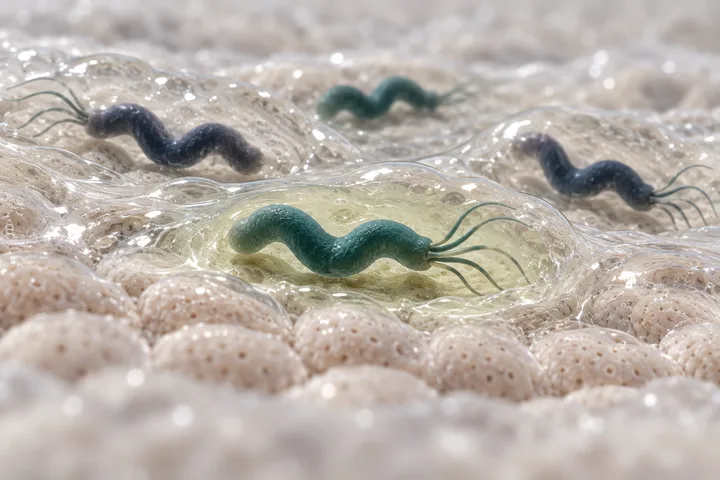
Helicobacter pylori is a Gram-negative, spiral, flagellated, microaerophilic bacterium that colonises the mucus layer and epithelial surface of the human stomach and, unless treated, usually stays there for life 4.
Where it lives in the body
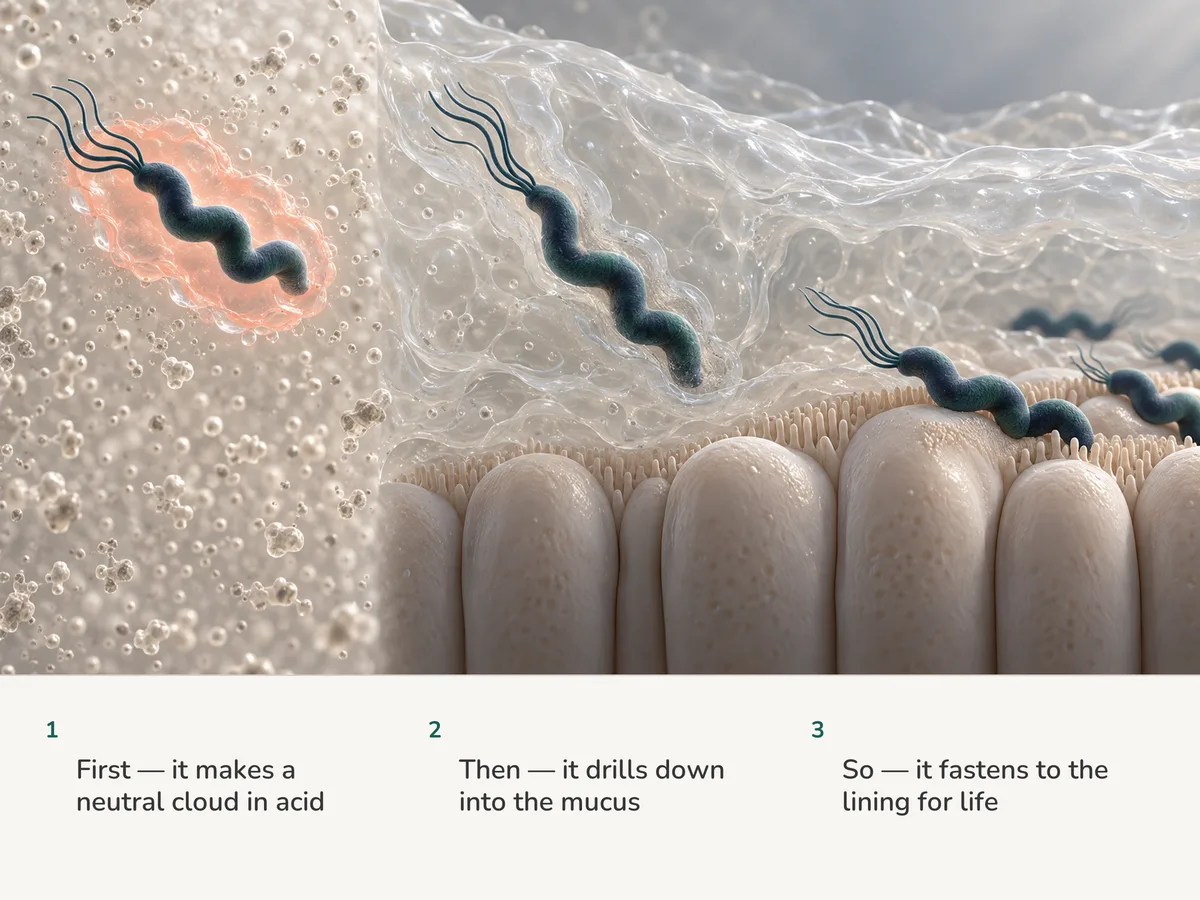
Not in the acid in the middle of the stomach, which would kill it, but in the gel layer just above the stomach's own cells, most often in the antrum 4. Everything interesting about this organism follows from that address.
Getting there takes two tools. The bacterium makes large quantities of urease, an enzyme that splits urea into ammonia and carbon dioxide and buffers the space immediately around the cell; its flagella then drive it out of the acid lumen into the near-neutral mucus, where adhesins fasten it to the epithelium 4. Colonisation is usually acquired in childhood and, once established, persists lifelong unless it is deliberately removed 4.
How many people carry it? A systematic review and meta-analysis of 184 studies from 62 countries found pooled prevalence highest in Africa at 70.1 % and lowest in Oceania at 24.4 %, with individual countries running from 18.9 % in Switzerland to 87.7 % in Nigeria — and extrapolated about 4.4 billion infected people worldwide in 2015 5. The caveat belongs in the same breath: that is a pooled estimate from heterogeneous studies, and the epidemiology has been shifting with improvements in sanitation and in eradication 5.
What it does against us
Gastritis and ulcers. Chronic active gastritis is the baseline consequence — present in nearly every colonised person, symptomatic in a minority. From there the infection is a key factor in peptic ulceration, gastric adenocarcinoma and gastric MALT lymphoma, with the outcome shaped by virulence factors such as CagA and VacA and by the host's immune genetics and acid secretion 4.
Gastric cancer. The cleanest human observation is still a Japanese cohort published in 2001. Investigators followed 1526 patients — 1246 infected, 280 not — for a mean of 7.8 years, with endoscopy and biopsy at enrolment and again afterwards 6. Gastric cancer developed in 36 of the infected patients, 2.9 %, and in none of the uninfected 6. Risk concentrated in those with severe gastric atrophy, corpus-predominant gastritis and intestinal metaplasia 6. Caveat, said plainly: this was an endoscopy-clinic population in a high-incidence country, not a random sample of humanity, and 2.9 % over a mean 7.8 years is a group statistic, not a personal forecast.
The global arithmetic. H. pylori is the first bacterium formally recognised as a human carcinogen 4. An International Agency for Research on Cancer analysis of 2018 incidence attributed 2.2 million cancer cases worldwide to infectious pathogens, and H. pylori was the single largest contributor at 810 000 cases, an age-standardised incidence of 8.7 per 100 000 person-years 7. More than human papillomavirus. More than hepatitis B.
Does removing it help? A Cochrane review pooled 7 randomised trials in healthy, asymptomatic, infected adults — 8323 participants. Eradication therapy reduced subsequent gastric cancer, RR 0.54 (95 % CI 0.40–0.72), on moderate-certainty evidence, and reduced death from gastric cancer, RR 0.61 (95 % CI 0.40–0.92), across 4 trials and 6301 participants 8. Now the caveats, all of them: six of the seven trials were in Asian populations, the authors explicitly decline to extrapolate elsewhere, and all-cause mortality did not move — RR 0.97 (95 % CI 0.85–1.12) 8. Fewer stomach cancers is a real gain. Living longer overall has not been demonstrated.
What it may do for us
This is the half most articles skip, and it is where honesty costs something.
Oesophageal adenocarcinoma runs the other way. A meta-analysis of 28 eligible studies found a significant inverse association between H. pylori infection and oesophageal adenocarcinoma, pooled OR 0.57 (95 % CI 0.44–0.73), with CagA-positive strains less likely to be associated with that cancer than CagA-negative ones, OR 0.64 (95 % CI 0.52–0.79) 9. There was no significant association with oesophageal squamous cell carcinoma, OR 1.16 (95 % CI 0.83–1.60) 9. A plausible mechanism exists — long-standing infection can lower acid output, and reflux drives that cancer — but these are observational studies, and confounding is not ruled out. When the two Cochrane trials that reported this outcome looked prospectively, 16 of 1947 participants in eradication arms and 13 of 1941 on placebo developed oesophageal cancer, RR 1.22 (95 % CI 0.59–2.54) 8 — an interval wide enough to hold both the hope and the fear. It is not an answer.
Asthma and allergy also run the other way. In 7663 adults from the third US National Health and Nutrition Examination Survey, carriage of a CagA-positive strain was inversely related to ever having asthma, OR 0.79 (95 % CI 0.63–0.99), with the childhood-onset association — onset at or before age 15 — stronger at OR 0.63 (95 % CI 0.43–0.93); colonisation, especially with a CagA-positive strain, was inversely associated with ever having a diagnosis of allergic rhinitis, OR 0.77 (95 % CI 0.62–0.94) 10. A separate analysis of 7412 participants from the 1999–2000 survey found seropositivity inversely associated, among those aged 3–19, with asthma beginning before age 5, OR 0.58 (95 % CI 0.38–0.88), and, among those aged 3–13, with current asthma, OR 0.41 (95 % CI 0.24–0.69) 11. Caveat at full volume: both are cross-sectional. They cannot say which came first, and the authors present the work as a direction for research, not a finding to act on 11.
So the honest ledger reads like this. The harms are causal and measured. The apparent benefits are associations pointing consistently one way, with no demonstrated job the bacterium performs on your behalf — an absence of harm elsewhere is not a service rendered.
The name, new and old
The current name is Helicobacter pylori, with the naming authority (Marshall et al. 1985) Goodwin et al. 1989. It entered the literature in the genus Campylobacter, first as Campylobacter pyloridis, corrected to Campylobacter pylori, and was transferred into a newly created genus, Helicobacter, in 1989 3. If you meet Campylobacter pylori in an older paper, that is this organism under its former name — nothing was reclassified biologically; the taxonomy caught up with the genetics.
Where medicine has landed
The Kyoto global consensus produced 24 statements at above 80 % agreement and recommended eradicating the infection before preneoplastic changes develop, where that is feasible 13. The Maastricht VI/Florence consensus went further: H. pylori infection is now classified as an infectious disease in ICD‑11, which leads in principle to treating everyone infected 12. The same document names the obstacle: continuously rising antibiotic resistance, which is why susceptibility testing and careful choice of first-line and rescue therapy now fill so much of the guidance 12.
What to hold on to
Helicobacter pylori is neither a passenger nor a partner. It is an organism that solved the problem of living in acid, and the machinery it uses to do that inflames the tissue underneath it for decades. That is causal, and it is why clearing the infection prevents stomach cancers where it has been tested 8. Carrying it also tracks with less oesophageal adenocarcinoma and less childhood asthma 91011 — associations that are real, unexplained, and not yet a reason to keep a carcinogen.
The correct posture is the uncomfortable one: write down both columns — the harm, which is proven, and the benefit, which is so far only a pattern — and leave the decision about your own stomach with a clinician who knows your history and your region.
Key facts
- Found in 1984 in antral biopsies from 100 consecutive gastroscopy patients: curved bacilli in 58 of them, cultured from 11.1
- A volunteer with histologically normal gastric mucosa swallowed a culture and developed gastritis proven on biopsy by day 10 of a 14-day illness.2
- Pooled prevalence ranged from 24.4 % in Oceania to 70.1 % in Africa; roughly 4.4 billion people were estimated infected in 2015.5
- In a 7.8-year Japanese cohort, gastric cancer developed in 36 of 1246 infected patients (2.9 %) and in none of the 280 uninfected.6
- H. pylori was the single largest infectious cause of cancer worldwide in 2018, at 810 000 of 2.2 million infection-attributable cases.7
- A 28-study meta-analysis found infection inversely associated with oesophageal adenocarcinoma (pooled OR 0.57, 95 % CI 0.44–0.73).9
Questions people ask
If half the world carries it, is it really a pathogen?
Yes — and being common does not soften that. It is the first bacterium formally recognised as a human carcinogen [s4], and in a Japanese cohort gastric cancer appeared only in infected patients [s6]. But most carriers never develop ulcers or cancer, which is why prevalence and disease stay separate questions.
Does it do anything good for me?
Nothing has been shown to be a job it performs for you. What exists is inverse association: less oesophageal adenocarcinoma across 28 pooled studies [s9] and less childhood-onset asthma and allergic rhinitis in two national surveys [s10][s11]. Observational, cross-sectional, and unproven as cause.
Does clearing it prevent stomach cancer?
In the populations tested, yes, moderately. A Cochrane review of 7 randomised trials and 8323 participants found eradication cut gastric-cancer incidence (RR 0.54) and gastric-cancer death (RR 0.61) [s8]. Six of those seven trials were in Asian populations, and all-cause mortality did not change [s8].
Why do old papers call it Campylobacter?
Because it was first described there. The organism entered the literature as Campylobacter pyloridis, was corrected to Campylobacter pylori, and was moved into a new genus, Helicobacter, in 1989 [s3]. Same bacterium, current name.
Should I get tested?
That is a clinical decision, not an encyclopedia one. The Maastricht VI consensus treats H. pylori gastritis as an infectious disease and holds that infected patients should in principle be treated [s12], while naming rising antibiotic resistance as the main obstacle [s12]. Testing and treatment belong with a doctor who knows your history and your region.
Sources
- Marshall B. J., Warren J. R., The Lancet, 1984 — doi:10.1016/s0140-6736(84)91816-6
- Marshall B. J. et al., The Medical Journal of Australia, 1985 — doi:10.5694/j.1326-5377.1985.tb113443.x
- Goodwin C. S. et al., International Journal of Systematic Bacteriology, 1989 — doi:10.1099/00207713-39-4-397
- Kusters J. G., van Vliet A. H. M., Kuipers E. J., Clinical Microbiology Reviews, 2006 — doi:10.1128/CMR.00054-05
- Hooi J. K. Y. et al., Gastroenterology, 2017 — doi:10.1053/j.gastro.2017.04.022
- Uemura N. et al., New England Journal of Medicine, 2001 — doi:10.1056/NEJMoa001999
- de Martel C. et al., The Lancet Global Health, 2020 — doi:10.1016/S2214-109X(19)30488-7
- Ford A. C. et al., Cochrane Database of Systematic Reviews, 2020 — doi:10.1002/14651858.CD005583.pub3
- Nie S. et al., Diseases of the Esophagus, 2014 — doi:10.1111/dote.12194
- Chen Y., Blaser M. J., Archives of Internal Medicine, 2007 — doi:10.1001/archinte.167.8.821
- Chen Y., Blaser M. J., The Journal of Infectious Diseases, 2008 — doi:10.1086/590158
- Malfertheiner P. et al., Gut (Maastricht VI/Florence consensus report), 2022 — doi:10.1136/gutjnl-2022-327745
- Sugano K. et al., Gut (Kyoto global consensus report), 2015 — doi:10.1136/gutjnl-2015-309252
Related

Same capsule, opposite result: what makes a probiotic work
120 overweight adults, 12 weeks: heat-killed L. plantarum did nothing on average. Only the least varied guts lost weight. Why that is a lead, not proof.

IBS pain is not in your head: enzymes poke the gut's nerves
Stool fluid from IBS patients made gut nerve networks fire far harder than fluid from healthy people, a 2026 Gut study found. What it shows — and does not.
Actinomycetota: the phylum that guards infants and causes TB
Actinomycetota, formerly Actinobacteria: the phylum of Bifidobacterium and of tuberculosis. Where it lives in your body, what it does for and against you.