
The gut microbe that raised GLP‑1 — and missed its target
In a 142-person trial in Gut Microbes, 2026, four months of pasteurised (heat-killed) Akkermansia muciniphila did not improve whole-body insulin sensitivity, the one thing it was built to test. In exploratory analyses, which raise questions rather than settle them, it did raise the body's own GLP‑1 after a glucose drink and nudged liver insulin sensitivity in prediabetic participants.
 Written by: Magnus Larsen · Microbiologist · Science bloggerPublished: Facts checked:

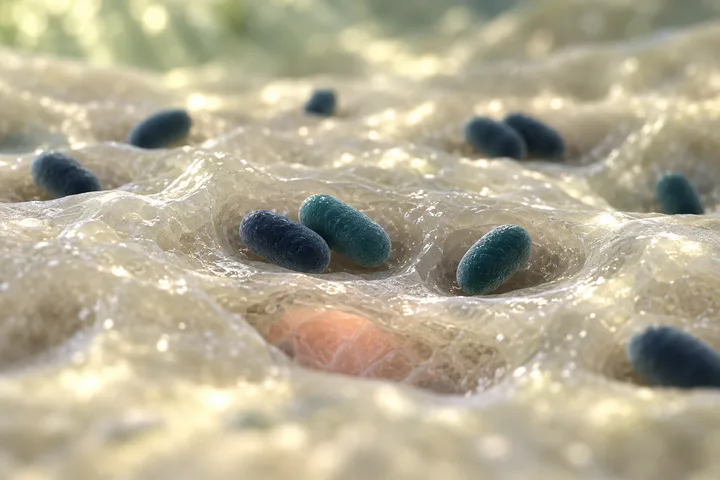
Somewhere along your intestinal wall there is a thin layer of mucus that keeps the trillions of bacteria in your gut from touching the cells underneath. One resident bacterium makes its living grazing on that layer. It is called Akkermansia muciniphila — the mucin-lover — and researchers have long asked whether giving it back to people does anything for metabolism.
The most serious attempt yet to answer that question has now been published. The honest headline is that it did not work, at least not for the thing it was built to test.
What was actually tested
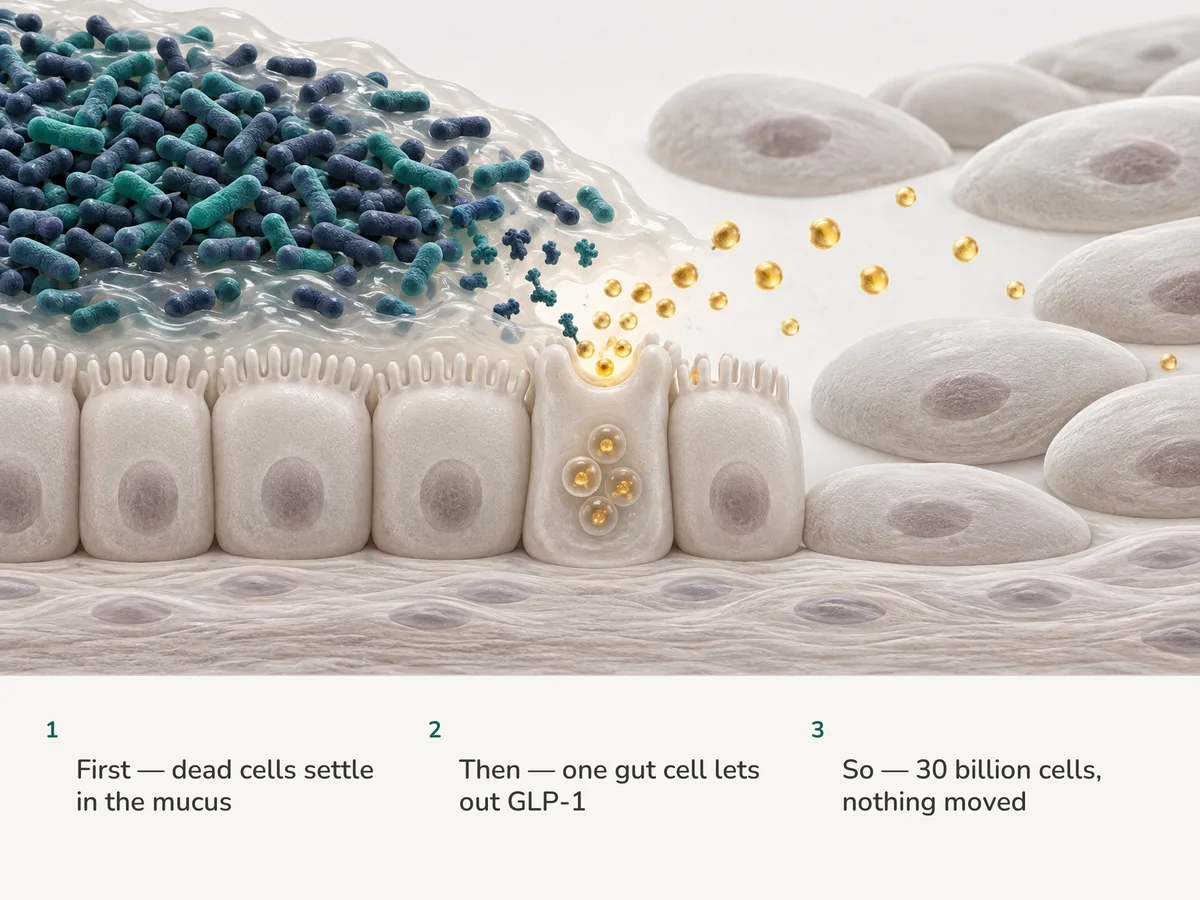
The trial appeared in Gut Microbes in 2026, from Peter Suenaert and colleagues 1. It was randomised, double-blind, placebo-controlled and run at two centres — Cork in Ireland and Kiel in Germany — in 142 adults with metabolic syndrome, some with prediabetes and some without 1. Each participant took one capsule a day for 16 weeks: either placebo, or 30 billion pasteurised cells of A. muciniphila strain MucT 1. Pasteurised is the word to hold on to. These bacteria are heat-killed. Nothing is colonising anything.
The primary endpoint was whole-body insulin sensitivity, read off a three-hour glucose tolerance test as the Matsuda index. After four months it did not differ from placebo 1. That is the result of the study. The authors state it plainly and add the consequence themselves: because the primary outcome was negative, every analysis that follows in the paper is exploratory — question-raising, not question-answering — and must be read that way 1.
What did move, and what it is worth
Two exploratory findings are still worth your attention — worth it as leads to follow, not as results to act on.
First, after three months the rise in GLP‑1 that follows a glucose drink was larger in the treated group than in placebo, at p < 0.01 — a gap that size is unlikely to be chance alone 1. By four months the difference was weaker and no longer significant 1. GLP‑1 is the gut hormone the current diabetes and weight-loss drugs were designed to imitate. Nobody injected anything here. The participants' own intestinal cells released more of it.
Second, in the participants who had prediabetes, a liver-weighted measure of insulin sensitivity — how readily the liver itself answers insulin — rose 12 % after three months — at p = 0.054, just short of the conventional threshold, which makes it a hint rather than a finding 1. A similar borderline signal on the same liver-weighted measure turned up in participants aged 63 and older 1. In postmenopausal women (n = 46) — one slice of the same group of people, measured with the same Matsuda index that stayed flat across the trial as a whole — the index did reach significance after four months (+21 %, p = 0.031) 1. A slice moving while the whole stays flat is not a contradiction; it is what a subgroup finding looks like, and it is why this stays a lead rather than a result.
Why a dead bacterium would move a hormone at all
This is the part worth picturing, because the mechanism is not mystical.
Scattered through the lining of your gut are enteroendocrine L cells. Their job is to sense a meal arriving and release GLP‑1, which prompts insulin, slows the stomach and tells the brain you have eaten. Akkermansia lives in the mucus pressed right against that lining, which puts it in physical position to speak to those cells.
In mice, one protein secreted by the bacterium — an 84 kDa protein its discoverers named P9 — was enough on its own to trigger GLP‑1 release, by binding a surface molecule called ICAM‑2 3. Whether P9 survives pasteurisation, reaches human L cells and still works is, in the trial authors' own words, not known 1.
So: a mucus-grazing bacterium, alive or not, nudging your own hormone cells from the other side of a thin wall. That is the picture. It is not a drug, and this trial ran no comparison against one.
The caveats, said out loud
Four of them matter, and three come from the authors themselves.
The primary endpoint — the one question the trial was built to answer — was negative. Slice 142 people finely enough and something will look interesting. Subgroup results after a missed primary outcome generate hypotheses; they do not test them.
The cohort was the wrong cohort for the question. These participants turned out to carry unusually high baseline levels of Akkermansia, in places above matched healthy controls — leaving little room for more of it to help 1. The authors flag this openly.
Sixteen weeks may simply be too short to shift insulin resistance that took decades to build. Also the authors' own point 1.
And several authors work for the company developing the product, alongside academic groups in Belgium, the Netherlands, Finland and the UK, and a Danish microbiome-analysis company 1. That does not make the numbers false. It makes independent replication the thing worth waiting for.
Safety was unremarkable: 104 of the 142 participants reported at least one adverse event, 53 on placebo and 51 on the active capsule, and the single serious event — a pneumonia — occurred in the placebo group 1.
Where this leaves you
In 2019, a much smaller exploratory study — 40 overweight adults enrolled, 32 finishing — reported a 28.62 % improvement in insulin sensitivity on pasteurised cells against placebo, at P = 0.002 2. That number is where the excitement came from. A larger, better-powered, multi-centre trial has now failed to reproduce it as a whole-body effect.
That is not a disaster. That is the process functioning correctly, and a clean null — a plain no — teaches more than a fourth enthusiastic pilot would have. What survives is a plausible, picturable mechanism and the paper's own best lead. Participants who began the trial with low gut Akkermansia did improve: better insulin sensitivity and a larger GLP‑1 excursion at three months, and less trunk and android fat — the fat carried around the middle — by four months 1. That analysis is exploratory too, decided after the primary endpoint had already missed. So the question of whether the people who benefit are specifically the people with little of this bacterium to begin with is now a hypothesis with data behind it, not an answer.
If you want the background on the organism itself, we keep an entry on it: Akkermansia muciniphila.
Key facts
- The trial randomised 143 adults with metabolic syndrome at two centres, Cork in Ireland and Kiel in Germany, and ran double-blind against placebo for 16 weeks; 142 of them took at least one capsule.1
- The daily dose was one capsule containing 30 billion pasteurised — heat-killed — cells of Akkermansia muciniphila strain MucT.1
- The primary endpoint, whole-body insulin sensitivity measured by the Matsuda index, did not differ from placebo. Every later analysis in the paper is exploratory.1
- Post-glucose GLP‑1 excursion was higher on the bacterium than on placebo after three months (p < 0.01).1
- A liver-weighted measure of insulin sensitivity rose 12 % in prediabetic participants after three months, at p = 0.054 — just short of the conventional threshold.1
- The participants who started with low gut Akkermansia levels were the ones who moved: better insulin sensitivity and a larger GLP‑1 excursion at three months, and less trunk fat by four months. The analysis is exploratory.1
- In mice, an 84 kDa protein secreted by A. muciniphila, named P9, triggered GLP‑1 release on its own by binding ICAM‑2.3
- An earlier exploratory study — 40 overweight adults enrolled, 32 completing — reported a 28.62 % gain in insulin sensitivity on pasteurised cells against placebo (P = 0.002); the larger trial did not confirm it.2
Questions people ask
Did the trial fail?
It answered its question, and the answer was no. Whole-body insulin sensitivity did not improve over placebo after four months [s1]. A trial that reports a clean null is doing its job — it just is not the result anyone hoped for.
Is this the same as the GLP‑1 weight-loss drugs?
No. Those drugs are engineered molecules that act on the GLP‑1 receptor at doses no food or microbe reaches. Here the participants' own gut cells released more of their own hormone after a glucose drink [s1]. The trial ran no comparison against any medicine, and nothing in it supports one.
Why would a heat-killed bacterium do anything?
Because some of what it does is structural, not metabolic. Surface and secreted proteins can signal to the gut lining without the cell being alive. In mice, one secreted A. muciniphila protein was enough on its own to trigger GLP‑1 release [s3]. Whether it survives pasteurisation and works the same way in people is unresolved [s1].
Should I take an Akkermansia supplement?
Nothing here settles that. The first well-controlled trial in this population missed its primary endpoint [s1], and the subgroup signals that survived are hypothesis-generating, not guidance. What would change the picture is an independent replication in people chosen for low baseline levels.
Who ran the study?
Several of the authors are affiliated with the company developing the product, alongside academic groups in Belgium, the Netherlands, Finland and the UK, and a Danish microbiome-analysis company [s1]. That does not make the data wrong. It does make independent replication the thing to wait for.
Sources
- Suenaert P. et al., Gut Microbes, 2026 — doi:10.1080/19490976.2026.2690689
- Depommier C. et al., Nature Medicine, 2019 — doi:10.1038/s41591-019-0495-2
- Yoon H.S. et al., Nature Microbiology, 2021 — doi:10.1038/s41564-021-00880-5
Related

Akkermansia muciniphila: the microbe that eats your mucus
A gut bacterium that feeds on your own mucus lining — and may protect your metabolism. What the named studies show, and where they stop.

Verrucomicrobiota: the mucus eater you want in your gut
Verrucomicrobiota, formerly Verrucomicrobia, is the gut phylum of Akkermansia muciniphila. What the mucus eater does for you, and against you.