
Why the probiotic worked for your friend, not you
Because you did not run the same experiment. The effect depends on the exact strain, the dose, how long you take it, and possibly on the community you started with. A 2026 trial in 120 overweight adults missed its primary endpoint and saw a weight difference only in a later look at the half whose guts held the fewest species.
 Written by: Magnus Larsen · Microbiologist · Science bloggerPublished: Facts checked:
You are asking why the same capsule that seemed to rebuild your friend's month did nothing at all for you. It is the best question that reaches me, because the honest answer is not that one of you is imagining things. You may both be right — and there is published work that shows how.
"Probiotic" is a category, not a specification — a label, not a recipe
The working definition — live microorganisms which, when administered in adequate amounts, confer a health benefit on the host — was examined and reaffirmed by an expert panel convened by the International Scientific Association for Probiotics and Prebiotics 6. Read it closely and notice what it does not promise. It names no organism, no amount, and no person.
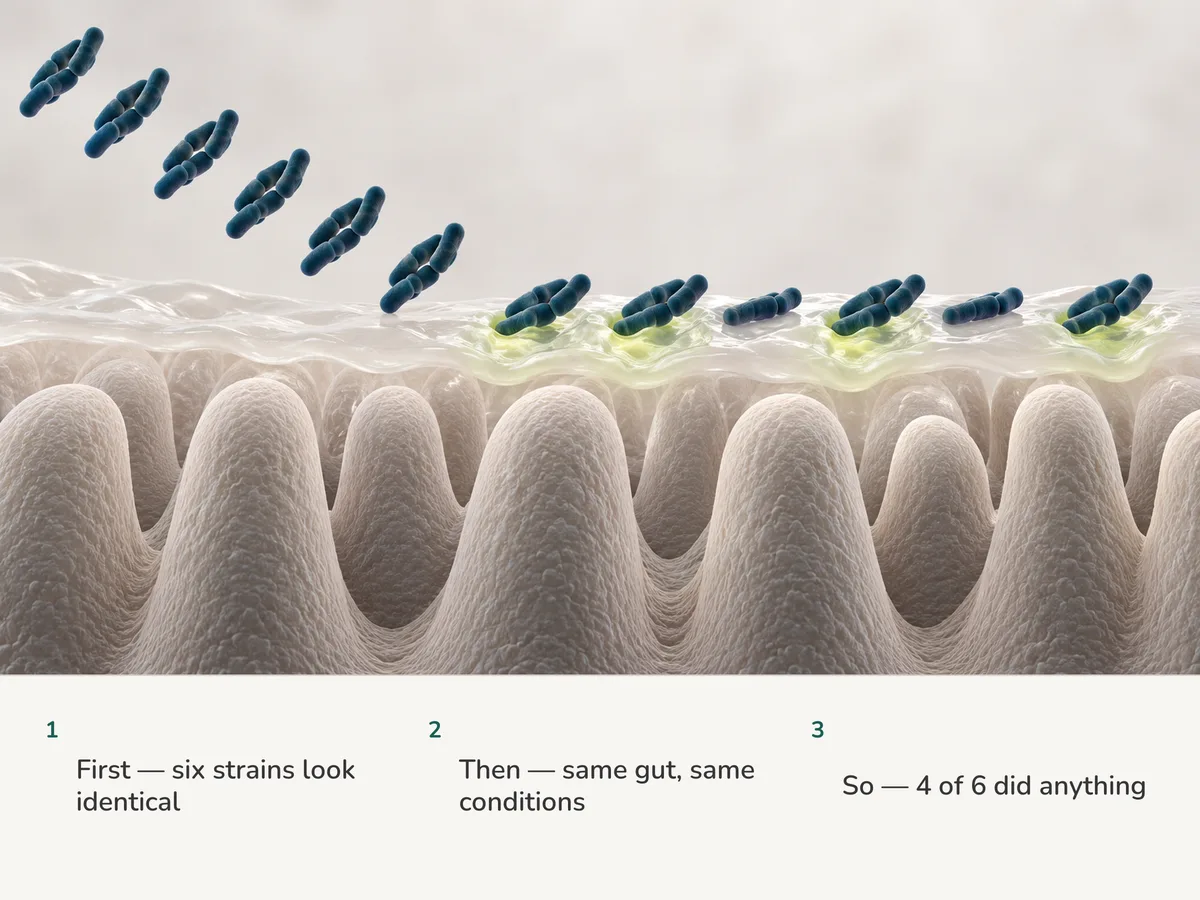
McFarland and colleagues went looking for the consequence. Searching the literature from 1970 to 2017 3, they assembled 228 randomised controlled trials covering 25 identifiable probiotics — 15 single strains and 10 mixtures 3. Efficacy turned out to be strain-specific and disease-specific: 7 of 10 types tested for prevention, and 11 of 17 tested for treatment, showed significant benefit 3. The rest did not. Among the six Lactobacillus-containing probiotic types pooled for prevention of antibiotic-associated diarrhoea in adults, only four showed significant efficacy — L. rhamnosus GG was one of the two that did not 3.
So "my friend takes a probiotic" carries about as much information as "my friend takes a pill". If the code after the species name on their jar — the letters and digits, GG or R0052 or LRCC5282 — does not match the code on yours, the two of you did not run the same experiment. You ran two.
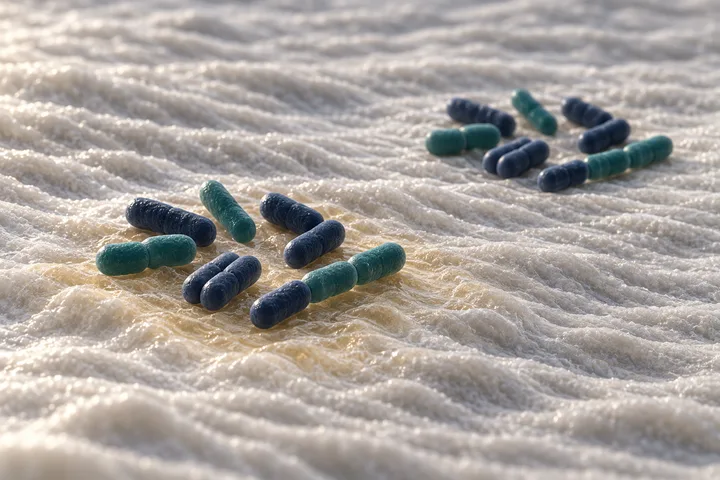
The gut you started with
Even an identical strain does not walk into an identical room. Zmora and colleagues gave healthy volunteers an 11-strain probiotic combination 2 and then looked directly, by endoscopy, at whether it had settled on the gut lining rather than merely passed through. Some people were permissive, some resistant, and the pattern was person-, region- and strain-specific — predictable from host and microbiome features measured before the first capsule 2. The detail that should end a great many arguments: whether the strain showed up in stool did not distinguish the colonised from the uncolonised 2. Shedding is not settling.
The starting communities differ more than most people expect. Sequencing the gut bacteria of 292 Danish adults, Le Chatelier and colleagues found that roughly 23 % carried a low count of bacterial genes 7, and that this low-richness group carried more body fat, more insulin resistance and more inflammation than the rest 7.
The responder finding — who it did work for — and how big it actually is
The clearest test I know of arrived this year. In a 12-week randomised, double-blind trial, 120 overweight adults took either a heat-killed Lactiplantibacillus plantarum preparation or placebo 1. Across the whole group, the answer was nothing — no clinical outcome separated the arms 1. Then the authors went back to the stool samples taken before the first sachet and split everyone by how diverse their gut had been at baseline. In the low-diversity half, weight fell 1.98 kg against 0.95 kg on placebo, BMI 0.74 points against 0.31, and leptin 2.07 ng/mL against 0.24 1. In the high-diversity half, nothing coherent appeared 1.
Now the caveats, out loud, because they matter more than the result. The primary endpoint — total body fat on a DXA scan — was not met 1. The diversity split was a secondary analysis in subgroups of about 25 people 1. And the sponsor developed the strain 1. I wrote the trial up in full in the news item on baseline diversity. It is a hypothesis worth testing properly, not a finding to reorganise your shopping around.
Dose and duration are not decoration
Ouwehand reviewed what is known about how much you need. For antibiotic-associated diarrhoea, both the meta-analyses and the studies that compared two doses head-to-head found more organisms meant more protection 4. For necrotising enterocolitis, prevention of atopic dermatitis, slow intestinal transit and relief of irritable bowel symptoms, no dose–response could be identified at all 4 — which, as the review is careful to say, does not prove there is none; the data are simply too thin to conclude 4.
Duration is blunter. Thirty healthy adults took 30 × 10⁹ CFU a day for two weeks 5. The strains appeared in stool 1–2 days after the first capsule 5 and cleared between 3.4 and 8.5 days after the last, depending on which strain 5. Nothing here is permanent tenancy. Stop, and within roughly a week the strains are no longer detectable in stool.
What you can actually check about yourself
Four things, and none of them need a laboratory.
The strain code. Read the full designation on both jars. Same species, different strain, different evidence.
The dose and the schedule. Find the trial the claim rests on, and check that your amount and your duration match it. If the trial ran 12 weeks and you ran four days, you have not tested the product; you have tested your patience.
Your own transit. In the persistence study, whole gut transit sorted the volunteers into three groups averaging 28.2, 47.3 and 75.6 hours 5. Persistence did not simply rise with transit time: only one of the five strains, L. helveticus R0175, differed significantly between groups, and it lingered longest in the intermediate group, not the slowest one 5. So transit is a real variable, and one you can observe without a kit — but it is not a dial that predicts how long a strain stays.
What you were comparing. Your friend changed a capsule, and possibly also their sleep, fibre and week. So did you.
What I cannot tell you
Which half you are in. The 2026 trial cut its groups using a composite of five diversity indices, ranked within each treatment arm and split at that arm's median 1 — a boundary no consumer stool test reproduces. And I cannot tell you that any product on a shelf will do for you what a dead L. plantarum did for two dozen adults in Korea.
What I can tell you is that a null result across a whole group — nothing at all separating the people who took it from the people who did not — can hide a minority who genuinely responded, and a glowing anecdote can hide a majority who felt nothing. Your friend is one data point. So are you. Neither of you is lying.
— Magnus
Key facts
- Across 228 randomised trials of 25 identifiable probiotics, efficacy was both strain-specific and disease-specific: 7 of 10 types tested for prevention and 11 of 17 tested for treatment showed significant benefit; the rest did not.3
- Of the six Lactobacillus-containing probiotic types pooled for prevention of antibiotic-associated diarrhoea in adults, only four showed significant efficacy; L. rhamnosus GG was one of the two that did not.3
- Given an 11-strain probiotic, whether it settled on the gut lining was person-, region- and strain-specific, predictable from features measured before the first capsule — and stool testing did not distinguish the colonised from the uncolonised.2
- In a 12-week trial of 120 overweight adults, weight fell 1.98 kg versus 0.95 kg on placebo in the low-diversity half only; the primary body-fat endpoint was not met.1
- After two weeks of 30 × 10⁹ CFU a day, strains appeared in stool 1–2 days after the first capsule and cleared 3.4 to 8.5 days after the last, depending on strain.5
- For antibiotic-associated diarrhoea a higher dose meant more protection; for necrotising enterocolitis, atopic dermatitis prevention, slow transit and irritable bowel relief, no dose–response could be identified.4
Questions people ask
How do I know whether my jar and my friend's jar hold the same thing?
Compare the strain codes, not the species. A label saying Lactobacillus rhamnosus is a species; GG is the strain. If the letters and digits after the species name differ, the two jars are different organisms with different evidence behind them, and the review of 228 trials found efficacy varies within a single species.
Can a stool test tell me whether a probiotic is working in me?
Not reliably. In the endoscopy study, whether a strain appeared in stool did not distinguish the people whose gut lining it colonised from the people it passed straight through. Shedding is not settling.
Should I take a bigger dose so it works?
Only where a dose–response has actually been shown. The dose review found one clearly for antibiotic-associated diarrhoea, and none for several other uses. Where no curve has been demonstrated, a larger number on the box buys certainty you have not been sold.
If my gut diversity is low, does that mean a probiotic will work for me?
No. That trial's diversity split was a secondary analysis in subgroups of about 25 people, the primary body-fat endpoint failed, and the sponsor developed the strain. It is a hypothesis for future trials to stratify on, not a rule you can apply to yourself today.
How long should I give it before deciding it did nothing?
Take the duration from the trial the claim rests on and run at least that long. The 2026 trial ran 12 weeks. Judging after four days tests nothing — not because the strains are absent, they show up in stool within 1–2 days, but because no trial has ever measured a clinical outcome on that timescale.
Sources
- Lim A. et al., Gut Microbes, 2026 — doi:10.1080/19490976.2026.2722835
- Zmora N. et al., Cell, 2018 — doi:10.1016/j.cell.2018.08.041
- McFarland L. V., Evans C. T., Goldstein E. J. C., Frontiers in Medicine, 2018 — doi:10.3389/fmed.2018.00124
- Ouwehand A. C., Beneficial Microbes, 2017 — doi:10.3920/BM2016.0140
- Tremblay A. et al., Journal of Neurogastroenterology and Motility, 2023 — doi:10.5056/jnm22031
- Hill C. et al., Nature Reviews Gastroenterology & Hepatology, 2014 — doi:10.1038/nrgastro.2014.66
- Le Chatelier E. et al., Nature, 2013 — doi:10.1038/nature12506
Related

Same capsule, opposite result: what makes a probiotic work
120 overweight adults, 12 weeks: heat-killed L. plantarum did nothing on average. Only the least varied guts lost weight. Why that is a lead, not proof.

IBS pain is not in your head: enzymes poke the gut's nerves
Stool fluid from IBS patients made gut nerve networks fire far harder than fluid from healthy people, a 2026 Gut study found. What it shows — and does not.

Actinomycetota: the phylum that guards infants and causes TB
Actinomycetota, formerly Actinobacteria: the phylum of Bifidobacterium and of tuberculosis. Where it lives in your body, what it does for and against you.