
Yes, but not all of it: your gut after antibiotics
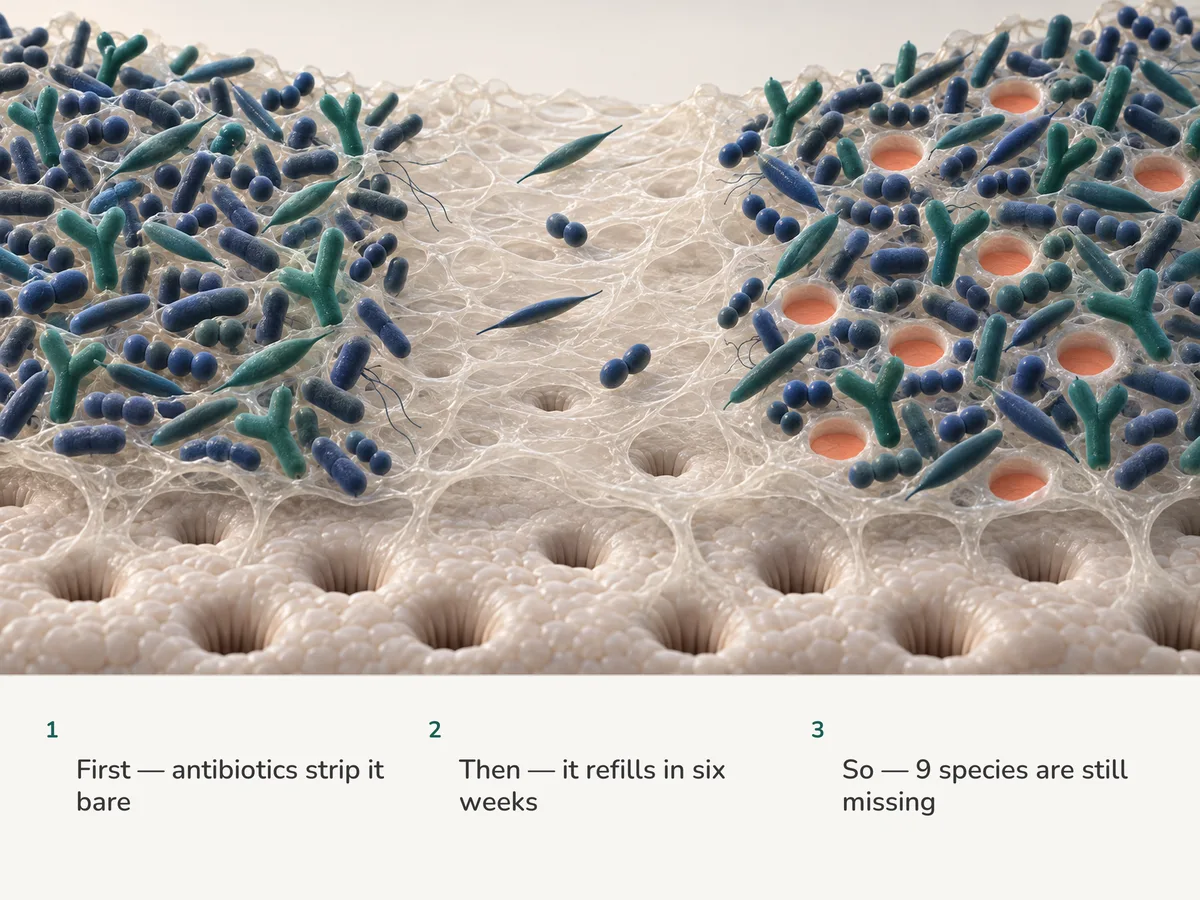
Mostly, yes. In 12 healthy men given three antibiotics for four days (Nature Microbiology, 2018), the gut community returned close to baseline within about 1.5 months, but nine species present in all of them beforehand were still undetectable in most of them at day 180. Recovery is real, incomplete, and slower in some people than in others.
 Written by: Magnus Larsen · Microbiologist · Science bloggerPublished: Facts checked:
You want to know whether the community in your gut comes back after a course of antibiotics, and how long you should give it. Good question, and an answerable one — several groups have watched it happen, sample by sample, and their numbers are more interesting than either the panic or the reassurance you will find elsewhere.
What a course actually does
The clearest human picture comes from Palleja and colleagues in Nature Microbiology in 2018 1. Twelve healthy young men took a four-day cocktail of three last-resort antibiotics — meropenem, gentamicin and vancomycin — and gave stool samples across the following six months 1. That is deliberately a worst case. Nobody gets that combination for a sore throat.
What happened first was not emptiness but a reshuffle. Enterobacteria and other pathobionts bloomed, among them Enterococcus faecalis and Fusobacterium nucleatum, while Bifidobacterium species and the butyrate producers were depleted 1. Butyrate is the short-chain fatty acid the cells lining your colon burn for fuel, so losing the organisms that make it is not a cosmetic change.
It also happens fast. In Dethlefsen and Relman's ten-month study of three people through two courses of ciprofloxacin, published in PNAS 2, diversity fell and community composition shifted within three to four days of starting the drug 2. Days, not weeks.
How long recovery takes in the measured studies
Each timeline below belongs to a named study, and none of them is a promise about you.
In the Copenhagen men, the community was back near its baseline composition within about 1.5 months 1. That is the encouraging half. The other half is that nine species present in every one of the twelve men before treatment were still undetectable in most of them at day 180 1.
Dethlefsen and Relman saw the same shape at finer resolution. About a week after each ciprofloxacin course the communities began returning toward their starting state, but the return was often incomplete 2, and by the end of the ten months each person's gut had settled into a stable composition that was not the one it started with 2.
The long tail runs longer than most people expect. Jernberg and colleagues followed four people given a seven-day clindamycin course, alongside four untreated controls, across nine sampling points over two years 3. Clonal diversity among their Bacteroides isolates collapsed, resistant clones persisted, resistance genes stayed elevated in stool DNA, and the Bacteroides community — a genus inside the Bacteroidota phylum — never returned to its original composition inside that window 3.
Weeks for the bulk, months for the detail, and for some members longer than anybody has yet watched.
What helps, and what the evidence does not support
Here the honest answer disappoints whoever is selling the solution.
Probiotics do one thing well and another thing badly. The thing they do well is diarrhoea. A Cochrane review by Guo and colleagues pooled 33 randomised trials in children, 6352 participants in total 5: antibiotic-associated diarrhoea occurred in 8 % of children on probiotics against 19 % on control 5, nine treated to prevent one case, and six when the daily dose was at least 5 billion CFU 5. Moderate-certainty evidence 5. It also shortened diarrhoea by close to a day 5. That is real — and it is a symptom result, not a rebuild.
Nor does it hold in everyone. PLACIDE, a trial that randomised 2981 hospital inpatients aged 65 and over — 2941 of them in the primary analysis — given a multi-strain lactobacilli-and-bifidobacteria preparation at 6 × 10¹⁰ organisms daily for 21 days, found antibiotic-associated diarrhoea in 10.8 % on the preparation and 10.4 % on placebo 6. No benefit in that population at all.
The thing probiotics do badly is the rebuild itself. Suez and colleagues, in Cell in 2018, went past stool and sampled the gut mucosa endoscopically after antibiotics 4. Compared with simply waiting, a multi-strain probiotic produced a markedly delayed and persistently incomplete return of the person's own indigenous microbiome and of the gut's own gene expression 4. An autologous faecal transplant — the person's own stool, banked before the antibiotics and given back afterwards — brought a rapid and near-complete recovery within days 4. In the dish, soluble factors secreted by lactobacilli held the returning community back 4.
On diet, the strongest signal is in mice and I will label it as such. Ng and colleagues, in Cell Host & Microbe, found that a fibre-deficient diet made the collapse worse and the recovery slower, and that animals housed alone recovered far less well than animals housed together 7. Mouse ecology is a hypothesis for you, not an instruction. It points the same way as everything else known about fibre and butyrate producers, and eating plants carries no risk.
What the evidence does not support: a named recovery date for your gut, a supplement shown to restore the community as a measured outcome, or a shop-bought stool test that tells you when you are finished. Of the 33 trials in that Cochrane review, one reported microbiome characteristics at all, and it found no difference 5.
Why your recovery is not the study's recovery
Twelve men. Three people. Four people 123. Those are the human sample sizes above, and ecology at this scale is personal. In Dethlefsen and Relman's data, variation between individuals was the largest single source of difference between samples 2 — larger than the drug.
So what falls, what blooms and what comes back depends on the community you walked in with, the drug, the length of the course, what you eat, and things nobody has measured yet. Two people can take the same seven days and land somewhere different.
What I would take from it
Finish the course you were prescribed; nothing above is an argument for leaving an infection half-treated. Then give the community months rather than days, and feed the members you want back — fibre for the butyrate producers, on the mouse evidence and on first principles 7. If diarrhoea is your problem, probiotics have evidence for that problem 5, weaker in older inpatients 6. And if someone offers to rebuild your microbiome on a schedule, ask them which study measured it. So far, the ones that measured it found the rebuild slower and less complete than the promise.
Key facts
- After a 4-day course of meropenem, gentamicin and vancomycin, the gut microbiota of 12 healthy men returned to near-baseline composition within about 1.5 months.1
- In the same 12 men, 9 species present in every subject before treatment were still undetectable in most of them 180 days later.1
- Ciprofloxacin cut gut diversity and shifted community composition within 3 to 4 days of the first dose; the return afterwards was often incomplete.2
- Four people given a 7-day clindamycin course were followed for 2 years: their Bacteroides community never returned to its original composition inside that window.3
- Pooled across 33 randomised trials in children (6352 participants), antibiotic-associated diarrhoea occurred in 8 % on probiotics versus 19 % on control, 9 children treated to prevent one case.5
- Among the 2941 analysed hospital inpatients aged 65 and over (2981 randomised), a multi-strain probiotic gave 10.8 % antibiotic-associated diarrhoea versus 10.4 % on placebo — no benefit.6
Questions people ask
How long should I wait before deciding my gut has recovered?
There is no validated finish line for an individual. The measured studies give ranges, not personal deadlines: near-baseline composition at about 1.5 months in one group of healthy young men, incomplete return after ten months in another study, and altered Bacteroides communities two years after a single week of clindamycin. Judge by how you feel and what your doctor sees, not by a date.
Should I take a probiotic during the course?
For preventing antibiotic-associated diarrhoea in children, yes, the evidence is moderate-certainty and the effect is real. For rebuilding the community itself, no: in the one study that sampled the gut lining directly, a probiotic delayed the return of a person's own microbiome compared with simply waiting. Those are two different goals and they do not point the same way.
Does a stool test tell me whether my microbiome has recovered?
Not usefully. The studies here used shotgun metagenomics, 16S sequencing or molecular fingerprinting against each person's own pre-antibiotic sample, which is the comparison that makes the answer meaningful. Without your own baseline, a commercial report has nothing to measure recovery against.
Will eating fibre speed it up?
The clearest evidence is from mice, where a fibre-deficient diet made the collapse worse and the recovery slower. That is a hypothesis for humans, not a demonstrated result. It also costs nothing and carries no risk, which is more than can be said for most of the alternatives.
Is it ever right to stop the course early to protect my gut?
No. Nothing in this evidence is a reason to leave an infection half-treated. Every study above starts from people who completed the antibiotics they were given.
Sources
- Palleja A. et al., Nature Microbiology, 2018 — doi:10.1038/s41564-018-0257-9
- Dethlefsen L., Relman D. A., PNAS, 2011 — doi:10.1073/pnas.1000087107
- Jernberg C. et al., The ISME Journal, 2007 — doi:10.1038/ismej.2007.3
- Suez J. et al., Cell, 2018 — doi:10.1016/j.cell.2018.08.047
- Guo Q. et al., Cochrane Database of Systematic Reviews, 2019 — doi:10.1002/14651858.CD004827.pub5
- Allen S. J. et al., The Lancet, 2013 (PLACIDE) — doi:10.1016/S0140-6736(13)61218-0
- Ng K. M. et al., Cell Host & Microbe, 2019 — doi:10.1016/j.chom.2019.10.011
Related

Same capsule, opposite result: what makes a probiotic work
120 overweight adults, 12 weeks: heat-killed L. plantarum did nothing on average. Only the least varied guts lost weight. Why that is a lead, not proof.
IBS pain is not in your head: enzymes poke the gut's nerves
Stool fluid from IBS patients made gut nerve networks fire far harder than fluid from healthy people, a 2026 Gut study found. What it shows — and does not.
Actinomycetota: the phylum that guards infants and causes TB
Actinomycetota, formerly Actinobacteria: the phylum of Bifidobacterium and of tuberculosis. Where it lives in your body, what it does for and against you.