
The carcinogen your own mouth makes out of ordinary sugar
Microbes cultured from head-and-neck cancer patients' saliva turned sugar (glucose) and alcohol (ethanol) into acetaldehyde, a Group 1 carcinogen, the top category, alongside tobacco smoking. Output peaked at 100 mM sugar. An antimicrobial peptide with bean gum stopped it, but biofilm-sheltered microbes survived until enzymes dissolved the plaque shell. Laboratory dishes only: no human trial, no cancer outcome.
 Written by: Magnus Larsen · Microbiologist · Science bloggerPublished: Facts checked:
A carcinogen with a local supply chain
When most of us hear the word carcinogen, we picture something arriving from outside — smoke, a chemical, a bad batch of something. Acetaldehyde is not like that. When it comes from the metabolism of alcohol it sits in Group 1, the top category the international cancer agency uses — the same one as tobacco smoking 2. And the point of a new paper is that your own mouth can manufacture it on site, out of the sugar in a biscuit.
The study is by Wakade, Liu, Diep and Daniell at the University of Pennsylvania School of Dental Medicine, published in Molecular Therapy: Oncology in 2026 1. Let me walk through what they actually did, because the mechanism is simple enough to picture — and the caveat is big enough that it belongs in the same breath.
What they grew, and what it made
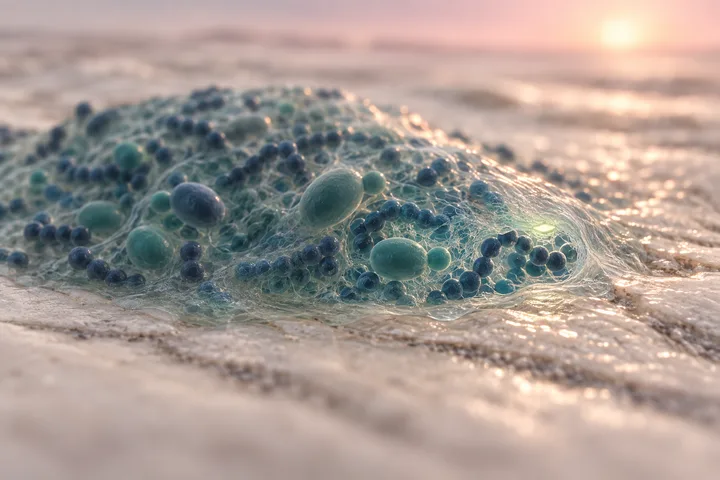
They did not order tidy reference strains from a catalogue. They took saliva from patients with head and neck squamous cell carcinoma and cultured out what was living in it: a yeast of the genus Candida, aerobic streptococci, and two anaerobes long familiar from gum disease — Fusobacterium nucleatum, of the Fusobacteriota, and Porphyromonas gingivalis 1.
Then they fed them, and watched for a pink halo. The detection trick is charming in its simplicity: acetaldehyde diffusing out of the culture reacts with a dye in the agar and stains a spreading circle. Bigger circle, more carcinogen.
Five separate yeast colonies isolated from patient saliva all made the stuff, in a tight band of 260–321 µM 1. The colony that made the most, at 321 µM, was carried forward 1. Feed it more glucose and it made more — rising from 5 mM up to 100 mM, then falling off again at 200–400 mM, probably because that much sugar is itself stressful to a cell 1. The same shape appeared with alcohol: production peaked around 100 mM ethanol, then declined 1. The two anaerobes peaked at 170 mM ethanol 1. The streptococci were the interesting ones — they made acetaldehyde in ethanol-free medium, which the authors put down to glucose metabolism through pyruvate; with ethanol added their output climbed further still, peaking between 500 and 1,100 mM 1.
That last detail is the one I would underline. This is not only a story about drinking. A mouth carrying the wrong community has a route running from breakfast to acetaldehyde — the molecule the cancer agency puts in Group 1 when it arrives by way of alcohol 2, and which the authors of this paper call a Group 1 carcinogen outright 1.
The lock is the biofilm — the sticky plaque shell, not the bacteria
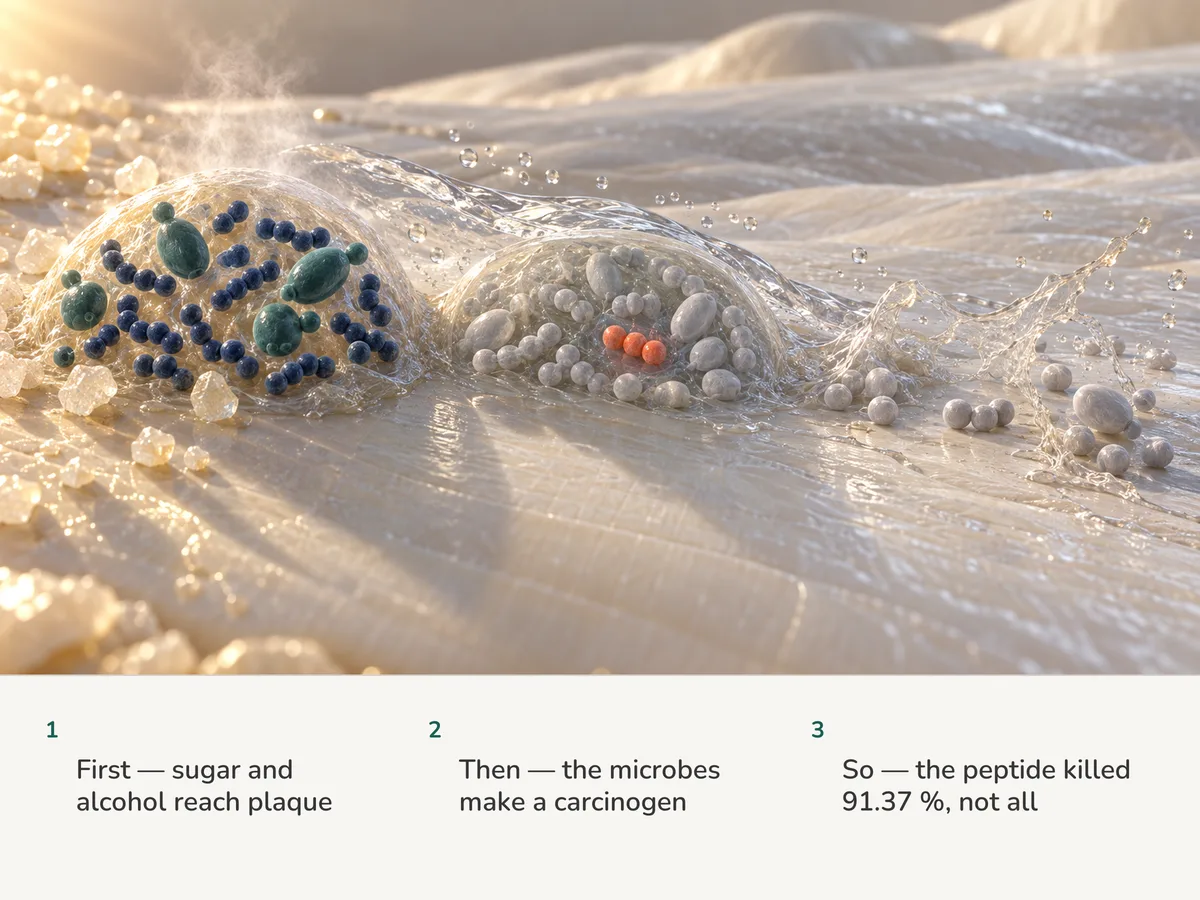
Here is the part with a mechanism anyone can picture. The authors used protegrin‑1, an antimicrobial peptide, together with an extract of the bean gum, to kill the organisms and stop the output. Against a streptococcal isolate with no real biofilm it worked outright — acetaldehyde fell from 272.06 µM to the edge of detection, and viability collapsed 1. Against the biofilm-former it went only part of the way: acetaldehyde dropped from 869.7 µM below the detection limit, but just 91.37 % of the colonies died — the rest lived on 1.
Bacteria in a biofilm live inside a shell of sticky sugar polymer. Pouring an antiseptic over that is like spraying disinfectant on a zipped-up tent and calling the inside clean. So the team added two enzymes that digest exactly that shell — dextranase and mutanase. With the tent open, the peptide finished the job: acetaldehyde and colonies both went to nothing 1. In the two anaerobes the same combination brought output down from 685.7 µM to negligible levels and from 473.6 µM to undetectable 1.
The yeast needed a different key. Its wall is chitin, glucans and mannoproteins, so they reached for β-glucanase, chitinase and mannanase. A microbial cocktail took acetaldehyde from 978.8 µM to 38.7 µM — a 96.04 % reduction — with 99.99 % of the cells killed 1. A plant-made version of the same enzymes, grown inside lettuce cells, brought 873.9 µM down to roughly 70.8 µM over three sequential doses 1.
The delivery idea is chewing gum: the enzymes made in plant cells and pressed into a tablet, released slowly while you chew — though the peptide used in these experiments was chemically synthesised rather than plant-grown 1. A related gum from the same laboratory already holds an investigational new drug number, 154,897, for an unrelated antiviral purpose 1.
Now the catch, out loud
This is a dish. Every result above happened in vitro, in monoculture, and the authors say so themselves — real mouths are mixed communities where organisms feed and shelter one another, and that was not modelled. Mutagenicity was never measured; they quantified acetaldehyde, not DNA damage. There were no healthy-donor yeast isolates to compare against, because Candida had not been found in the healthy saliva analysed earlier. The isolate-level work rests on five yeast colonies, two streptococcal isolates, and three biological replicates per viability assay 1. No patient was treated. No cancer was prevented. No human trial has been run.
So what survives once the excitement is stripped out? A clean demonstration that the sugar and alcohol sitting in your mouth are raw material, that the biofilm is the shield, and that enzymes which open the shield are a plausible way through. That is a good day's work. It is not a product, and it is not advice.
What it does justify today is unglamorous: fewer sugar exposures spread across the day, less alcohol, and mechanical disruption of the biofilm — brushing and flossing the plaque off — morning and night. Those act on the same supply chain — and unlike the gum, they already exist.
Key facts
- Acetaldehyde associated with the consumption of alcoholic beverages is classified a Group 1 human carcinogen — the top category, the same one as tobacco smoking.2
- Five yeast colonies isolated from head-and-neck cancer patient saliva each produced acetaldehyde, in a narrow band of 260–321 µM.1
- Acetaldehyde output rose with glucose from 5 to 100 mM, then fell again at 200–400 mM.1
- An enzyme cocktail cut acetaldehyde release from 978.8 µM to 38.7 µM, a 96.04 % reduction, and killed 99.99 % of the yeast.1
- Protegrin‑1 with bean gum drove acetaldehyde below the detection limit in a biofilm-forming streptococcal isolate but killed only 91.37 % of the colonies; dextranase and mutanase were needed to wipe out the rest.1
Questions people ask
Does this mean sugar causes mouth cancer?
No, and the study does not claim it. It shows that microbes taken from patients make more of a known carcinogen when there is more sugar or alcohol around them, up to a point — highest at 100 mM, lower again at 200–400 mM [s1]. That is a mechanism in a dish, not a demonstrated cause of disease in people.
Should I buy an enzyme chewing gum?
There is nothing to buy on the strength of this paper. The formulations were laboratory preparations tested against isolated organisms. A related chewing gum from the same laboratory has an investigational new drug number, 154,897, for a different target entirely [s1] — permission to begin testing, not evidence that it works.
Which microbes were involved?
A yeast of the genus Candida, aerobic streptococci, and two anaerobes familiar from gum disease — Fusobacterium nucleatum and Porphyromonas gingivalis — all cultured from the saliva of head-and-neck cancer patients [s1].
Why did the peptide need enzymes?
Because biofilm bacteria live inside a sticky sugar-polymer shell. Against a biofilm-forming streptococcal isolate, protegrin‑1 with bean gum drove acetaldehyde below the detection limit but killed only 91.37 % of the colonies; adding dextranase and mutanase to open that shell wiped out the survivors [s1].
Sources
- Wakade G., Liu S. C., Diep N. E. & Daniell H., Molecular Therapy: Oncology, 2026 — doi:10.1016/j.omton.2026.201314
- Secretan B. et al. (IARC Monograph Working Group), The Lancet Oncology, 2009 — doi:10.1016/s1470-2045(09)70326-2
Related
Bad breath isn’t dirt. It’s one bacterial gene doing its job
A 2026 lab-dish and rat study turned down the bacterial gene behind bad breath. Here is the mechanism, the numbers, and everything the study did not show.
Bacillus coagulans: a spore passing through, not a resident
Bacillus coagulans (also Heyndrickxia coagulans — one bug, two names): what this spore-forming probiotic does for mouth and gut, and where the evidence stops.
Why the 'colon cancer bacterium' is normal in your mouth
Fusobacteriota (formerly Fusobacteria) is a normal phylum — a whole branch — of mouth bacteria. One small clade is linked to colon cancer; most of it is not.