
Bad breath from the stomach? One case in a hundred
Partly true, and barely. The smell is volatile sulfur compounds, made by anaerobic bacteria on the back of the tongue and under the gums, above the food pipe and not below it. In a breath clinic of 491 patients the mouth explained 87 % of cases and the digestive tract 1 %. Gastric bad breath exists; it is the exception.
 Written by: Magnus Larsen · Microbiologist · Science bloggerPublished: Facts checked:
The sentence arrives with complete confidence, usually from someone who has already bought three mouthwashes. It's not my teeth. It's coming from my stomach. It is the most durable explanation for bad breath in circulation, and it survives because it feels anatomically obvious: the mouth opens onto a tube, the tube ends in a stomach, air comes out of the mouth. Something must be rising.
The verdict
Partly true — and the "partly" is very small.
In a Belgian multidisciplinary breath odour clinic that examined 491 patients with an ear-nose-throat specialist, a periodontologist and, when needed, a psychiatrist, oral causes accounted for 87 % of cases. The digestive tract accounted for 1 % 1. That is one patient in a hundred, in a clinic that people reach precisely because everything simpler has already failed.

Where the smell is actually made
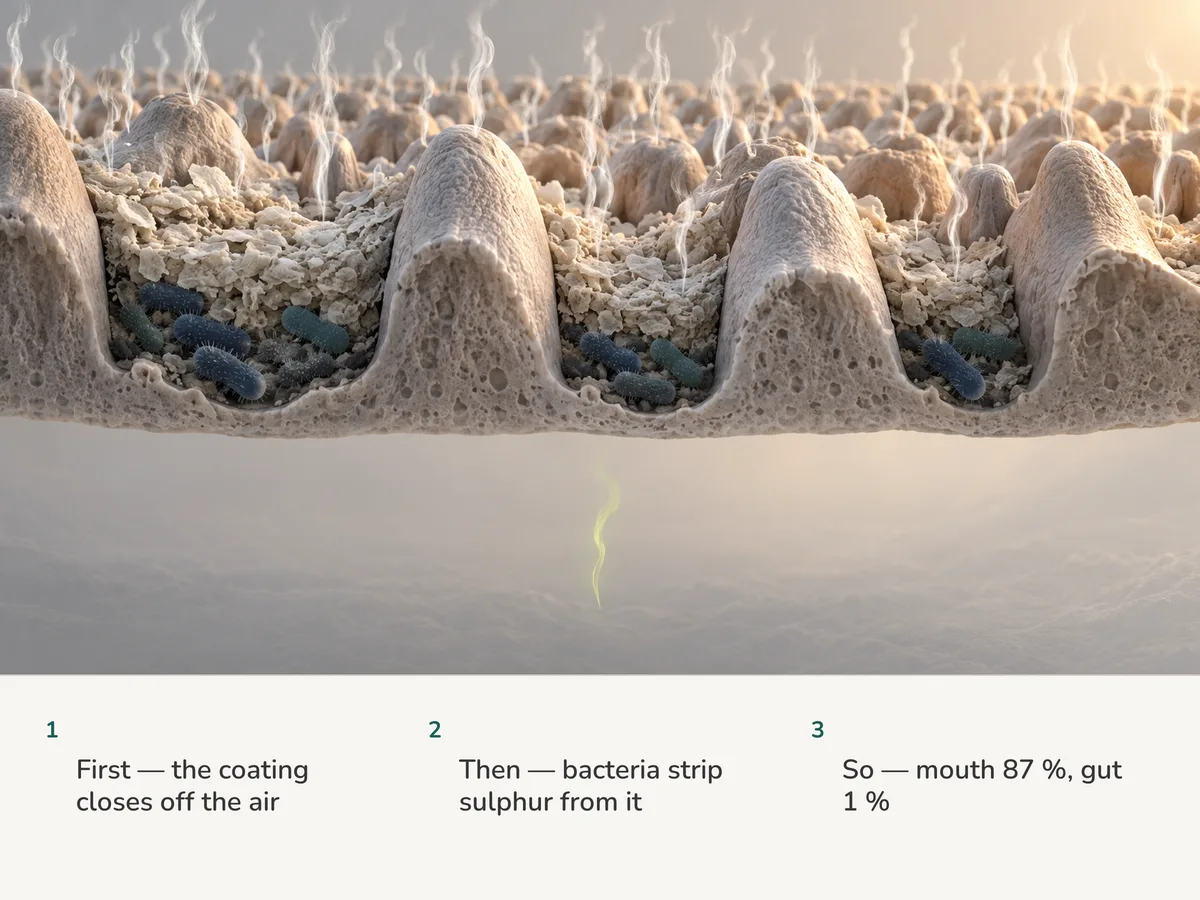
Bad breath is mostly one class of molecule: volatile sulfur compounds. Tonzetich, in the 1977 review that still anchors this field, showed that hydrogen sulphide and methyl mercaptan account for approximately 90 % of the total sulphur content of mouth air, and that the odour comes from putrefaction of sulphur-containing proteins by predominantly gram-negative oral microorganisms 2. Brushing studies in that same work found plaque and tongue both to be important sources, with most of the odour emanating from the dorso-posterior surface of the tongue — the far back of it 2.
That is worth sitting with, because it explains the whole misunderstanding. The back of the tongue is a fissured, papillated surface that holds a thick coat of shed epithelial cells, saliva sediment and food debris. Underneath the coat, oxygen runs out. Anaerobic bacteria then do what anaerobic bacteria do to protein: they strip the sulfur off cysteine and methionine and release it as gas 3. The substrate is your own dead cells. The conditions Tonzetich named for optimum putrefactive activity — low carbohydrate, physiological pH, anaerobic — are exactly the conditions on the tongue's back third when the mouth is closed and saliva is slow 2.
The gums do the same thing in a periodontal pocket, which is why gum disease and bad breath travel together. In the Belgian series, tongue coating was behind 51 % of the oral cases, gingivitis 17 %, periodontitis 15 %, and combinations the remaining 17 % 1. The organisms responsible are the familiar anaerobes of plaque and the gum line: when common oral anaerobes were incubated with cysteine and methionine and their headspace measured, Porphyromonas gingivalis was among the major producers of both hydrogen sulphide and methyl mercaptan 11.
The share that really does not come from the mouth
The literature is consistent about the size of the non-oral slice, if not about its exact edges. Tangerman and Winkel put extra-oral halitosis of every kind at about 5–10 % of all cases 3. A 2022 systematic review of the aetiology literature put intra-oral factors at 80–90 % and extra-oral at 10–20 % 4. The Belgian clinic's non-oral 13 % broke down as ear-nose-throat problems 4 %, mixed ENT-and-oral 3 %, presumed psychiatric 5 %, and the digestive tract 1 % 1.
Note what fills that non-oral slice in the Belgian series: ear-nose-throat problems and presumed psychiatric causes, each of them larger than the digestive tract 1. And when a systemic condition does reach your breath, it does not do so by venting up the oesophagus. Odorous compounds circulating in the bloodstream cross into the lungs, volatilise into alveolar air, and leave with every exhalation 6. That is why blood-borne halitosis smells the same through the nose as through the mouth, while mouth-made halitosis does not. In a study of 58 people complaining of bad breath, 47 had an oral source, six had an extra-oral one, and five had no measurable malodour at all; all six extra-oral cases showed elevated dimethyl sulphide in both mouth and nose breath 5.
What the stomach bug Helicobacter pylori does and does not prove
The stomach's best claim is Helicobacter pylori. A 2016 meta-analysis of 21 studies found the odds of halitosis about 2.85 times higher in infected people than in uninfected ones, and a markedly lower rate of halitosis after successful eradication compared with failed eradication 7. Taken alone, that reads like a verdict for the stomach.
It is not, and the reason is a study that bothered to look at the mouths. A hundred dyspeptic patients with positive H. pylori serology were examined for bad breath, dental status by the DMFT index (decayed, missing, filled teeth) and oral hygiene by the simplified oral hygiene index. Halitosis tracked the dental index and the hygiene index, both significantly; the authors concluded they could not attribute halitosis in H. pylori patients to the organism with certainty 8. That same study found no significant relationship between halitosis and coated tongue in this particular group 8, so it is not a straightforward vote for the tongue either — but it does take the smell away from the stomach. The bacterium is also found in dental plaque and saliva as well as in the stomach; a review of the oral literature concluded that the mouth is its first extra-gastric reservoir 12. An association with bad breath can therefore run through the mouth rather than through the gut. Eradication therapy is also a course of antibiotics, which does not leave the oral flora untouched. This is an association worth investigating in refractory cases, not a licence to skip the tongue.
What the myth costs the people who believe it
If you believe the smell comes from below, everything you do points downward: digestive enzymes, gastric remedies, elimination diets, endoscopies. Meanwhile the tongue goes unscraped. The Belgian team reported that many of their patients had already undergone diagnostic and therapeutic interventions to no avail before arriving 1. In a separate inventory of 406 patients from the same clinic, most of those who returned the follow-up questionnaire were disappointed by the suggestion that their halitosis came down to insufficient oral hygiene 10. Disappointment is the honest human response to a boring solution — and the boring solution is the one with the evidence.
A systematic review identified five publications providing seven experiments comparing mechanical tongue cleaning plus toothbrushing against toothbrushing alone. Every experiment showed a positive effect on measures of oral malodour, though the reviewers were explicit that evidence for chronic halitosis specifically remains insufficient 9. That is a modest claim, and it is the one the data support.
So: clean the back of the tongue, get the gums assessed, and treat the mouth as the default suspect it statistically is. If the smell survives a genuinely clean mouth, the search moves outward — to the nose and sinuses first, then to blood-borne causes, and only then to the stomach. Mouth first, then nose, then blood, then stomach — that order is not a prejudice. It is the order the numbers were counted in.
Key facts
- In a Belgian multidisciplinary breath clinic that examined 491 patients, oral causes accounted for 87 % and the digestive tract for 1 %.1
- Tongue coating alone accounted for 51 % of the oral cases in that clinic — more than gingivitis and periodontitis together.1
- Hydrogen sulphide and methyl mercaptan make up roughly 90 % of the total sulphur content of mouth air, and most of the odour comes off the back of the tongue.2
- Extra-oral causes of all kinds — the nose and upper airway, the lower airway, and blood-borne causes — cover about 5–10 % of halitosis cases.3
- A meta-analysis of 21 studies found halitosis about 2.85 times more likely in people infected with Helicobacter pylori, and less frequent after successful eradication.7
- In 100 Helicobacter-positive dyspeptic patients, bad breath tracked the DMFT (decayed, missing, filled teeth) index and the oral hygiene index; the authors could not attribute it to the infection with certainty.8
Questions people ask
So the stomach never causes bad breath?
It can, and rarely does. In the 491-patient clinic series the digestive tract was the identified cause in 1 % of patients [s1]. Extra-oral causes of every kind together run at about 5–10 % [s3] to 10–20 % [s4] depending on the series and how strictly they are measured. If your breath problem is genuinely gastric, you are in a small minority, and you will usually have other digestive symptoms rather than bad breath alone.
Why does my breath smell right after I burp, then?
Because you have just pushed stomach gas out through your mouth. That is a real smell and a real event, but it is transient. Chronic halitosis is the smell that sits in your breath while the oesophagus is closed and doing nothing — and that smell is made in the mouth. The two get confused because the burp is the memorable one.
Can Helicobacter pylori be the reason?
It is associated. A meta-analysis of 21 studies put the odds of halitosis about 2.85 times higher in infected people, with fewer complaints after successful eradication [s7]. But a study of 100 Helicobacter-positive dyspeptic patients found bad breath tracking their DMFT and oral hygiene scores, and its authors said plainly that they could not attribute the smell to the organism with certainty [s8]. Association, not a settled cause.
What should I actually do first?
Clean the back of the tongue. A systematic review of five publications and seven experiments found that mechanical tongue cleaning added to toothbrushing improved measures of oral malodour in every experiment, though the authors noted the evidence for chronic halitosis specifically is thin [s9]. Then have gums and teeth looked at. Only after the mouth has been ruled out does the search move outward.
How do doctors tell an oral cause from an extra-oral one?
By comparing mouth breath with nose breath and by measuring which sulfur gas is present. Methyl mercaptan and hydrogen sulphide dominate in mouth-made halitosis; dimethyl sulphide dominates when the source is blood-borne. In one series of 58 complainants, all six extra-oral cases showed elevated dimethyl sulphide in both mouth and nose breath [s5].
Sources
- Delanghe G., Bollen C. & Desloovere C., Laryngo-Rhino-Otologie, 1999 — doi:10.1055/s-2007-996920
- Tonzetich J., Journal of Periodontology, 1977 — doi:10.1902/jop.1977.48.1.13
- Tangerman A. & Winkel E. G., Journal of Breath Research, 2010 — doi:10.1088/1752-7155/4/1/017003
- Memon M. A. et al., Oral Diseases, 2022 — doi:10.1111/odi.14172
- Tangerman A. & Winkel E. G., Journal of Clinical Periodontology, 2007 — doi:10.1111/j.1600-051X.2007.01116.x
- Tangerman A., International Dental Journal, 2002 — doi:10.1002/j.1875-595x.2002.tb00925.x
- Dou W. et al., Medicine (Baltimore), 2016 — doi:10.1097/MD.0000000000004223
- Anbari F. et al., Helicobacter, 2018 — doi:10.1111/hel.12556
- Van der Sleen M. I. et al., International Journal of Dental Hygiene, 2010 — doi:10.1111/j.1601-5037.2010.00479.x
- Delanghe G. et al., Quintessence International, 1999 — PMID 10635284
- Salako N. O. & Philip L., Medical Principles and Practice, 2011 — doi:10.1159/000319760
- Adler I. et al., World Journal of Gastroenterology, 2014 — doi:10.3748/wjg.v20.i29.9922
Related

The carcinogen your own mouth makes out of ordinary sugar
Mouth microbes from cancer patients turned sugar and alcohol into acetaldehyde — a carcinogen ranked with tobacco. Plaque hid the rest until enzymes opened it.
Bad breath isn’t dirt. It’s one bacterial gene doing its job
A 2026 lab-dish and rat study turned down the bacterial gene behind bad breath. Here is the mechanism, the numbers, and everything the study did not show.

Bacillus coagulans: a spore passing through, not a resident
Bacillus coagulans (also Heyndrickxia coagulans — one bug, two names): what this spore-forming probiotic does for mouth and gut, and where the evidence stops.