
Do probiotics survive acid? That's the wrong question
Some do. Spore-formers survive by construction; delicate strains mostly do not, though a coating and a meal improve the odds. Survival is the wrong finish line: the one study of the human gut lining found swallowed strains viable after the trip, settling in some people and not others. Passing through is not moving in.
 Written by: Magnus Larsen · Microbiologist · Science bloggerPublished: Facts checked:
You want to know whether the bacteria in a probiotic actually arrive alive, or whether your stomach kills them on the way. It is the right question — and it opens a second one that matters more.
What acid actually does to a swallowed bacterium
Your stomach is not merely unpleasant for bacteria. It is a chemical filter, and most swallowed cells fail it.
The clearest measurement of that filter I know comes from Woodward and colleagues at the University of British Columbia, who did something clever. They tagged a bacterial population with more than 2 000 distinguishable genetic barcodes, fed it to mice, and then counted how many of those lineages were still represented downstream 1. If nothing were lost, they would have found thousands. They found an average of 12 to 43 1. Raise the stomach pH first with an acid-blocking drug, and the number of founding lineages in the upper small intestine rose by up to 6.8-fold 1.
Say the caveat out loud: that was mice, and the organism was a gut pathogen, not a probiotic. It does not tell you what happens to a Lactobacillus inside you. What it does show — with a number rather than an adjective — is the shape of the barrier. Acid does not politely thin a swallowed population. It strangles its diversity, so that a handful of survivors found everything that comes after.
One more detail from that work is worth keeping, because it is exactly what marketing leaves out: raising the stomach pH did not significantly change the total bacterial count downstream 1. More lineages got through; the head count did not move. Survival and abundance are not the same measurement, and neither one is benefit.
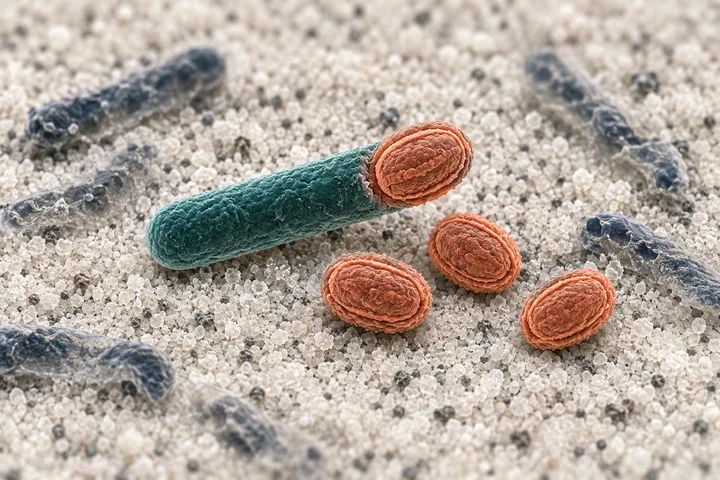
The spore is a different object — a seed, not a cell
Here the answer genuinely splits by organism, and not for marketing reasons.
An ordinary lactic acid bacterium — the kind in yoghurt — meets stomach acid as a living, metabolising cell with a membrane to defend. A spore-forming bacterium meets it as a spore: dormant, dehydrated, armoured. That is what a spore is for — a difference in physical object, not in branding.
Duncan and colleagues in Milan followed one such strain, Heyndrickxia coagulans LMG S-24828 — the organism labels still commonly print under its older name, Bacillus coagulans — through in vitro and then in vivo digestion, and reported robust survival with evidence of significant spore germination in the human gut 3. So the spore route is real, and shown in people, not only in glassware.
Then the caveat, which is not a small one: that was one strain, in one study, co-authored by an employee of the company that supplies it 3. "Spore-formers survive acid" is a statement about spores. It is not a promise about every product built on one.
Capsules, coatings and what you swallow it with
The other lever is packaging, and here there is a number worth holding on to.
Surono and colleagues ran two probiotic strains through a dynamic, computer-controlled model of the human upper gut. As free cells they came out the far end at about 18.5 % survival for Lactobacillus plantarum IS‑10506 and 15.0 % for Enterococcus faecium IS‑27526 2. Microencapsulate them, and L. plantarum rose to 84.5 % — while E. faecium barely moved, reaching 15.7 % 2. Same coating, same model, opposite outcome. Encapsulation is not a universal fix. It is a fix that has to be demonstrated for the strain it wraps.
Food matters too, for the dull reason that it buffers. Bove and colleagues put L. plantarum WCFS1 through an oro-gastro-intestinal simulator in different carriers and found higher survival in complex, nutrient-rich matrices 9. Pitino and colleagues delivered seven L. rhamnosus strains inside a model cheese through a dynamic gastric model and recorded good survival, with three of the seven outlasting the reference strain L. rhamnosus GG through the gastric stage 6. A capsule swallowed with a meal is in a different stomach from a capsule swallowed on an empty one.
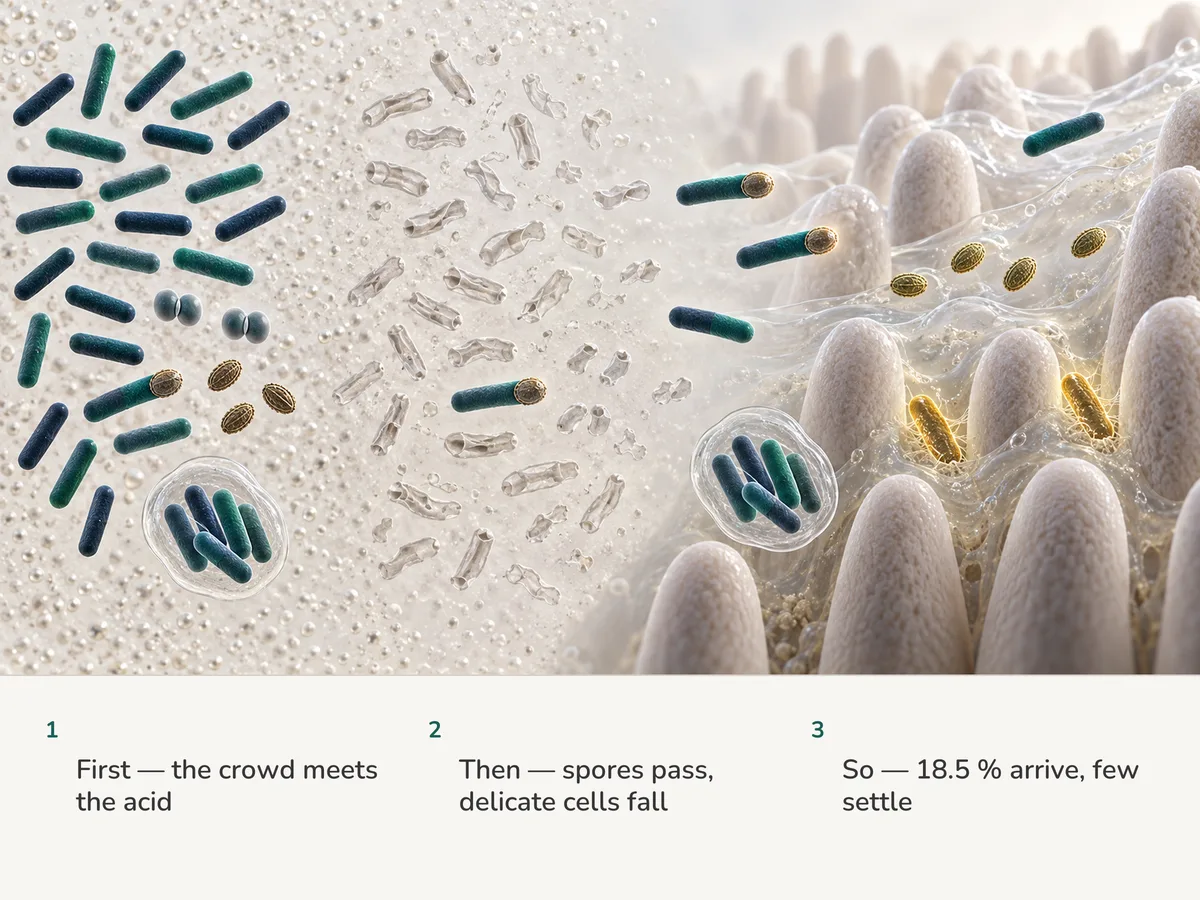
What a survival study is actually measuring
Almost every number above comes out of a machine rather than a person. These simulators are standardised, repeatable and useful — and they are not you.
They also measure a narrow thing: how many colony-forming units can be recovered at the far end. Not whether those cells did anything once they arrived. Ghelardi and colleagues tested 21 probiotic formulations sold worldwide and found survivability in simulated gastric and intestinal fluids highly variable between products, with the microorganisms in four of them surviving both the acidic and the alkaline stage 5. That study also found the labels mostly honest and occasionally not: one product held fewer viable microbes than claimed, one contained two undeclared species, one was missing a labelled strain 5. Read that one knowing two of its eight authors work for a company that sells probiotics 5. Kesavelu and colleagues, testing 20 products sold as pharmaceuticals in India, reported poor correlation between declared and measured contents 8. Before you ask whether a strain survives your stomach, it is fair to ask whether it was in the bottle.
Surviving is not colonising — arriving is not settling in
Now the part that reframes your question.
Zmora and colleagues at the Weizmann Institute gave healthy volunteers an eleven-strain probiotic and then did what almost nobody does: they went in with an endoscope and sampled the gut lining directly, instead of reading stool 4. The strains were viable after gastrointestinal passage. They survived 4. But whether they colonised the mucosa was person-specific, region-specific and strain-specific, foreshadowed by that person's own baseline host and microbiome features — and, the sentence to remember, could not be told from their presence in stool at all 4.
So a product can pass every survival test, show up in your stool, and never have settled anywhere. Passing through is not moving in.
The same group's companion paper adds something uncomfortable. After antibiotics, the probiotic colonised the human mucosa more readily — and that came with a markedly delayed and persistently incomplete return of the person's own microbiome, compared with recovering spontaneously 7. More colonisation was not automatically better.
The honest bottom line
Yes, some probiotics survive stomach acid. Spore-formers survive it by construction 3; delicate strains survive it in the low tens of percent, better inside a coating tested for that particular strain, better alongside food 29.
But if you take one thing from a microbiologist: survival is the entry ticket, not the show. The organism still has to reach somewhere it can work, do something measurable there, and keep doing it for as long as you keep taking it. So ask a manufacturer for the trial that measured the outcome you actually care about — not the one that counted how many cells came out the other end.
Key facts
- In a barcoded mouse experiment with a gut pathogen, a population carrying more than 2,000 distinguishable lineages was cut to an average of 12–43 founding lineages across the gut regions sampled.1
- Raising gastric pH with an acid-blocking drug increased founding lineages in the upper small intestine by up to 6.8-fold — while total bacterial counts did not significantly change.1
- Free cells of Lactobacillus plantarum IS‑10506 survived a dynamic model of the upper gut at 18.5 %; microencapsulated, the same strain reached 84.5 %, while Enterococcus faecium IS‑27526 moved only from 15.0 % to 15.7 %.2
- A spore-forming strain, Heyndrickxia coagulans LMG S-24828, showed robust survival and evidence of significant spore germination in the human gut — one strain, in one industry-co-authored study.3
- In an eleven-strain probiotic given to healthy volunteers, the strains were viable after gut passage, but mucosal colonisation was person-, region- and strain-specific and could not be inferred from stool.4
- Across 21 probiotic formulations sold worldwide, survivability in simulated gastric and intestinal fluids was highly variable; the microorganisms in four of them survived both the acidic and the alkaline stage.5
Questions people ask
Should I take a probiotic with food or on an empty stomach?
The published mechanics point at food, for a dull reason: a meal buffers the stomach. Bove and colleagues found higher survival of Lactobacillus plantarum WCFS1 in complex, nutrient-rich carriers in an oro-gastro-intestinal simulator, and Pitino and colleagues recorded good survival for seven Lactobacillus rhamnosus strains delivered inside a model cheese. Both were laboratory models, not people, and neither compared with-food against without-food dosing of a real product against a health outcome. Treat it as plausible mechanics, not an instruction.
Do capsules and coatings actually help?
Sometimes, and strain by strain. In the same dynamic model of the upper gut, microencapsulation lifted one strain more than fourfold — from 18.5 % to 84.5 % — and left the other one essentially where it started, 15.0 % to 15.7 %. That is the honest shape of it: a coating is not a property of the technology, it is a property of the pairing, and it has to be demonstrated for the organism it wraps.
Are spore-based probiotics better than Lactobacillus ones?
They are better at the one job of getting through acid, because a spore is a dormant, dehydrated, armoured object rather than a living cell with a membrane to defend. Better at surviving is not the same as better at helping. What a spore does after it germinates is a separate question with a separate evidence base, and it is answered per strain, never per genus.
If I can find the strain in my stool, did it work?
No — and this is the finding that reorganised the field. When Zmora and colleagues sampled the human gut lining directly by endoscopy, whether a strain had colonised the mucosa could not be told from whether it appeared in stool. Stool tells you something passed through. It does not tell you anything settled.
I take an acid-blocking medication. Does that change things?
It plausibly changes how much gets through, since acid is the barrier in question — but I have no human probiotic trial to hand you that measured it, so I am not going to invent an answer. If you take acid-suppressing medication and are considering a live-organism supplement, that is a question for the doctor who prescribed it, not for a label.
Sources
- Woodward S.E., Vogt S.L., Peña-Díaz J. et al., The ISME Journal, 2022 — gastric acid as a bottleneck to host colonisation — doi:10.1038/s41396-022-01321-9
- Surono I., Verhoeven J., Verbruggen S., Venema K., Journal of Applied Microbiology, 2018 — microencapsulation and survival in the TIM-1 model of the upper gut — doi:10.1111/jam.13740
- Duncan R., Mantegazza G., Gargari G., Pierallini E., Russo R., Guglielmetti S., Probiotics and Antimicrobial Proteins, 2024 — Heyndrickxia coagulans LMG S-24828 germination in the human gut — doi:10.1007/s12602-024-10383-4
- Zmora N., Zilberman-Schapira G., Suez J. et al., Cell, 2018 — personalised gut mucosal colonisation resistance to empiric probiotics — doi:10.1016/j.cell.2018.08.041
- Ghelardi E., Mazzantini D., Celandroni F. et al., Frontiers in Microbiology, 2023 — microbial content of probiotic products sold worldwide and survivability in simulated gut conditions — doi:10.3389/fmicb.2023.1127321
- Pitino I., Randazzo C.L., Cross K.L. et al., Food Microbiology, 2012 — Lactobacillus rhamnosus in a cheese matrix through a dynamic gastric model — doi:10.1016/j.fm.2012.02.013
- Suez J., Zmora N., Zilberman-Schapira G. et al., Cell, 2018 — post-antibiotic gut mucosal microbiome reconstitution impaired by probiotics — doi:10.1016/j.cell.2018.08.047
- Kesavelu D., Rohit A., Karunasagar I., Karunasagar I., Cureus, 2020 — composition and laboratory correlation of commercial probiotics in India — doi:10.7759/cureus.11334
- Bove P., Russo P., Capozzi V., Gallone A., Spano G., Fiocco D., Microbiological Research, 2013 — Lactobacillus plantarum through an oro-gastro-intestinal simulator, carrier matrix effect — doi:10.1016/j.micres.2013.01.004
Related

Same capsule, opposite result: what makes a probiotic work
120 overweight adults, 12 weeks: heat-killed L. plantarum did nothing on average. Only the least varied guts lost weight. Why that is a lead, not proof.
IBS pain is not in your head: enzymes poke the gut's nerves
Stool fluid from IBS patients made gut nerve networks fire far harder than fluid from healthy people, a 2026 Gut study found. What it shows — and does not.
Actinomycetota: the phylum that guards infants and causes TB
Actinomycetota, formerly Actinobacteria: the phylum of Bifidobacterium and of tuberculosis. Where it lives in your body, what it does for and against you.