
Sleep badly and your gut hears it — then answers
Sleep and the gut move together, but the evidence is stronger in one direction. Observational work links poor, irregular sleep to lower microbial diversity. The two controlled human sleep-restriction experiments disagree: one found two short nights nudged the share each group holds; the other found no change. Fibre, and a fixed waking hour, are the moves with evidence.
 Written by: Magnus Larsen · Microbiologist · Science bloggerPublished: Facts checked:
There is a version of this story that gets told a lot: your gut bacteria run your sleep, so fix the bacteria and you will sleep. There is a second version, equally popular and pointing the other way: sleep badly and you wreck your microbiome. Both are built on the same evidence, and that evidence is more modest and more interesting than either headline.
Here is what is actually on the table, and what to do with it before Tuesday night.
What the observational studies measured
The largest look at this comes from a population sample: 720 adults in the Survey of the Health of Wisconsin, sampled in 2016 and 2017, with sleep measured both by questionnaire and by wrist actigraphy 1. Four things travelled with a less rich, less diverse gut community — night-to-night variability in how long people slept, time spent awake after first falling asleep, low sleep efficiency, and simply rating your own sleep as poor 1.
A smaller study did the same trick with a tighter population and a longer recording: 26 healthy young men, each wearing an actigraph for a month 2. Total microbiome diversity rose with sleep efficiency and fell as time awake after sleep onset went up 2.
Two independent samples, two different designs, the same direction. That is worth something. What it is not is a cause. People who sleep in a ragged, irregular pattern also eat at ragged, irregular times, and diet is among the strongest influences on the gut community. Nothing in either study separates the two.
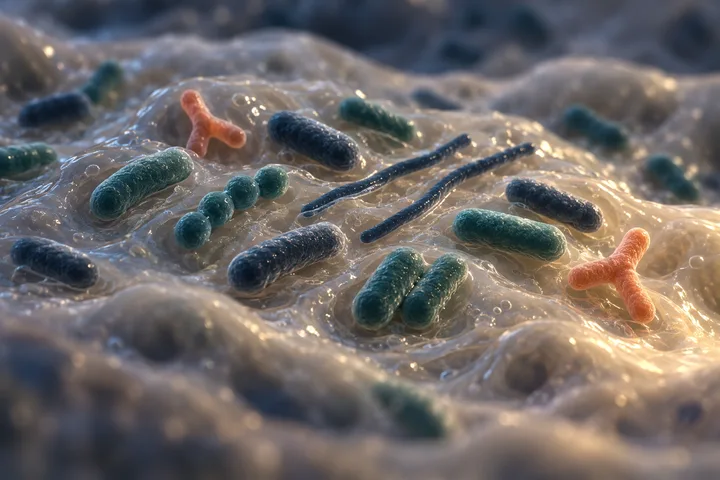
Push sleep, and the two experiments disagree
Two human studies have pushed sleep deliberately and watched the gut, and they do not agree.
In the first, nine normal-weight men were studied twice in a randomised crossover, with meals and exercise fixed by protocol: two nights with a sleep window of 02:45–07:00, against two nights of 22:30–07:00 3. The Firmicutes-to-Bacteroidetes ratio shifted, and two bacterial families rose while another phylum fell 3. Insulin sensitivity dropped, fasting and after a glucose drink 3. And the things that would have made a bigger story did not move: overall community structure was unchanged, and faecal short-chain fatty acids were unchanged 3.
The second pushed harder and found less. Eleven adults spent five in-lab nights on four hours in bed; richness did not change significantly, community composition did not shift consistently against either baseline or recovery, and phylum ratios — the Firmicutes-to-Bacteroidetes ratio included — did not move 10. The authors' own conclusion was that the microbiome is largely resistant to sleep restriction.
So the honest reading is a nudge in one small experiment and nothing in the other, at nine and eleven people, over two and five nights. Anyone selling you more than that from either study is selling you their hope.
The routes proposed between gut and brain
Between gut and brain there are several known channels, and they are the same channels whichever direction you argue: the vagus nerve, gut hormone signalling, the immune system, tryptophan metabolism, and microbial metabolites, chiefly short-chain fatty acids 5. Tryptophan is the one people reach for, because it is the precursor the body turns into serotonin and then melatonin, and because gut microbes compete for it.
The clock route is the better-evidenced one. The gut community itself oscillates over a day, in mice and in people, and that oscillation is shaped by feeding rhythms 4. Break the rhythm — knock out the host clock genes, or impose jet lag — and the oscillation goes wrong; transplant the resulting community into germ-free mice and the metabolic trouble travels with it 4. Sleep does not act on your gut directly so much as it decides when you eat.
Fibre is where this becomes practical, because fibre is what the butyrate-producing residents such as Faecalibacterium prausnitzii live on, and butyrate is one of the metabolites on that list 5.
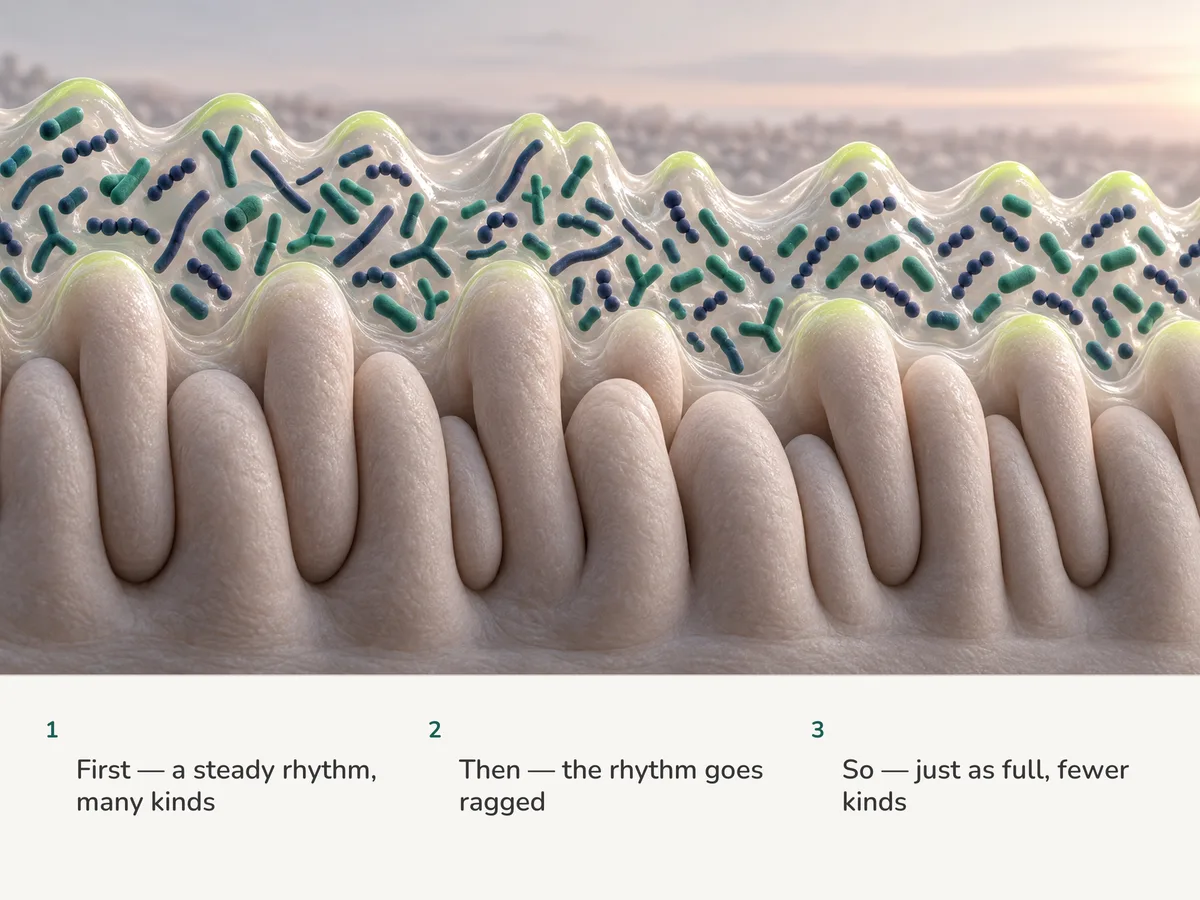
What the intervention studies do not show
This is the part usually left out. A 2026 systematic review looked for randomised trials of probiotics and synbiotics on sleep in exercised people and found six, totalling 180 participants, running 4 to 17 weeks; 9 of 12 primary sleep outcomes favoured supplementation, most consistently self-rated quality and time to fall asleep 8. Six small trials with subjective endpoints is a signal to follow, not a conclusion.
A separate review of 12 trials and 3,350 healthy working adults found a modest effect on mood and a drop in cortisol, and then stated plainly that the available evidence was not enough to conclude anything about sleep quality 9.
The closest thing to a positive result runs through the precursor rather than the bugs: 30 older adults, 12 weeks, 100 mg of 5-hydroxytryptophan a day. Participants who began as poor sleepers improved their subjective sleep score, and their gut diversity rose relative to the control group (p = 0.013) 7. Thirty people, single-blinded, one centre. Interesting; not instructions.
What to do on a Tuesday
Three habits have evidence behind them, in descending order of how good that evidence is.
Hold your rise time. Variability in sleep duration was among the measures most consistently tied to lower richness and diversity 1, and a fixed wake-up is what stabilises meal timing — the lever the clock work actually identifies 4.
Eat more fibre during the day. In 26 adults on the habitual-sleep arm of a randomised crossover study, one day of self-selected eating was regressed against that night's polysomnography: higher fibre intake predicted more slow-wave sleep (P = 0.0286), a higher share of energy from saturated fat predicted less of it (P = 0.0422), and more sugar predicted more arousals (P = 0.0320) 6. Two flags on that. The fibre finding is a within-day correlation, not the randomised comparison the study was built to make. And the study measured diet and sleep stages, not bacteria — the microbial link is inference.
Stop eating well before bed. This one follows from mechanism rather than from a sleep trial: the daily oscillation of the gut community is set by feeding rhythm 4, and a long overnight gap is the cheapest way to give it a clean edge.
What would change my mind
A randomised trial that fixes sleep irregularity in people with ragged schedules, measures the microbiome by metagenomics rather than 16S, and reports polysomnography instead of a questionnaire. Until that exists, the honest position is short. Sleep and the gut are correlated in populations — they travel together, which is not the same as one causing the other. The two experiments that actually cut people's sleep disagree about whether the gut community moves at all. And nobody has yet shown you can sleep better by rearranging your bacteria.
Key facts
- In 720 adults from the Survey of the Health of Wisconsin, greater night-to-night variability in sleep duration, more time awake after falling asleep, lower sleep efficiency and worse self-rated sleep were each associated with lower gut microbiome richness and diversity.1
- In 26 healthy young men wearing a wrist actigraph for a month, total microbiome diversity was positively correlated with sleep efficiency and negatively correlated with time awake after sleep onset.2
- One controlled human experiment — nine normal-weight men, randomised crossover, two nights with a sleep window of 02:45–07:00 against two nights of 22:30–07:00 — found a shifted Firmicutes-to-Bacteroidetes ratio but no change in beta diversity and no change in faecal short-chain fatty acids.3
- A second controlled experiment pushed sleep harder — eleven adults, five in-lab nights of four hours in bed — and found no significant change in gut microbiome richness, no consistent shift in community composition, and no change in phylum ratios.10
- In 26 adults on the habitual-sleep arm of a randomised crossover study, one day of self-selected eating was regressed against that night's polysomnography: higher fibre intake predicted more slow-wave sleep (P = 0.0286), a higher share of energy from saturated fat predicted less of it (P = 0.0422), and more sugar predicted more arousals (P = 0.0320).6
- A 12-week single-blinded randomised trial gave 30 older adults 100 mg of 5-hydroxytryptophan daily; among those who started as poor sleepers, subjective global sleep score improved and Simpson diversity rose against the control group (p = 0.013 for the diversity comparison).7
- A 2026 systematic review of probiotics and sleep in exercised people found six randomised trials totalling 180 participants, with 9 of 12 primary sleep outcomes favouring supplementation — mostly self-reported quality and time to fall asleep.8
Questions people ask
Does bad sleep damage my gut bacteria?
Nothing in the human record supports the word damage. Two nights of short sleep shifted the relative abundance of a few groups in nine men, and left overall community structure and short-chain fatty acid output alone [s3]. A harder push — five nights of four hours in bed, in eleven adults — moved nothing measurable at all [s10]. The larger associations are with long-run patterns — irregularity, low efficiency — not with one rough night [s1].
Will a probiotic help me sleep?
Possibly a little, and the evidence is thin. The best-organised review found six small trials in athletes, 180 people in total, with most sleep outcomes pointing the right way but resting on questionnaires [s8]. A larger review in working adults could not draw any conclusion about sleep at all [s9]. That is not a reason to take one; it is a reason to want a bigger trial.
Which direction is the causal one?
Both are plausible and neither is settled in people. Sleep loss changes feeding rhythms, and feeding rhythms drive the daily oscillation of the gut community — that was shown in mice and humans, with jet-lag dysbiosis transferring metabolic trouble to germ-free mice [s4]. The return route — microbes shaping sleep — has known channels but no controlled human demonstration yet [s5].
What single habit is worth changing first?
A fixed rise time. Night-to-night variability in sleep duration was one of the measures most consistently tied to lower microbial richness and diversity [s1], and a stable wake-up anchors meal timing, which is the lever the animal work points at [s4]. Fibre at your regular meals is the second [s6].
Sources
- Holzhausen E.A. et al., Sleep, 2024 — doi:10.1093/sleep/zsad300
- Smith R.P. et al., PLOS ONE, 2019 — doi:10.1371/journal.pone.0222394
- Benedict C. et al., Molecular Metabolism, 2016 — doi:10.1016/j.molmet.2016.10.003
- Thaiss C.A. et al., Cell, 2014 — doi:10.1016/j.cell.2014.09.048
- Foster J.A., Rinaman L., Cryan J.F., Neurobiology of Stress, 2017 — doi:10.1016/j.ynstr.2017.03.001
- St-Onge M.-P. et al., Journal of Clinical Sleep Medicine, 2016 — doi:10.5664/jcsm.5384
- Sutanto C.N. et al., Clinical Nutrition, 2024 — doi:10.1016/j.clnu.2024.01.010
- Salehi Asl M. et al., Journal of the International Society of Sports Nutrition, 2026 — doi:10.1080/15502783.2026.2670564
- Ben Fredj S. et al., BMC Psychology, 2026 — doi:10.1186/s40359-025-03885-5
- Zhang S.L. et al., PNAS, 2017 — doi:10.1073/pnas.1620673114