
Bad breath isn’t dirt. It’s one bacterial gene doing its job
Bad breath is a gas. Anaerobes, mouth bacteria in tongue coating and gum pockets, strip sulfur from amino acids with an enzyme the mgl gene encodes. In a 2026 Journal of Oral Microbiology study, two lactic-acid bacteria turned that gene down in a lab dish and cut tongue coating in rats, though no human was tested and no gas measured.
 Written by: Magnus Larsen · Microbiologist · Science bloggerPublished: Facts checked:
We think of bad breath as a hygiene failure — something you did not scrub hard enough. It is not. It is a chemical reaction with a name, an enzyme and a gene.
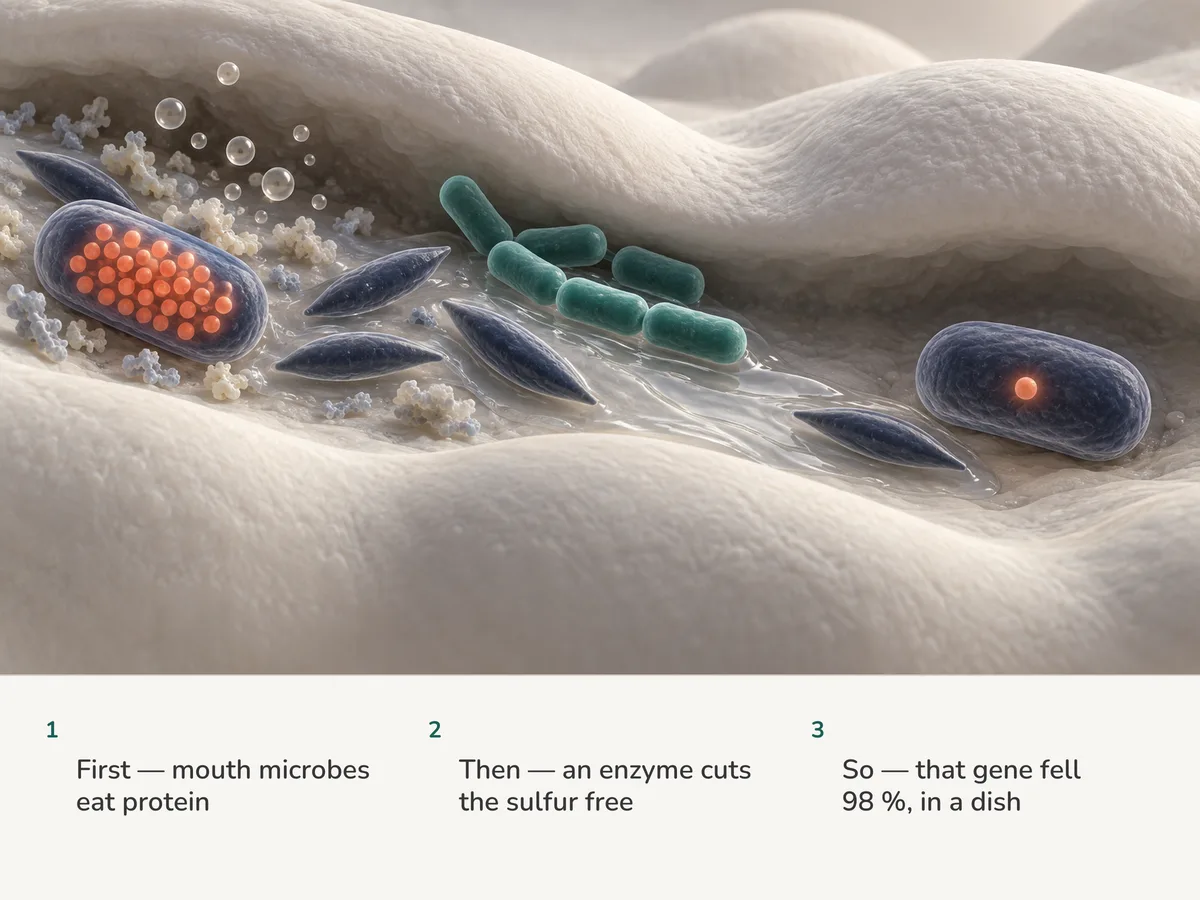
Anaerobic bacteria in the tongue coating and the pockets around your teeth cannot live on sugar the way the bacteria on your tooth surfaces do. They eat protein. And when they break down sulfur-containing amino acids such as methionine, they release that sulfur as gas: hydrogen sulfide, which smells like rotten eggs, and methyl mercaptan, which is worse. The enzyme doing the methionine step is methionine γ-lyase, written into the bacterium by a gene called mgl 1.
That gene is the reason this story exists. If bad breath is an enzyme doing its job, the target is not the smell. It is the instruction behind it.
What the study did
The study is Haque and colleagues, published in the Journal of Oral Microbiology in 2026 1. It has two halves, and they are not equally strong.
The first half was done in culture. The researchers took two lactic-acid bacteria — Lactobacillus gasseri HHuMIN D and Lacticaseibacillus paracasei OK, together called Complex OK — grew them, and used only the liquid they left behind: the culture supernatant, mixed into the pathogen's medium at 20 %. They exposed two of the mouth's best-known anaerobes to it and measured how loudly mgl was expressed 1.
In Porphyromonas gingivalis, the gasseri supernatant cut mgl expression by 60 %, the paracasei supernatant by 86 %, and a 1:1 mix of the two by 98 % 1. In Fusobacterium nucleatum, a member of the Fusobacteriota, the single strains managed only 15 % and 39 % — but the mix reached 88 % 1. Two organisms, same direction: the pair does something neither does alone.
The pair also suppressed growth. Against Streptococcus mutans, 98.2 %; against F. nucleatum, 91.2 %; against P. gingivalis, 99.1 %; against Prevotella intermedia, 96.6 % 1. And it reduced how well those bacteria stuck to oral epithelial cells — by 64.40 %, 64.04 % and 80.52 % respectively, though only 23.90 % for P. intermedia 1. That last figure is the weak one, and it belongs in the record beside the strong ones.
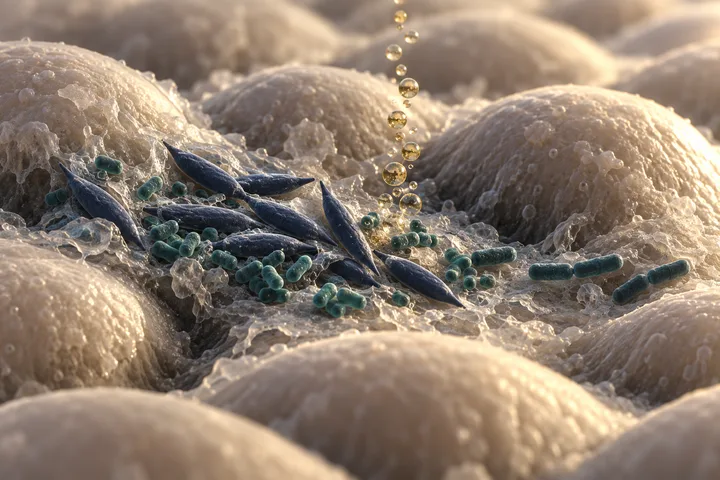
Then they gave it to rats
The second half moved into animals: 45 male Sprague-Dawley rats in five groups — a healthy control, a periodontitis control, and three dose levels of 0.2, 2 and 20 mg per head per day, corresponding to roughly 10⁷, 10⁸ and 10⁹ CFU per head per day, for five weeks 1. Periodontitis was induced by tying silk sutures bilaterally around the maxillary second molars, three weeks into dosing and left in place for the final two weeks — the standard way to force gum inflammation in a rodent.
Tongue coating was scored on a 0–12 index. Periodontitis controls came in at 10.0 ± 0.9. The medium dose dropped to 7.6 ± 1.7 and the high dose to 6.4 ± 2.6 1. Dose-ordered, and in the direction the culture work predicted.
Blood IL‑1β, an inflammatory signal that tracks gum disease, fell from 8.379 ± 5.467 pg/mL in the periodontitis controls to 0.464 ± 1.391 pg/mL — in the low-dose group 1. Not the high-dose group. When an effect does not follow the dose, that is a reason for caution, not a headline.
Now the part that gets left out
Alveolar bone loss — the actual destruction that makes periodontitis a disease rather than a smell — did not significantly improve. The periodontitis controls lost 1.897 ± 0.601 mm against 0.974 ± 0.326 mm in healthy animals, and the probiotic groups were only numerically lower, with no statistical significance (p > 0.05) 1. The authors say so themselves, blaming the short study.
And the sulfur gas was never measured. No gas chromatography. No halimeter. The entire halitosis claim rests on gene expression in a dish and a visual tongue score in rats 1. The authors list this as one of three limitations, beside no positive control such as chlorhexidine and microbiome sampling from gum tissue rather than the tongue where the odour actually forms; they say the halitosis results should be read as modulation of VSC-associated pathways, not as evidence of less sulfur gas. Elsewhere in the discussion they add that a ligature model in rats does not fully replicate human oral microbiota. The probiotic also went in by stomach tube, not onto the mouth.
One more thing. Four of the nine authors are employed by the research centre of BIFIDO Co., the Korean probiotic firm behind the HHuMIN D strain — though the paper's disclosure statement declares no conflict of interest. That does not make the data wrong. It makes independent replication the next necessary step.
What a human answer looks like
Two human trials have measured the gas. The closer one used this very pair: a 2025 randomised, double-blind, placebo-controlled study gave Complex OK to 80 Korean adults with halitosis for 12 weeks, 70 of whom finished. Hydrogen sulfide and total volatile sulfur compounds fell significantly against placebo (p < 0.05) — while oral health indices and the counts of the harmful bacteria did not move at all 3. The authors read that as a systemic rather than an antibacterial effect. The trial was also run by BIFIDO, which owns the strain, so it carries the same conflict as the rat work.
The other, from 2023, used a different organism: 100 adults with halitosis took a tablet of Weissella cibaria CMU at 1 × 10⁸ CFU daily for 8 weeks, with the gases actually measured. Total volatile sulfur compounds were significantly lower in the probiotic group at week 8 (p = 0.017) 2. And the caveat that paper states plainly: they were already lower in that group at baseline (p = 0.046), so the week‑8 difference cannot be credited to the tablet alone.
So where does this leave you? With a mechanism worth understanding and a result worth watching — not much more yet. Bad breath is bacterial chemistry, and chemistry can be turned down. The lactic-acid bacteria here appear to work by changing what the anaerobes express — which genes they switch on — rather than by killing everything within reach, which is a genuinely different strategy from a mouthwash. But every trial of this pair so far has been run by the company that owns the strain — and between a rat's tongue and your own morning breath sits the independent replication nobody has done: the same trial, run by someone who does not own the strain.
Key facts
- A 1:1 mix of the two probiotic supernatants cut mgl gene expression by 98 % in Porphyromonas gingivalis and by 88 % in Fusobacterium nucleatum in culture.1
- In co-culture the pair suppressed growth of S. mutans by 98.2 %, F. nucleatum by 91.2 %, P. gingivalis by 99.1 % and P. intermedia by 96.6 %.1
- In 45 male Sprague-Dawley rats dosed for five weeks, the tongue coating index fell from 10.0 ± 0.9 in periodontitis controls to 6.4 ± 2.6 at the highest dose, on a 0–12 scale.1
- Alveolar bone loss was not significantly improved: probiotic groups were only numerically lower than the 1.897 ± 0.601 mm of the periodontitis controls (p > 0.05).1
- Volatile sulfur compounds were never directly measured — no gas chromatography, no halimeter — so the halitosis claim rests on gene expression and tongue coating alone.1
Questions people ask
What actually causes bad breath?
Gases, not grime. Anaerobic bacteria in the tongue coating and gum pockets strip sulfur from amino acids such as methionine and release hydrogen sulfide and methyl mercaptan [s1]. The enzyme that performs the methionine step is methionine γ-lyase, encoded by the mgl gene.
Did this study show that a probiotic fixes bad breath?
No. It showed that a probiotic pair turned down the gene that makes the gas in culture, and reduced tongue coating in rats [s1]. The gas itself was never measured, and no person was tested.
Was the gum bone damage reversed?
No. The authors state plainly that probiotic-treated groups showed numerically lower bone loss but no statistically significant difference (p > 0.05) [s1]. Five weeks is a short window for bone.
Has anything like this been tested in people?
Yes — this exact pair has. A 2025 randomised, double-blind, placebo-controlled trial gave Complex OK to 80 Korean adults with halitosis for 12 weeks (70 completed) and did measure the gases: hydrogen sulfide and total volatile sulfur compounds fell significantly versus placebo (p < 0.05), while oral health indices and pathogen counts did not change [s3]. That trial was run by the strain's owner. A separate 2023 trial of a different organism, Weissella cibaria CMU at 1 × 10⁸ CFU daily for 8 weeks in 100 adults, also found lower total volatile sulfur compounds at week 8 (p = 0.017) [s2] — with the honest caveat that they were already lower at baseline (p = 0.046).
Sources
- Haque M. A. et al., Journal of Oral Microbiology, 2026 — doi:10.1080/20002297.2026.2705080
- Han H.-S., Yum H., Cho Y.-D. & Kim S., Frontiers in Microbiology, 2023 — doi:10.3389/fmicb.2023.1108762
- Choi J. H. et al., Probiotics and Antimicrobial Proteins, 2025 — doi:10.1007/s12602-025-10603-5
Related
The carcinogen your own mouth makes out of ordinary sugar
Mouth microbes from cancer patients turned sugar and alcohol into acetaldehyde — a carcinogen ranked with tobacco. Plaque hid the rest until enzymes opened it.
Bacillus coagulans: a spore passing through, not a resident
Bacillus coagulans (also Heyndrickxia coagulans — one bug, two names): what this spore-forming probiotic does for mouth and gut, and where the evidence stops.
Why the 'colon cancer bacterium' is normal in your mouth
Fusobacteriota (formerly Fusobacteria) is a normal phylum — a whole branch — of mouth bacteria. One small clade is linked to colon cancer; most of it is not.