
Three days will change your gut. Then it changes back
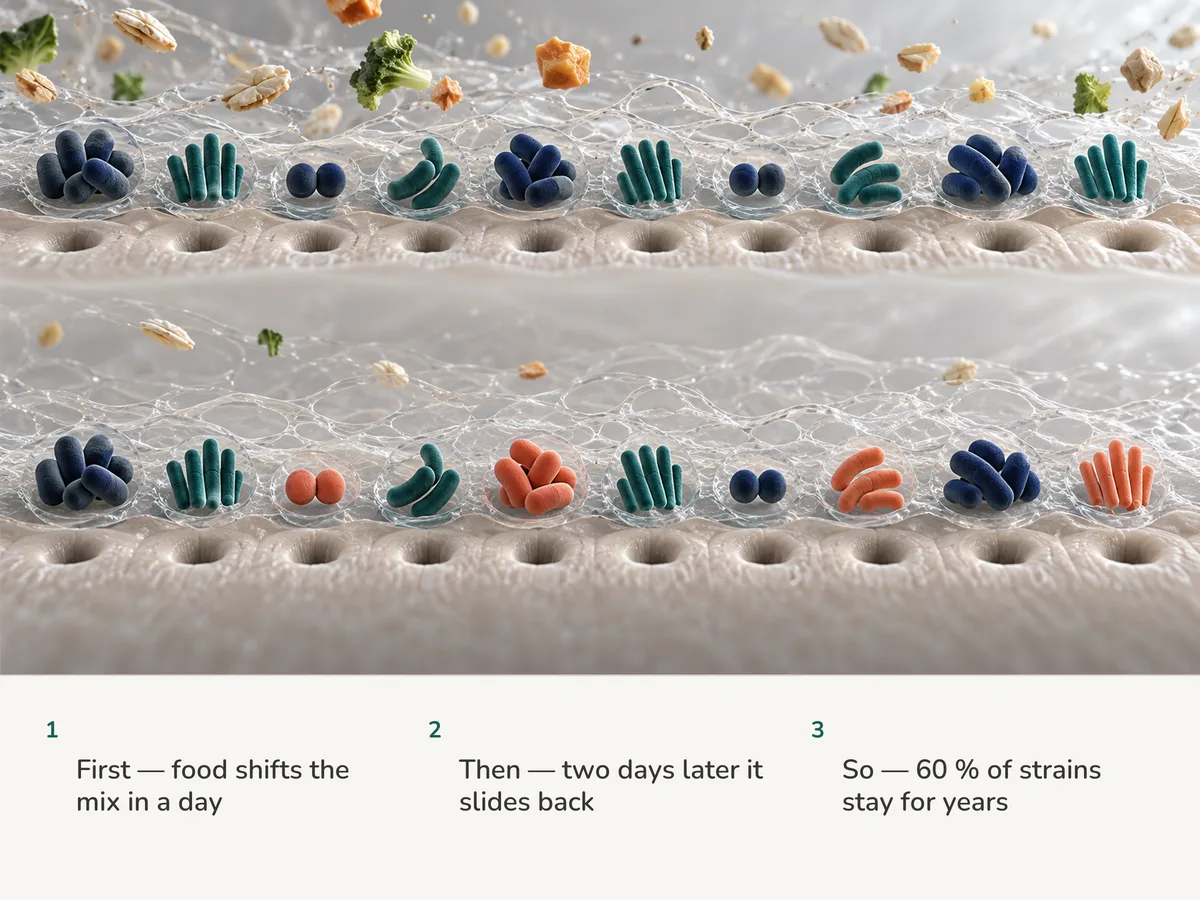
False. Food does move the gut community, and fast. Eleven volunteers ate two extreme diets in turn: the mix shifted one day after the food arrived and went back two days after the diet stopped (Nature, 2014). About 60 % of an adult’s strains are still there five years later (Science, 2013). Three days changes the reading, not the residents.
 Written by: Magnus Larsen · Microbiologist · Science bloggerPublished: Facts checked:
You have met this one in a supermarket aisle and in a podcast ad: three days of juice, or broth, or a powdered "gut protocol", and your microbiome starts over. Clean slate. New you. It is one of the rare health claims that arrives with a stopwatch attached, which makes it unusually easy to check — because the measurements exist, and they run the clock in both directions.
Verdict: false. Three days is genuinely enough to move a gut community — that part of the sales pitch is real. It is nowhere near enough to reset one, and "reset" is the word being sold.
What three days actually does
Start with the strongest evidence that the claim is not simply nonsense. In 2014, David and colleagues recruited eleven volunteers 1 — ten on each of two extreme diets, nine of them completing both arms 1 — one diet composed entirely of animal products, one entirely of plants, each eaten for five consecutive days 1. The community moved, and it moved fast: differences in composition were apparent one day after a tracing dye showed the animal-based diet had reached the gut 1. Bile-tolerant organisms including Alistipes, Bilophila and Bacteroides rose on the animal diet, while the Firmicutes that ferment plant polysaccharides — Roseburia, Eubacterium rectale, Ruminococcus bromii — fell 1.
Wu and colleagues had clocked the same speed three years earlier. In a controlled-feeding study of ten subjects 2, composition changed detectably within 24 hours 2 of a switch to high-fat, low-fibre or low-fat, high-fibre food.
So, yes. Three days of a serious dietary change will show up in a stool sample. If "reset" means "a different reading than last week", the claim is true, and trivially so.
And how fast it undoes itself
Now the other direction, from the same paper. Subjects' gut microbiota reverted to their original structure two days after the animal-based diet ended 1. Two days. The change did not outlast the diet that caused it by even half a working week.
Wu's group tested the deeper layer and found it held. Enterotype identity — the broad Bacteroides-versus-Prevotella configuration a person sits in — remained stable across the whole 10-day study 2 while day-to-day composition was shifting underneath it. Those enterotypes tracked long-term dietary patterns 2: the years of eating, not the week of it.
The part that does not move
The most direct answer to "can I start over" comes from counting strains rather than species. Faith and colleagues sequenced the stool of 37 US adults 3 across intervals reaching five years 3 and found that, on average, 60 % of the roughly 200 microbial strains in an adult's intestine were retained over that five-year window 3. Extrapolating the decay curve, they concluded that most strains in a person are residents for decades 3.
That is the number that decides this myth. Your gut is not a slate. It is a neighbourhood with a long-settled population, and three days changes what the residents are doing, not who they are.
What a real disturbance looks like
If a juice protocol cannot reset a gut, what can? Antibiotics are the strongest disturbance anyone has deliberately applied to healthy volunteers, and even they underdeliver on the word.
Palleja and colleagues gave 12 healthy men 4 a four-day course 4 of three last-resort antibiotics — meropenem, gentamicin and vancomycin — and followed them for six months 4. The community crashed, bloomed with pathobionts, then rebuilt: back to near-baseline composition within about 1.5 months 4. But nine common species present in every subject beforehand were still undetectable in most of them after 180 days 4.
Dethlefsen and Relman had watched a milder version in three people over ten months 5 spanning two courses of ciprofloxacin. Diversity dropped within three to four days of starting the drug 5. Communities began returning about a week after each course ended 5, but the return was often incomplete 5, and by the end of the study each person's gut had stabilised at a composition altered from where it started 5.
Read those two together and the picture is not a reset. It is a community that resists being pushed, springs most of the way back when pushed hard, and keeps a mark where it was pushed hardest.
Why "reset" is the wrong word
A reset implies a factory state to return to. Your microbiome has no factory state. The only baseline it holds is the one you have been assembling since birth — and if you are unhappy with your gut, that baseline is precisely the thing you were hoping to leave. Returning to it is what a three-day protocol reliably does 1.
The honest version of the claim is narrower and more useful than the one on the label. Diet changes the gut community quickly, and the community holds the change for as long as you hold the diet. That is not a disappointment; it is the mechanism. Fibre feeds fermenters, and fermenters bloom while the fibre keeps arriving. Stop, and within about two days you are back where you began 1.
What to take from it
Judge the claim by its clock. Three days is long enough to change a measurement and too short to change a population. Nothing in the literature above says a short protocol is harmful, and nothing in it says the effect survives the protocol. If someone is selling you seventy-two hours, ask what they expect to be true on hour seventy-three — and whether they have measured it.
Three days is a reading on a lab test, not a renovation. The renovation is the fourth month of eating differently, and nobody sells that in a bottle.
Key facts
- Gut community composition shifted one day after an entirely animal-based diet reached the gut, and reverted to its original structure two days after that diet ended, in eleven recruited volunteers — ten per five-day diet arm, nine completing both arms.1
- In a controlled-feeding study of ten subjects, composition changed detectably within 24 hours of a diet switch, while enterotype identity stayed stable across the whole 10-day study.2
- On average 60 % of the roughly 200 bacterial strains in an adult's intestine were retained over a five-year sampling period in 37 US adults.3
- After a four-day cocktail of meropenem, gentamicin and vancomycin, twelve healthy men were back to near-baseline composition within about 1.5 months, yet nine common species were still undetectable in most of them at 180 days.4
- Two courses of ciprofloxacin cut gut diversity within three to four days of starting the drug; communities began returning about a week after each course, but the return was often incomplete.5
Questions people ask
So a three-day cleanse does nothing at all?
It does something measurable, and something short. In the Nature 2014 crossover, five days of an extreme diet moved the community within a day of the food reaching the gut and the community reverted to its original structure two days after the diet stopped. Nothing published shows three days producing a durable rebuild.
How long does a diet change have to last to stick?
No trial has published a clean threshold, and I will not invent one. What the evidence shows is the shape of the problem: in the Science 2011 controlled feeding, day-to-day composition moved within 24 hours while enterotype identity remained stable across the whole 10-day study, and enterotypes tracked long-term eating patterns rather than the study week.
Do antibiotics reset the gut, then?
No, and they are the strongest disturbance anyone has ethically applied. In Nature Microbiology 2018, twelve men on four days of three last-resort antibiotics rebuilt to near-baseline within about 1.5 months, but nine species that everyone carried beforehand were still missing in most of them six months later. That is damage plus regrowth, not a clean slate.
Would a stool test show that my reset worked?
A sample taken during the protocol may well read differently from one taken before it. A sample taken a few days after you stop is the harder test, and the Nature 2014 reversion data suggest it would look much like your old community. Ask what your test is comparing to, and when it was taken.
Is there any situation where the gut really is rebuilt from scratch?
Not by eating. The published examples of wholesale community replacement involve faecal transplant into a disrupted gut, which is a clinical procedure with its own indications and risks, not a shelf product. It is outside what a three-day protocol is offering.
Sources
- David L.A. et al., Nature, 2014 — doi:10.1038/nature12820
- Wu G.D. et al., Science, 2011 — doi:10.1126/science.1208344
- Faith J.J. et al., Science, 2013 — doi:10.1126/science.1237439
- Palleja A. et al., Nature Microbiology, 2018 — doi:10.1038/s41564-018-0257-9
- Dethlefsen L. & Relman D.A., PNAS, 2011 — doi:10.1073/pnas.1000087107
Related

Same capsule, opposite result: what makes a probiotic work
120 overweight adults, 12 weeks: heat-killed L. plantarum did nothing on average. Only the least varied guts lost weight. Why that is a lead, not proof.

IBS pain is not in your head: enzymes poke the gut's nerves
Stool fluid from IBS patients made gut nerve networks fire far harder than fluid from healthy people, a 2026 Gut study found. What it shows — and does not.
Actinomycetota: the phylum that guards infants and causes TB
Actinomycetota, formerly Actinobacteria: the phylum of Bifidobacterium and of tuberculosis. Where it lives in your body, what it does for and against you.