Bifidobacterium is not automatically a good bacterium
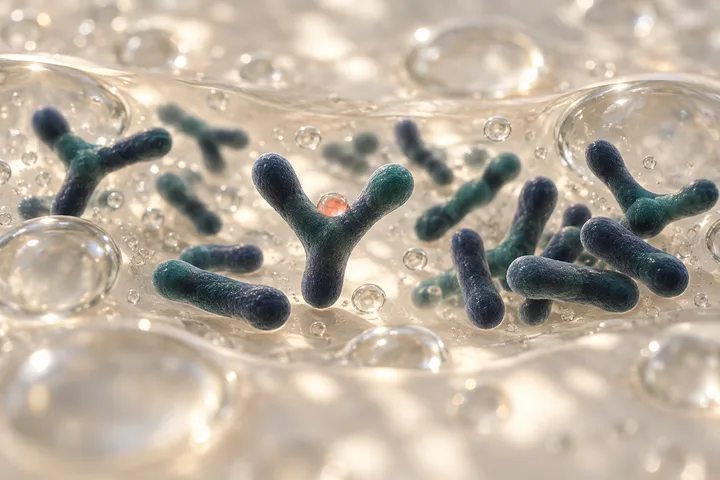
Bifidobacterium is a genus of bifurcated (fork-shaped), anaerobic (air-avoiding) bacteria dominating a breastfed baby's gut by feeding on human-milk sugars. Most species are harmless, fermenting those sugars into acetate and lactate, two mild acids; a few are not: B. dentium is an opportunistic cariogen isolated from dental caries, and probiotic strains have occasionally reached the bloodstream of very preterm infants.
 Written by: Magnus Larsen · Microbiologist · Science bloggerPublished: Facts checked:
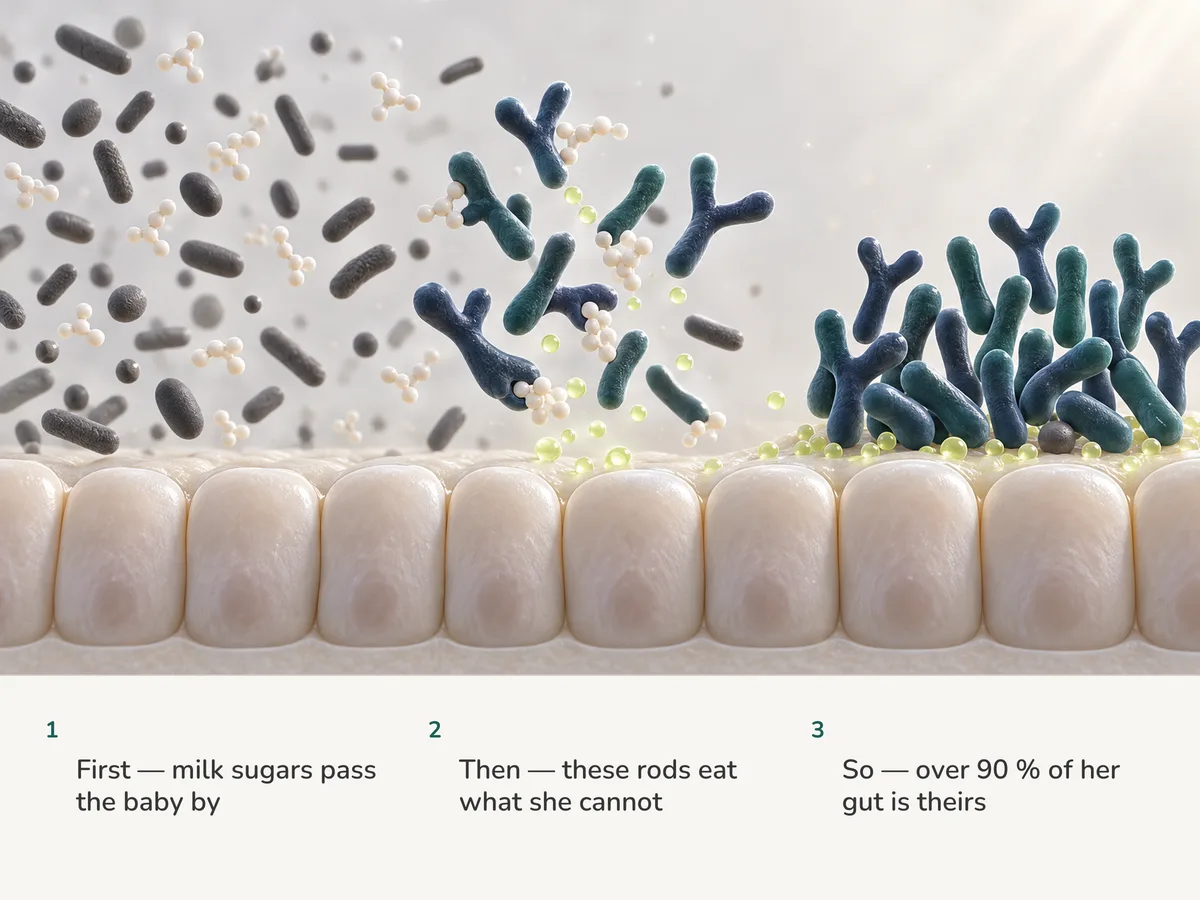
Ask someone to name a bacterium and you will hear E. coli, or Salmonella, or something they once read on a chicken label. Almost nobody names the one that arrives first. Within days of birth, in a baby who is breastfed, a genus called Bifidobacterium takes over the large intestine so thoroughly that it can account for more than 90 % of the bacteria living there 1.
That is worth pausing on. One genus, one organ, one window of life — and a share of the population that no other gut microbe reaches. So let us take it apart the way we would take apart a drug: what it is, where it is, what the evidence says it does for us, and — the part that tends to fall out of the marketing — what it does against us.
What it actually is
Bifidobacterium is a genus of high-G+C Gram-positive, anaerobic bacteria with a bifurcated — "bifid" — cell shape, that ferment sugars through the bifid shunt into acetate and lactate (roughly 1.5 mol acetate and 1 mol lactate per mol of glucose) and live chiefly in the intestinal microbiota of mammals and other animals, with the B. asteroides group typical of insects and the B. pullorum group of birds 12.
Two words in that sentence do most of the work. Anaerobic: air is a problem for these organisms, which is why they thrive in the depths of the colon and why keeping them alive outside the body is a manufacturing problem rather than a slogan. Bifid: the name comes from bifidus, forked — it was the bifurcated shape of the cells Tissier found in the stools of breastfed babies in 1900 that gave them the name Bacillus bifidus 1.
Where it lives in the body
The large intestine is the main address. It is not the only one. Bifidobacteria are found across a range of niches directly or indirectly connected to the animal gut — the human colon, the human oral cavity, the insect gut, even sewage 2. The oral finding is not trivia; we will come back to it, because that is where the genus stops being uniformly friendly.
What it does for us
Three mechanisms, each with a study attached.
It eats what we cannot. Human milk oligosaccharides are the third most abundant solid component of breast milk, and the human newborn cannot assimilate them as nutrients at all 3. They are not baby food. They are microbe food, and the mother makes them anyway. Bifidobacteria — Bifidobacterium longum subsp. infantis above all — carry the enzymes to dismantle those sugars, which is why breast milk builds an environment in which this genus flourishes while its competitors are outcompeted 4. Evolution did not put an indigestible sugar in milk by accident.
It makes acetate, and acetate defends the gut wall. This is the cleanest mechanistic result in the field. Working with gnotobiotic mice and a lethal infection model of enterohaemorrhagic E. coli O157:H7, Fukuda and colleagues showed that certain bifidobacterial strains protected the animals from death, that the protection tracked with increased acetate production, and that translocation of Shiga toxin from the gut lumen into the blood was inhibited 5. Note the caveat out loud: mice, one pathogen, specific strains. It shows a mechanism can work. It does not show your yoghurt does it.
It talks to the immune system through its metabolites. Fed on human milk oligosaccharides rather than plain lactose, B. infantis makes markedly more indole‑3-lactic acid, a tryptophan metabolite; at 1–10 mM that compound damped LPS-driven NF-κB activation in a macrophage cell line and cut the TNF-α- and LPS-induced rise in interleukin‑8 in intestinal epithelial cell lines 6. Again — cell culture, not people. But it names a molecule, which is more than most claims about "supporting immunity" manage.
What it does against us
Here is where an honest encyclopedia entry parts company with a label.
One species is a cariogen. Bifidobacterium dentium was isolated from dental caries, and sequencing its Bd1 genome — a single circular chromosome of 2,636,368 base pairs with 2,143 predicted open reading frames — revealed adaptations for exactly that life: acid tolerance, tissue adhesion, and metabolism of compounds from human saliva 9. The authors' own phrase for what their data show is worth quoting in spirit: the boundary between a commensal and an opportunist is narrow.
Probiotic strains can enter the bloodstream. Three very-low-birth-weight preterm infants on a probiotic containing viable B. longum developed bacteraemia with that organism, and biochemical, mass-spectrometric and molecular analysis showed the blood isolates and the capsule strain to be the same 11. This is not a hypothetical risk; the strain was traced. How often? In one neonatal intensive care unit using multi-strain probiotics for more than a decade, 12 cases of bacteraemia with a product organism occurred among 2,109 exposed infants — 0.6 % — and no death was attributed to any of them 10. Small, real, and confined to a fragile population.
The benefit is far less general than the marketing. The PiPS trial randomised 1,315 very preterm infants to B. breve BBG‑001 or placebo 7. Necrotising enterocolitis occurred in 9 % of the probiotic group and 10 % of the placebo group (adjusted risk ratio 0.93), with no significant difference in sepsis or death either 7. And when 51 randomised trials covering 11,231 preterm infants were analysed strain by strain rather than lumped together, only 3 of 25 studied probiotic treatments significantly reduced mortality 8. Pooling every strain into one forest plot flatters the genus. Taking it apart does not.
The name, old and new
The genus is Bifidobacterium Orla-Jensen 1924; its type species, Bifidobacterium bifidum, was first described by Tissier in 1900 and transferred into the new genus by Orla-Jensen 14. The genus name itself has been stable ever since.
What changed is the address above it. The phylum published for decades as Actinobacteria was validly published under the name Actinomycetota in 2021, when 42 prokaryotic phyla were formally named at once 13 — and Actinomycetota is the lineage NCBI Taxonomy now shows for Bifidobacterium. Inside the genus, taxonomy has also moved: whole-genome phylogenomic methods have been used to reassess bifidobacterial classification and to identify apparent misclassifications made with older single-marker techniques 12. If an older text calls this an Actinobacteria organism, it is not wrong about the biology — only about the current name.
What to take away
Bifidobacterium is the clearest case in the human microbiome of co-evolution you can point at — two species shaping each other over time: a mother makes a sugar she cannot use, for a microbe her baby has not met yet. That much is solid. What is not solid is the leap from this genus matters to this product works — because benefit in the trials belongs to particular strains, in particular people, at particular doses. A genus is the family; a strain is one named member of it, and the member that helps one group is not the member that was tested in another. When a label names a genus and not a strain, it is telling you about biology it borrowed, not about a result it earned.
Key facts
- In breastfed infants, bifidobacteria can reach more than 90 % of the total bacterial population of the gut.1
- Human milk oligosaccharides are the third most abundant solid component of breast milk, and the newborn cannot digest them — bifidobacteria can.3
- In gnotobiotic mice, certain bifidobacterial strains protected against death from E. coli O157:H7; the effect was attributed at least in part to increased acetate, and translocation of Shiga toxin from the gut lumen to the blood was inhibited.5
- The PiPS trial randomised 1,315 very preterm infants and found no reduction in necrotising enterocolitis, sepsis or death from Bifidobacterium breve BBG‑001.7
- Bifidobacterium dentium is an opportunistic cariogenic species; its Bd1 genome carries adaptations for surviving in the acid environment of the mouth.9
- Among 2,109 preterm infants given probiotics in one NICU, 12 (0.6 %) developed bacteraemia with an organism from the product; no death was attributed to it.10
- The genus was named Bifidobacterium by Orla-Jensen in 1924; its type species was first described by Tissier in 1900.14
Questions people ask
Is Bifidobacterium a good bacterium or a bad one?
Neither label survives contact with the genus. Most species are quiet residents of the colon and some produce acetate that protects the gut wall in animal models. But Bifidobacterium dentium is an opportunistic cariogen isolated from dental caries, and probiotic strains have been cultured from the blood of very preterm infants. Genus is the wrong unit for a verdict — species and strain are the right ones.
Why do breastfed babies have so much of it?
Human milk carries oligosaccharides that the baby cannot digest at all. They are not food for the infant; they are food for the microbe. Bifidobacteria, and Bifidobacterium longum subsp. infantis in particular, carry the enzymes to break them down, so breast milk effectively feeds one genus and starves its competitors.
Does taking a Bifidobacterium supplement rebuild my gut?
That claim runs ahead of the data. A large phase 3 trial in very preterm infants, PiPS, randomised 1,315 babies to a Bifidobacterium breve strain or to placebo and found no benefit on any of its three primary outcomes. A strain-specific network meta-analysis of 51 trials found that only 3 of 25 treatment combinations reduced mortality. Effects belong to particular strains in particular populations, not to the genus.
Is it dangerous?
Rarely, and mostly in one population. Bifidobacterium bacteraemia has been reported in very-low-birth-weight preterm infants receiving probiotics, with the blood isolate matching the product strain. In one centre 12 of 2,109 exposed infants (0.6 %) were affected and no death was attributed to it. That is a small risk in a fragile group, not a general warning for healthy adults.
Has its scientific name changed?
The genus name has not. The phylum around it has: what was published for decades as Actinobacteria was validly published in 2021 under the name Actinomycetota, which is the lineage NCBI shows for Bifidobacterium today. Within the genus, whole-genome methods have also identified apparent misclassifications made with older single-marker techniques.
Sources
- Hidalgo-Cantabrana C. et al., Microbiology Spectrum, 2017 — doi:10.1128/microbiolspec.BAD-0010-2016
- O'Callaghan A., van Sinderen D., Frontiers in Microbiology, 2016 — doi:10.3389/fmicb.2016.00925
- Sánchez C. et al., Foods, 2021 — doi:10.3390/foods10061429
- Bakshani C. R., Crouch L. I., Trends in Microbiology, 2024 — doi:10.1016/j.tim.2023.11.015
- Fukuda S. et al., Nature, 2011 — doi:10.1038/nature09646
- Ehrlich A. M. et al., BMC Microbiology, 2020 — doi:10.1186/s12866-020-02023-y
- Costeloe K. et al. (PiPS trial), The Lancet, 2016 — doi:10.1016/S0140-6736(15)01027-2
- van den Akker C. H. P. et al., Journal of Pediatric Gastroenterology and Nutrition, 2018 — doi:10.1097/MPG.0000000000001897
- Ventura M. et al., PLoS Genetics, 2009 — doi:10.1371/journal.pgen.1000785
- Abda A. et al., The Journal of Pediatrics, 2025 — doi:10.1016/j.jpeds.2025.114521
- Zbinden A. et al., Neonatology, 2015 — doi:10.1159/000367985
- Lugli G. A. et al., Applied and Environmental Microbiology, 2018 — doi:10.1128/AEM.02249-17
- Oren A., Garrity G. M., International Journal of Systematic and Evolutionary Microbiology, 2021 — doi:10.1099/ijsem.0.005056
- Parte A. C. et al. (LPSN), International Journal of Systematic and Evolutionary Microbiology, 2020 — doi:10.1099/ijsem.0.004332
Related

Same capsule, opposite result: what makes a probiotic work
120 overweight adults, 12 weeks: heat-killed L. plantarum did nothing on average. Only the least varied guts lost weight. Why that is a lead, not proof.

IBS pain is not in your head: enzymes poke the gut's nerves
Stool fluid from IBS patients made gut nerve networks fire far harder than fluid from healthy people, a 2026 Gut study found. What it shows — and does not.
Actinomycetota: the phylum that guards infants and causes TB
Actinomycetota, formerly Actinobacteria: the phylum of Bifidobacterium and of tuberculosis. Where it lives in your body, what it does for and against you.