
Fermented foods: the microbes you eat aren't the point
Kefir, yoghurt, kimchi and sauerkraut carry live lactic acid bacteria, up to a hundred billion cells a serving. In a 17-week Stanford trial (Cell, 2021), six servings a day raised gut microbial diversity and lowered 19 inflammatory blood proteins. The bacteria you swallow mostly do not settle; your resident community shifts instead. Pasteurised jars contain none.
 Written by: Magnus Larsen · Microbiologist · Science bloggerPublished: Facts checked:
Open a jar of live sauerkraut and you are opening an ecosystem. But what is in the jar and what happens inside you are two different questions, and only one of them has a randomised trial behind it.
What is actually alive in the jar
A fermented food is one made through desired microbial growth and enzymatic conversions of food components — the wording an expert panel convened by the International Scientific Association for Probiotics and Prebiotics settled on 2. Notice what it does not say: nothing about the microbes still being alive when the food reaches your mouth. Some are. Many are not.
When they are, the numbers are large and inconsistent. A review of published counts in retail fermented foods by Rezac and colleagues at the University of Nebraska found yoghurt cultures from under 10⁴ to 10⁹ CFU per gram or mL 3; commercial kimchi at 7.14–9.23 log CFU/g of lactic acid bacteria 3; sauerkraut anywhere from 3.79 to 8.3 log CFU/g depending on the study, the top figure from a US product made with a starter culture 3; kefir made in Korea from commercial grains at 9.62 log CFU/g of lactic acid bacteria alongside 7.67 log CFU/g of yeast 3. At the top end, ISAPP puts up to 10¹¹ lactic acid bacteria in one serving of a live yoghurt or kefir 2.
The four are not versions of one thing. Yoghurt is the narrowest: two organisms by definition, Lactobacillus delbrueckii subsp. bulgaricus — a Lactobacillus — and Streptococcus thermophilus — the combination the Codex Alimentarius requires 25. Kefir is the widest: the Codex standard describes a fermented milk carrying Lentilactobacillus kefiri with Leuconostoc, Lactococcus and Acetobacter species, plus lactose-fermenting and non-lactose-fermenting yeasts 2. Kimchi and sauerkraut are usually wild ferments — what grows is whatever was on the cabbage — though some commercial sauerkraut is made with a starter culture, and it is the sample that counted highest 3.
The trial that put a number on it
Wastyk, Fragiadakis and colleagues at Stanford ran a randomised study over a 17-week protocol — a 10-week diet intervention with three weeks of baseline before it and four weeks of follow-up after 1: 36 generally healthy adults, 18 per arm 1, on either a high-fibre or a high-fermented-food diet. A serving was defined as 6 oz of kombucha, yoghurt or kefir, a quarter-cup of kimchi or sauerkraut, 2 oz of vegetable brine drink 1. A four-week ramp led to a target of six servings a day 1, and the fermented-food arm averaged 6.3 ± 2.9 servings a day at the end of maintenance 1.
Two things happened. Gut microbial alpha diversity rose on three measures — observed ASVs, PD whole tree and Shannon 1 — and stayed up through the four-week choice period afterwards 1. And 19 of 93 measured inflammatory serum proteins fell, IL‑6, IL‑10 and IL‑12b among them 1.
The high-fibre arm did neither: diversity did not move cohort-wide 1, and none of the 19 cytokines that fell in the fermented arm changed in the fibre arm 1. And the caveat, out loud, because the paper says it: the study's primary outcome, a cytokine response score, was not significant for either arm 1. The headline result here is a secondary one.
Why diversity rose, when the microbes did not stay
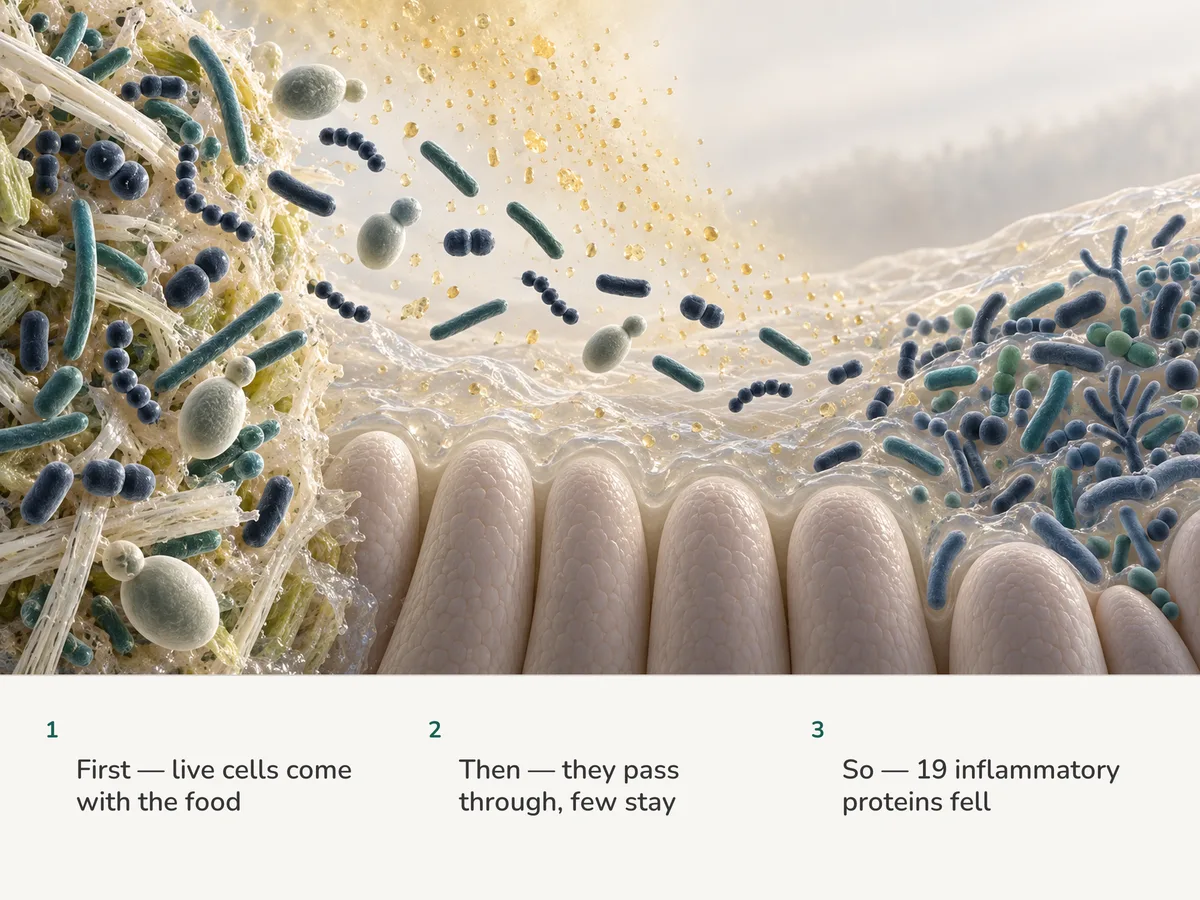
This is the finding that should change how you think about the jar. The Stanford team sequenced the foods as well as the stool, asking whether the new organisms in people's guts were ones they had eaten. Mostly they were not: overlap between new gut ASVs and fermented-food ASVs peaked at 5.4% early in the intervention and, later, was no different in the fermented arm than in the fibre arm 1. The authors conclude the diversity increase was not primarily due to consumed microbes, but to shifts in, or new acquisitions to, the resident community 1.
Mechanistically that is the more interesting story. A fermented food is not only cells; it is everything the cells made while the jar sat there — organic acids, peptides, broken-down sugars — arriving daily in a gut whose residents respond to that chemistry. Which of those does the work, nobody has isolated. What the trial rules out is the picture the marketing runs on: swallow bacteria, bacteria move in, diversity goes up.
What pasteurisation takes out
The live half, entirely. The ISAPP panel is explicit that heat-treated or pasteurised fermented vegetables, fermented sausage, soy sauce, vinegar and some kombuchas contain no living microorganisms by the time they are eaten 2. Leavened bread is baked after fermentation, which kills the organisms outright; wine and most beers go through steps that remove the live microorganisms; coffee and chocolate beans are roasted 2.
So shelf-stable sauerkraut and the refrigerated jar are not the same food for this purpose. Both were fermented; only one is alive. What fermentation built into the flavour survives the heat; the ecology does not.
The one benefit that really is the swallowed cells
One exception runs the other way. People who cannot digest lactose tolerate it in yoghurt, and the reason is the swallowed bacteria: their lactase is protected inside the cells, survives the stomach, and works in the small intestine as the pH rises and transit slows 5. Commercial yoghurts do this about equally well because they all carry roughly 10⁸ bacteria per mL 5. Europe's approved health claim for lactose digestion is written around live yoghurt cultures 2; heat the yoghurt and the cells go, and the lactase sheltered inside them goes too.
What a week looks like
Six servings a day is what was tested 1, and it is a lot. It is also the only amount with a controlled trial behind it, so treat it as the tested dose, not the minimum useful one — the trial had no smaller-dose arm 1.
A week that reaches it: a 6 oz pot of live yoghurt or kefir at breakfast 1, a quarter-cup of kimchi or sauerkraut with lunch and with dinner 1, and something fermented beside two other meals. Rotate rather than repeat: the four carry different organisms in different numbers 23, and the trial fed a mixture, not a product.
The observational picture is more modest. Taylor and colleagues compared stool from 6,811 people in the American Gut Project 4 and found differences between consumers and non-consumers that were statistically significant but, in their own word, subtle 4, with an enrichment of conjugated linoleic acid among consumers 4. Real. Small. Not proof of cause.
What this does not tell you
It does not tell you fermented food treats anything: 36 healthy adults over a 17-week protocol 1 is a mechanism study with a missed primary endpoint 1. It does not tell you a capsule reproduces the effect; nobody knows which part of the food is responsible. And it does not tell you your jar holds what the study's jars held — the counts swing by orders of magnitude between brands and shelf lives 3.
What it does tell you is short enough to carry to the shop. Buy it cold, buy it live, eat it most days, vary what you eat. A dull instruction resting on an interesting finding: the bacteria you swallow matter less than what they leave behind.
Key facts
- Retail yoghurt cultures range from under 10⁴ to 10⁹ CFU per gram or mL; commercial kimchi carries 7.14–9.23 log CFU/g of lactic acid bacteria, while reported sauerkraut counts run from 3.79 to 8.3 log CFU/g across studies.3
- An expert panel convened by ISAPP puts the ceiling at up to 10¹¹ lactic acid bacteria in a single serving of a live yoghurt or kefir.2
- In a 17-week randomised Stanford study, 18 adults eating a target of six servings of fermented food a day gained gut microbial diversity and dropped 19 of 93 measured inflammatory serum proteins, including IL‑6, IL‑10 and IL‑12b.1
- The diversity gain was not primarily due to the microbes in the food: overlap between new gut ASVs and fermented-food ASVs peaked at 5.4% early on, and at later time points was no different from the high-fibre arm.1
- Heat-treated or pasteurised fermented vegetables, fermented sausage, soy sauce, vinegar, some kombuchas, baked bread, wine and most beers reach the eater with no living microorganisms.2
- Commercial yoghurts carry roughly 10⁸ bacteria per mL, and that bacterial lactase survives the stomach and works in the small intestine, which is why lactose-intolerant people tolerate yoghurt.5
Questions people ask
Do I really need six servings a day?
That is what was tested, not a proven minimum. The Stanford arm ramped up over four weeks and averaged 6.3 servings a day, and that is the dose with a controlled human result behind it. The trial had no smaller-dose arm, so a smaller amount is untested there rather than shown to fail.
Is pasteurised sauerkraut pointless?
Not pointless, but it is a different food for this purpose. Heat removes the live organisms entirely, and the live organisms are what the trial was feeding people. The acids and aromas fermentation created survive the jar; the ecology does not. If you are buying for the microbes, buy from the chiller and check the label says live or unpasteurised.
Is a fermented food the same as a probiotic?
No, and the ISAPP panel says so plainly: probiotic applies only to well-defined, characterised live microorganisms with a demonstrated health benefit, so the two terms cannot be used interchangeably. Most fermented foods have never had their communities characterised to that standard.
Does kombucha count?
Only if it is live. Kombucha was one of the foods in the Stanford diet, but the same expert panel lists some kombuchas among the heat-treated products that reach the eater with no living microorganisms. The bottle has to tell you, and many do not.
Will this fix my gut?
Nothing here supports that claim. Thirty-six healthy adults over a 17-week protocol is a mechanism study; its primary outcome, a cytokine response score, was not significant for either arm; and the large survey across 6,811 people found differences its own authors call subtle. This is a reasonable habit with early evidence, not a treatment.
Sources
- Wastyk H. C. et al., Cell, 2021 — doi:10.1016/j.cell.2021.06.019
- Marco M. L. et al., Nature Reviews Gastroenterology & Hepatology, 2021 (ISAPP consensus statement) — doi:10.1038/s41575-020-00390-5
- Rezac S. et al., Frontiers in Microbiology, 2018 — doi:10.3389/fmicb.2018.01785
- Taylor B. C. et al., mSystems, 2020 — doi:10.1128/mSystems.00901-19
- Savaiano D. A., The American Journal of Clinical Nutrition, 2014 — doi:10.3945/ajcn.113.073023
Related

Same capsule, opposite result: what makes a probiotic work
120 overweight adults, 12 weeks: heat-killed L. plantarum did nothing on average. Only the least varied guts lost weight. Why that is a lead, not proof.

IBS pain is not in your head: enzymes poke the gut's nerves
Stool fluid from IBS patients made gut nerve networks fire far harder than fluid from healthy people, a 2026 Gut study found. What it shows — and does not.

Actinomycetota: the phylum that guards infants and causes TB
Actinomycetota, formerly Actinobacteria: the phylum of Bifidobacterium and of tuberculosis. Where it lives in your body, what it does for and against you.