
Not all fibre feeds your bacteria, and more isn't better
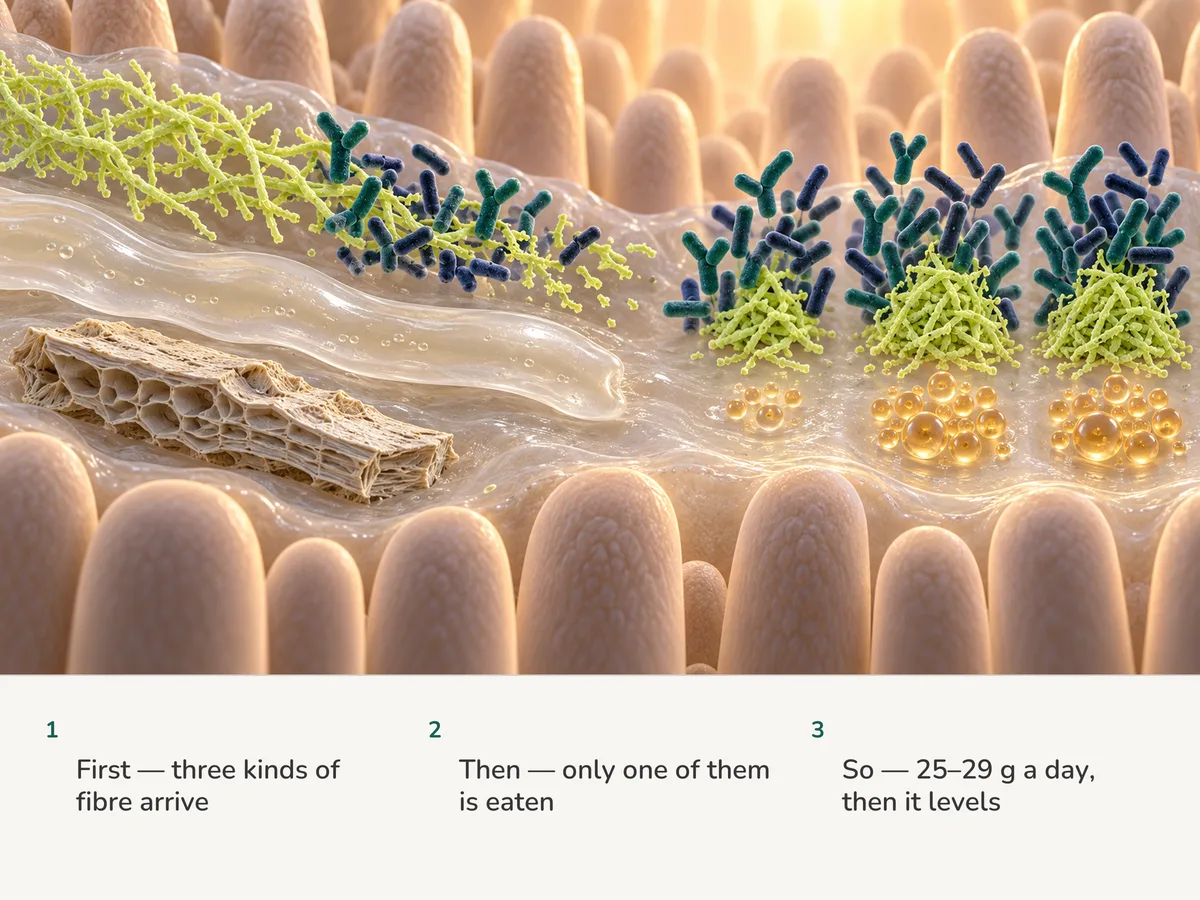
Fermentable fibre — fructans, galacto-oligosaccharides, resistant starch — is what your colon bacteria eat; you cannot digest it yourself. Viscous and coarse fibres do other jobs. Pooled data from studies tracking people for years put the greatest risk reduction between 25 g and 29 g a day, and fermentation effects plateau. Add it over weeks.
 Written by: Magnus Larsen · Microbiologist · Science bloggerPublished: Facts checked:
Ask someone how much fibre they eat and you get a shrug. Ask which kind and you get a blank. That is not carelessness. "Fibre" is one word stretched over plant carbohydrates that behave nothing alike once they reach your colon, and only some of them are food for anything living down there. So the mechanism first, and the shopping list second.
Fermentable fibre is a meal for your bacteria. The rest is plumbing
Your own enzymes give up on these molecules in the small intestine. What happens next depends on whether the bacteria in your colon carry the enzymes to break them down. When they do, they ferment the fibre and release short-chain fatty acids — and which acid comes out is not random: in a controlled trial, different resistant starch structures pushed output toward either propionate or butyrate, consistently within each treatment group 3.
Pooling 64 randomised trials in 2099 healthy adults, fibre intervention raised faecal Bifidobacterium with a standardised mean difference of 0.64 (95 % CI 0.42–0.86) 2, raised Lactobacillus by 0.22 2 and butyrate by 0.24 2 — with fructans and galacto-oligosaccharides doing most of the work 2. Note what did not move: alpha diversity, the number people usually mean when they say "diversity", was unchanged 2.
There is a reason to care beyond bacterial headcount. In gnotobiotic mice given a defined human gut community, taking fibre away made those bacteria switch to eating the host's own mucus glycoproteins, thinning the colonic mucus barrier and letting a mucosal pathogen kill animals that survived on a fibre-fed diet 8. That is mice, and I will come back to that. But it explains why "fermentable" is the adjective that matters: the community eats what you give it, or it eats the lining.

Fibre is not one category, it is several jobs
The most useful distinction is not soluble versus insoluble — that split has misled people for decades. It is viscosity. Gel-forming fibres such as beta-glucan, psyllium and raw guar gum lower cholesterol and improve glycaemic control; non-viscous soluble fibres such as inulin, fructo-oligosaccharides and wheat dextrin, and insoluble fibres such as wheat bran, do not deliver those particular benefits 4.
Laxation runs on a separate mechanism again, and it has a hard requirement: the fibre must survive the colon intact. Coarse insoluble particles irritate the mucosa into secreting water; gel-forming soluble fibre holds water against dehydration. Fermentable fibres do neither, because fermentation consumes them — and some fibres are actually constipating 4.
Read those two paragraphs together and you get the practical crux of this whole piece: the fibre that best feeds your bacteria is usually not the fibre that fixes your stool. They are different products doing different jobs, and a single daily gram target hides that completely.
The amounts trials actually measured: 25 g to 29 g a day
The best-anchored number comes from a series of systematic reviews covering 185 prospective studies and 58 clinical trials with 4635 participants 1. Comparing highest with lowest fibre consumers, observational data showed a 15–30 % lower rate of all-cause and cardiovascular mortality, coronary heart disease, stroke, type 2 diabetes and colorectal cancer 1, and risk reduction was greatest when daily intake fell between 25 g and 29 g 1. The same review's dose-response curves suggested higher intakes could confer even greater protection against cardiovascular disease, type 2 diabetes and colorectal and breast cancer 1 — so 25–29 g is where the measured benefit is densest, not a demonstrated ceiling for hard outcomes. Certainty of evidence for fibre: moderate 1.
Now the ceiling. With type-IV resistant starch, microbiome and short-chain fatty acid effects were dose-dependent but plateaued at 35 g a day 3. In a soluble corn fibre trial, the biggest rise in bifidobacteria came at 6 g of fibre a day, not at 12 g or 18 g 6 — with only 8 people per group over 14 days 6, so treat that one as a hint rather than a rule. And in a 17-week Stanford trial, 18 people per arm 7 were moved from a baseline of 21.5 g a day to 45.1 g a day 7. Doubling the intake did not double the results.
How to add it without the bloating that makes people quit
Here is the number that explains every abandoned fibre plan. In 29 healthy adults, agave inulin at 5.0 g and 7.5 g a day raised a composite gastrointestinal intolerance score from 0.4 on control to 1.9 and 2.3 on a 0–12 scale 5. Bloating, flatulence and rumbling were all more frequent on both doses than on control, and the composite score was higher on the larger one; diarrhoea did not increase 5. Breath hydrogen was raised 5–8 hours after the dose 5.
Three things fall out of that, and they are what to do on a Tuesday.
Ramp, don't jump. The trial that got people to 45.1 g used a 4-week ramp before its 6-week maintenance phase 7. Weeks, not a weekend.
Split the dose. The intolerance score tracked the daily amount 5 — that trial varied the daily total, not the size of a single serving, so spreading the same total across three meals is a sensible extrapolation rather than a measured result.
Expect the gas in the evening. Breath hydrogen was still raised 5–8 hours after the dose 5. Bloating after dinner from what you ate at lunch is fermentation working, not food intolerance — and it is the part that settles as the community adapts.
Then choose by job, not by label. Want the metabolic effects? A viscous gel-former 4. Want softer stools? A fibre that resists fermentation 4. Want to feed the microbes? Fructans and galacto-oligosaccharides had the strongest signal 2 — onion, leek, garlic and legumes. Cooled potatoes and rice feed the community too, but as resistant starch, the separate class the dose-response trial tested 3.
Where the evidence stops
I would rather say this out loud than let it sit in the footnotes. The mortality figures are observational 1, so they show association at population scale, not what happens to you. The mucus-barrier work is mice with a synthetic community 8. The pooled microbiota trials moved specific genera but not diversity 2. And the trial designed to test whether high fibre improves immune status did not find it: over 17 weeks, its primary cytokine response score was not significant, and the high-fibre participants split into three distinct immune trajectories that tracked their baseline microbiota diversity 7.
That last finding is the honest shape of the field. Fibre has strong, long-standing evidence for hard outcomes at population scale, a clear mechanism in the colon, and a genuinely uncertain answer to "what will it do for me, specifically, this month." Aim at 25 g to 29 g a day, pick the type of fibre that matches the job you want done, and give your bacteria weeks rather than days to catch up.
Key facts
- Pooling 185 prospective studies and 58 clinical trials, risk reduction across critical outcomes was greatest when daily dietary fibre intake was between 25 g and 29 g; the certainty of that evidence was graded moderate.1
- In 64 randomised trials with 2099 healthy adults, fibre intervention raised faecal Bifidobacterium (SMD 0.64) and Lactobacillus (SMD 0.22) and butyrate (SMD 0.24), but did not change alpha diversity; fructans and galacto-oligosaccharides drove the effect.2
- Viscosity, not solubility, predicts the small-bowel benefits: gel-forming fibres such as beta-glucan, psyllium and raw guar gum lower cholesterol and improve glycaemic control, while non-viscous soluble fibres such as inulin, fructo-oligosaccharides and wheat dextrin do not.4
- With type-IV resistant starch, microbiome and short-chain fatty acid effects were dose-dependent but plateaued at 35 g a day, and different starch structures shifted output toward either propionate or butyrate.3
- In 29 healthy adults, agave inulin at 5.0 g and 7.5 g a day raised a composite gastrointestinal intolerance score from 0.4 on control to 1.9 and 2.3 on a 0–12 scale, with breath hydrogen rising 5–8 hours after the dose and no increase in diarrhoea.5
- A 17-week trial moved 18 people from 21.5 g of fibre a day to 45.1 g using a 4-week ramp before a 6-week maintenance phase; its primary immune outcome was not significant and cohort-wide diversity did not change.7
Questions people ask
How much fibre should I actually aim for?
The best-anchored number is the range where measured risk reduction was greatest: 25 g to 29 g a day [s1]. That came from pooling 185 prospective studies and 58 trials, and the mortality part of it is observational, graded moderate certainty [s1]. It is a direction to move in, not a prescription for you.
Is a fibre supplement the same as fibre from food?
Not interchangeably. Supplements are single structures, and structure decides the outcome: gel-forming psyllium or beta-glucan do the cholesterol and glycaemic work, non-viscous inulin and wheat dextrin do not, and only fibre that survives fermentation loosens stool [s4]. Pick the fibre for the job you want, or eat plants and get several at once.
Why does adding fibre make me bloated?
Because gas is the fermentation you asked for. In healthy adults, breath hydrogen was raised 5–8 hours after an inulin dose, and bloating, flatulence and rumbling were all more frequent on 5.0 g and 7.5 g a day than on control [s5]. The composite intolerance score was higher on the larger daily dose, and the gas is delayed — which is exactly why a slow ramp works better than a jump.
Does more fibre keep giving more benefit?
Not linearly. Type-IV resistant starch effects on the microbiome plateaued at 35 g a day [s3], and in one soluble corn fibre trial the largest rise in bifidobacteria came at 6 g of fibre a day rather than 12 g or 18 g [s6]. More is a lever with a ceiling, not a dial.
Will eating more fibre fix my inflammation?
The honest answer is that a trial designed to test exactly that did not show it. Over 17 weeks, the high-fibre arm's primary outcome — a cytokine response score — was not significant, and participants split into three different immune trajectories that tracked their baseline microbiota diversity [s7]. Fibre has good long-term evidence; a personal anti-inflammatory effect is not yet one of the things it is proven to buy you.
Sources
- Reynolds A. et al., The Lancet, 2019 — doi:10.1016/S0140-6736(18)31809-9
- So D. et al., American Journal of Clinical Nutrition, 2018 — doi:10.1093/ajcn/nqy041
- Deehan E. C. et al., Cell Host & Microbe, 2020 — doi:10.1016/j.chom.2020.01.006
- McRorie J. W. & McKeown N. M., Journal of the Academy of Nutrition and Dietetics, 2017 — doi:10.1016/j.jand.2016.09.021
- Holscher H. D. et al., Food & Function, 2014 — doi:10.1039/c3fo60666j
- Costabile A. et al., PLoS ONE, 2016 — doi:10.1371/journal.pone.0144457
- Wastyk H. C. et al., Cell, 2021 — doi:10.1016/j.cell.2021.06.019
- Desai M. S. et al., Cell, 2016 — doi:10.1016/j.cell.2016.10.043
Related

Same capsule, opposite result: what makes a probiotic work
120 overweight adults, 12 weeks: heat-killed L. plantarum did nothing on average. Only the least varied guts lost weight. Why that is a lead, not proof.

IBS pain is not in your head: enzymes poke the gut's nerves
Stool fluid from IBS patients made gut nerve networks fire far harder than fluid from healthy people, a 2026 Gut study found. What it shows — and does not.

Actinomycetota: the phylum that guards infants and causes TB
Actinomycetota, formerly Actinobacteria: the phylum of Bifidobacterium and of tuberculosis. Where it lives in your body, what it does for and against you.