
More CFU is better? Not when 100× changed nothing
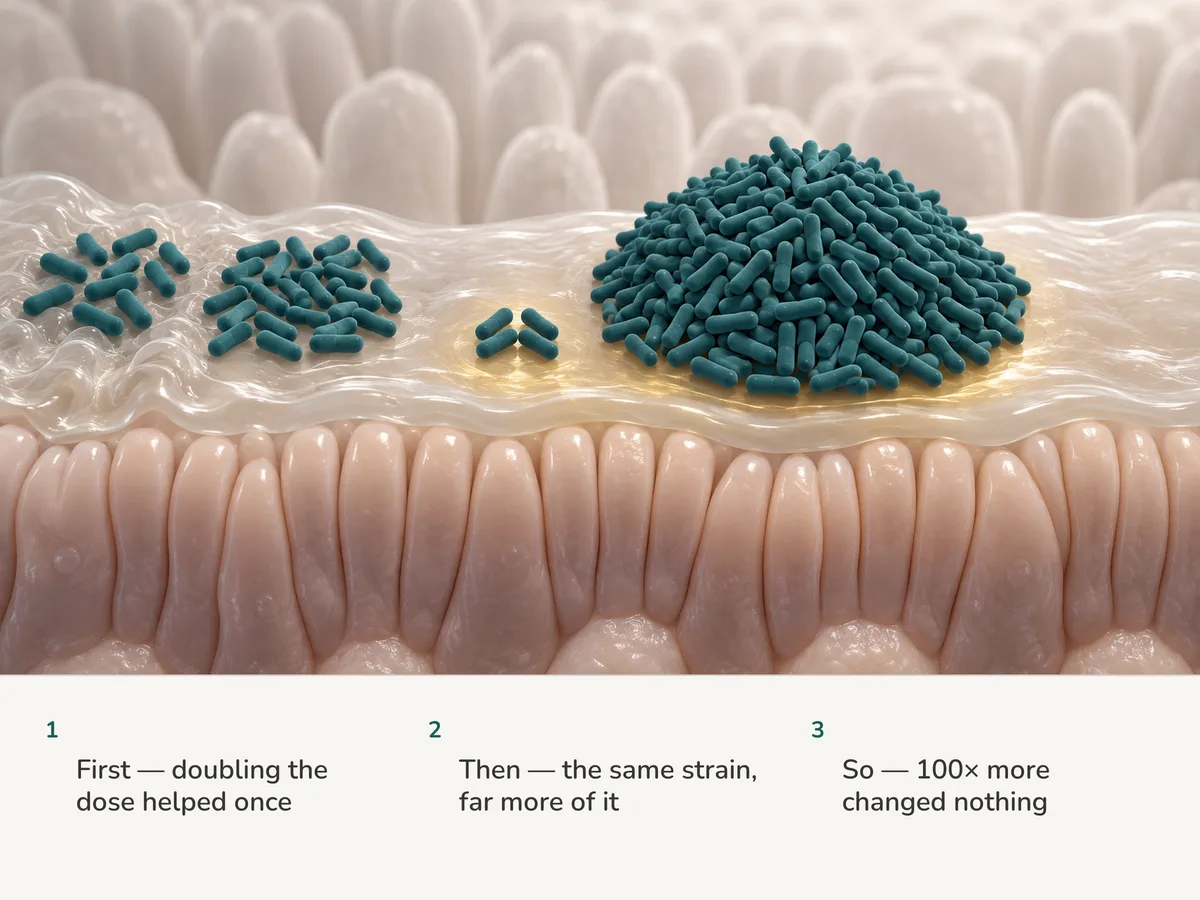
Partly true. Dose matters, but only inside one strain and one outcome. In one trial 100 billion CFU beat 50 billion for antibiotic-associated diarrhoea; in another, a hundredfold jump in the same organism changed nothing in children with acute diarrhoea. A label number is a claim about quantity, not about evidence.
 Written by: Magnus Larsen · Microbiologist · Science bloggerPublished: Facts checked:
Walk down any supplement aisle and you are walking through an arms race. Every pack carries a colony-forming-unit count, it climbs from one season to the next, it is printed larger than the strain name it belongs to, and it is the one thing on the box a shopper can compare without a biology degree. That is precisely why it gets compared — and precisely why it misleads.
Verdict: partly true. Dose is real, and in at least one well-run trial more of the same organism did produce a better result. But the useful dose is a property of a particular strain aimed at a particular outcome. Outside that pairing, a larger CFU figure is a specification, not a benefit.
Where more really was better
The strongest case for the myth is a randomised, double-blind, placebo-controlled dose-ranging trial in 255 adult hospital inpatients starting antibiotics 2. Both active arms got the same blend of Lactobacillus acidophilus CL1285 and Lactobacillus casei LBC80R; everyone swallowed two capsules a day, and the only variable was whether one of them or both held the organisms. Each active capsule held 50 billion CFU, so the high arm took 100 billion CFU daily 2. Antibiotic-associated diarrhoea appeared in 15.5 % of the 100 billion CFU group, 28.2 % of the 50 billion CFU group and 44.1 % of placebo 2. For Clostridioides difficile-associated diarrhoea the gap was wider still: 1.2 %, 9.4 % and 23.8 % 2.
That is a genuine dose-response. It is also the answer to one question — this blend, this dose pair, this complication, in hospital. Nothing in it licenses a general law about probiotics.

Where more changed nothing
Run the same experiment on a different strain and outcome and the curve flattens. In 559 Indian children hospitalised with acute watery diarrhoea, three arms compared oral rehydration solution alone against rehydration plus Lactobacillus rhamnosus GG at 10¹⁰ CFU or at 10¹² CFU twice daily 3. Both probiotic arms shortened diarrhoea, cut intravenous fluid requirement and shortened hospital stay against control. Between the two doses — a hundredfold difference — there was no significant difference at all 3.
The same flat curve turned up in inflammatory bowel disease. Seventy-five people with mild-to-moderate ulcerative colitis started an open-label randomised trial of Lactobacillus rhamnosus GG as sole therapy for one month, at 1.2 × 10¹⁰ CFU a day or double that 4. Both dose groups improved significantly against their own baseline, and neither efficacy nor safety separated them from each other 4. There was no placebo arm, so that improvement is not evidence the probiotic caused it — but the comparison between the two doses is the point, and the doses did not differ.
A hundredfold is not a rounding error. When a hundredfold buys nothing, the limiting step was never the count.
Why the strain and the illness, not the number, set the dose
Swallowed cells are rarely the bottleneck. Survival through stomach acid and bile is, and tolerance of simulated gastrointestinal conditions varies from strain to strain even among products sold under the same species name 7. So is whether the strain carries any mechanism for the thing you want — an adhesin, a bacteriocin, an immune signal. So is whether your own resident community will let a newcomer settle. Once enough cells arrive to pull that lever, extra cells have no second lever to pull.
This is why the literature keeps landing on the strain rather than the number. A systematic review of 228 randomised trials found probiotic efficacy to be both strain-specific and disease-specific: within a single species, some strains clearly prevented adult antibiotic-associated diarrhoea while others showed nothing, and single strains varied sharply in effect across different diseases 5. Pooling by genus — the way a shelf and most marketing copy pool — buries that.
The same logic complicates the sister myth that more strains beat fewer. Across 65 randomised trials in 10,863 people and eight indications, single strains were in most cases equivalent to mixtures built around them 6. Only three strains even had matching single-strain and mixture trials to compare, and of those the comparison broke both ways: Lactobacillus rhamnosus GG alone was significantly more protective against necrotising enterocolitis than two mixtures also containing it, while GG plus Bifidobacterium lactis Bb12 was significantly better than GG alone at eradicating Helicobacter pylori 6. Two numbers on a pack, cell count and strain count, and neither one is a result on its own.
If you want the organisms behind these trials in plain terms, the Lactobacillus encyclopedia entry covers what the genus actually does and where its evidence stops.
What the official definition means by "adequate amounts"
The definition every regulator leans on — "live microorganisms which when administered in adequate amounts confer a health benefit on the host" — was reinforced as relevant and sufficiently accommodating by the ISAPP expert panel convened in 2013, which reported that a more precise use of the word probiotic would help clinicians and consumers tell diverse products apart 1. Adequate is doing the work in that sentence, and the sentence ties it to the benefit rather than to the size of the number: an adequate amount is one large enough to confer the health benefit being claimed. Nothing in it points at the largest amount a fermenter can deliver at an acceptable cost.
What the number on the label does not tell you
There is a blunter problem. The figure may not be true when you swallow it.
Ten commercial products labelled as containing a single Limosilactobacillus reuteri strain were bought across four countries — Bulgaria, the Czech Republic, the United States and Brazil — and cultured inside their stated shelf life 7. Only four had viable counts consistent with their labels 7. Four more had live cells but fewer than claimed, and two grew no colonies whatever 7. Two of the ten turned out to hold a heterogeneous mix of organisms rather than the single strain named on the box 7. In a separate audit of thirteen products sold in India, five disagreed with their own labels on enumeration, some carried contaminants, and several printed species names that current taxonomy has retired 8.
So the CFU figure is a manufacturing claim made at packing, about an organism that dies on a shelf, verified by nobody at the till.
How to read a pack instead
Read for the strain designation, not the size of the number: genus, species, and the alphanumeric code after them. Then ask what that exact strain, at roughly that dose, has been shown to do for the exact outcome you care about, and over what period the trial ran. A pack that names only a species has given the CFU figure nothing to attach to.
A big number with no named strain behind it is not a stronger product. It is a stronger advertisement.
Key facts
- In a randomised double-blind dose-ranging trial in 255 hospital inpatients, two probiotic capsules a day of a Lactobacillus acidophilus CL1285 and Lactobacillus casei LBC80R blend (100 billion CFU) lowered antibiotic-associated diarrhoea to 15.5 % against 28.2 % for one capsule (50 billion CFU) and 44.1 % for placebo.2
- In 559 Indian children with acute watery diarrhoea, Lactobacillus rhamnosus GG at 10¹⁰ CFU and at 10¹² CFU both beat oral rehydration alone — and were no different from each other.3
- In 75 people with mild-to-moderate ulcerative colitis given Lactobacillus rhamnosus GG as sole therapy for one month, at 1.2 × 10¹⁰ CFU a day or double that, no difference in efficacy or safety appeared between the two doses.4
- A systematic review of 228 randomised trials concluded that probiotic efficacy is both strain-specific and disease-specific — within a single species, some strains prevented adult antibiotic-associated diarrhoea and others did not.5
- Of ten commercial products labelled as containing only Limosilactobacillus reuteri, all tested within their stated shelf life, only four had viable counts consistent with the label, and two yielded no colonies at all.7
- The ISAPP expert panel reinforced the FAO/WHO definition — live microorganisms which when administered in adequate amounts confer a health benefit on the host — and noted that a more precise use of the term 'probiotic' would help clinicians and consumers tell diverse products apart.1
Questions people ask
So is a higher CFU count ever worth paying for?
Sometimes, and only when a trial of that strain says so. The clearest example is a hospital blend where doubling the daily dose from 50 billion to 100 billion CFU roughly halved antibiotic-associated diarrhoea and cut Clostridioides difficile-associated diarrhoea from 9.4 % to 1.2 % [s2]. That is one blend, one setting, one outcome. It is evidence about that product, not a rule about the shelf.
Why would a hundredfold larger dose do nothing?
Because the limiting step is usually not how many cells you swallow. It is how many survive the stomach and bile — tolerance of simulated gastrointestinal conditions varies from strain to strain [s7] — whether the strain has any mechanism for the outcome you care about, and whether your own resident community lets it settle at all. Once enough cells arrive to trigger the effect, adding more has nothing left to trigger — which is what a trial of 559 children found when 10¹⁰ CFU and 10¹² CFU of the same organism showed no significant difference on any outcome measured [s3].
Is a product with more strains better than one with fewer?
Not as a rule. A review of 65 randomised trials in 10,863 people across eight indications compared single strains against mixtures containing the same strain, and in most cases the two were equivalent [s6]. Where they did differ it went both ways: Lactobacillus rhamnosus GG alone was more protective against necrotising enterocolitis than two mixtures that also contained it, while GG combined with Bifidobacterium lactis Bb12 beat GG alone for eradicating Helicobacter pylori. Count of strains, like count of cells, is a specification — not a result.
Does the CFU on the pack mean the CFU I swallow?
Often not. Ten products labelled as one Limosilactobacillus reuteri strain were tested inside their shelf life: four matched their labels, four had live cells but fewer than claimed, and two grew nothing at all [s7]. Of thirteen products sold in India, five disagreed with their own labels on enumeration [s8]. A number that is not verified at the point of purchase is a promise, not a measurement.
What should I read on the label instead?
The full strain designation — genus, species and the strain code after it, such as GG or CL1285. Then look for a trial of that exact strain, at that dose, for the outcome you want. If the pack names only a species, the CFU figure has nothing to attach itself to, because efficacy in 228 trials tracked the strain and the disease, not the genus [s5].
Sources
- Hill C., Guarner F., Reid G., Gibson G.R., Merenstein D.J. et al., Nature Reviews Gastroenterology & Hepatology, 2014 — ISAPP consensus statement on the scope and appropriate use of the term probiotic — doi:10.1038/nrgastro.2014.66
- Gao X.W., Mubasher M., Fang C.Y., Reifer C., Miller L.E., The American Journal of Gastroenterology, 2010 — dose-ranging trial of a Lactobacillus acidophilus CL1285 and L. casei LBC80R formula for antibiotic-associated and C. difficile-associated diarrhoea — doi:10.1038/ajg.2010.11
- Basu S., Paul D.K., Ganguly S., Chatterjee M., Chandra P.K., Journal of Clinical Gastroenterology, 2009 — randomised trial of two doses of Lactobacillus rhamnosus GG in acute watery diarrhoea in Indian children — doi:10.1097/MCG.0b013e31815a5780
- Pagnini C., Di Paolo M.C., Urgesi R., Pallotta L., Fanello G., Graziani M.G., Delle Fave G., Microorganisms, 2023 — Lactobacillus rhamnosus GG monotherapy at two doses in mild-to-moderate ulcerative colitis — doi:10.3390/microorganisms11061381
- McFarland L.V., Evans C.T., Goldstein E.J.C., Frontiers in Medicine, 2018 — strain-specificity and disease-specificity of probiotic efficacy: systematic review and meta-analysis — doi:10.3389/fmed.2018.00124
- McFarland L.V., Digestive Diseases and Sciences, 2021 — efficacy of single-strain probiotics versus multi-strain mixtures: systematic review of strain and disease specificity — doi:10.1007/s10620-020-06244-z
- de Oliveira e Silva I.S., Lima E.M.F., Leani K., Todorov S.D., Foods, 2026 — isolation, identification and validation of strains from commercial probiotics — doi:10.3390/foods15040674
- Madhumathi I., Ramesh V., Rathakrishnan B., Abirami B., Gunasekaran K. et al., Gut Microbes Reports, 2026 — safety and efficacy concerns in Indian probiotics: whole-genome sequencing and in vitro assessment — doi:10.1080/29933935.2026.2668863
Related

Same capsule, opposite result: what makes a probiotic work
120 overweight adults, 12 weeks: heat-killed L. plantarum did nothing on average. Only the least varied guts lost weight. Why that is a lead, not proof.

IBS pain is not in your head: enzymes poke the gut's nerves
Stool fluid from IBS patients made gut nerve networks fire far harder than fluid from healthy people, a 2026 Gut study found. What it shows — and does not.

Actinomycetota: the phylum that guards infants and causes TB
Actinomycetota, formerly Actinobacteria: the phylum of Bifidobacterium and of tuberculosis. Where it lives in your body, what it does for and against you.