
Mouthwash kills the microbes your blood pressure needs
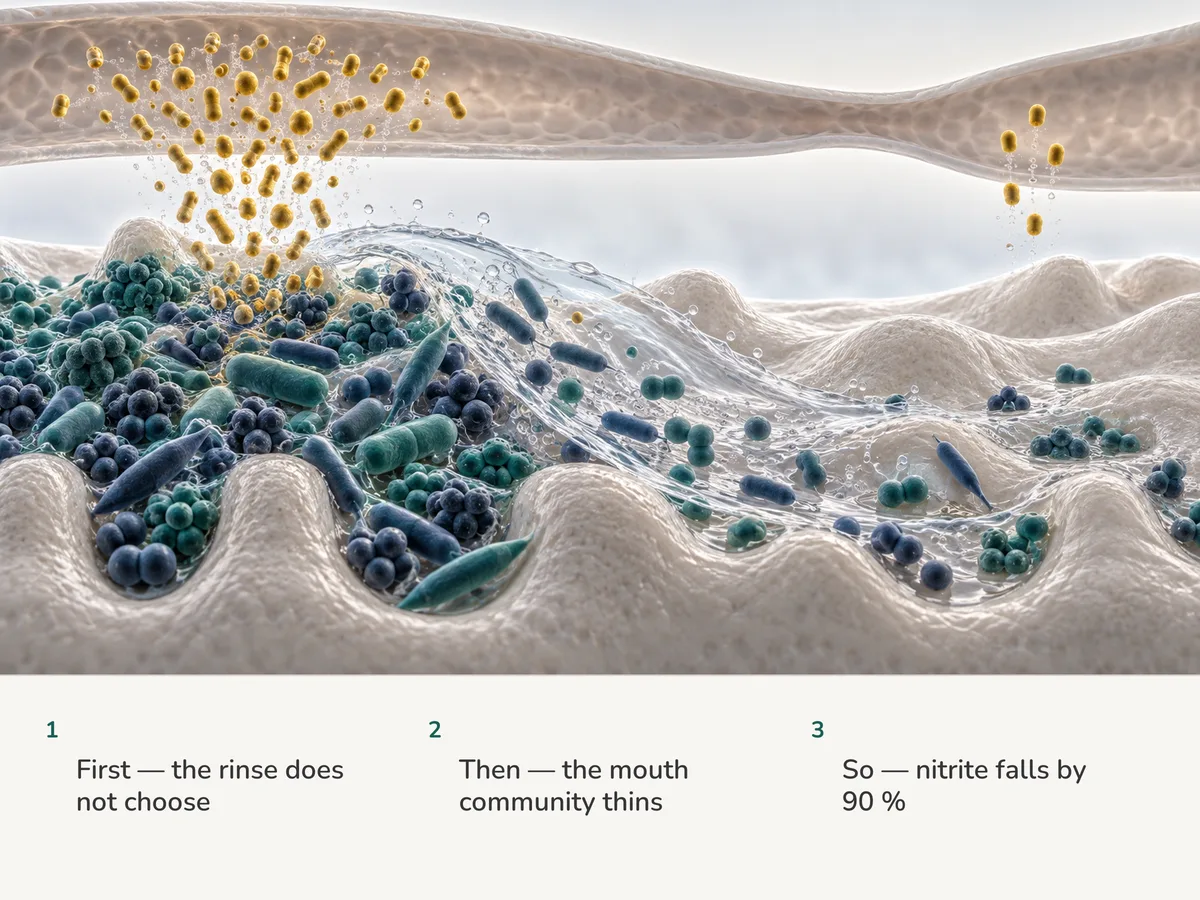
False. A broad antiseptic rinse cannot sort harmful microbes from useful ones, so it flattens your mouth’s own community. In a 2013 trial, seven days of chlorhexidine rinsing cut oral nitrite — what the body uses to relax blood vessels — by 90 % and raised blood pressure by 2–3.5 mmHg. A rinse treats a problem, not a routine.
 Written by: Magnus Larsen · Microbiologist · Science bloggerPublished: Facts checked:
There is a tidy logic behind the habit. Bacteria cause cavities. Bacteria cause gum disease. Therefore fewer bacteria must be better, and a rinse that kills nearly all of them must be best of all.
Every step in that chain sounds reasonable. The last one has been measured, and it does not hold.
Verdict: false
Killing more mouth bacteria is not always better. A broad antiseptic rinse does not perform triage. It cannot tell the organism eroding your enamel from the organism on the back of your tongue that turns dietary nitrate into a molecule your arteries use. It removes both — and the second loss shows up in your blood within a day 2.
That does not make antiseptic rinses useless. It makes them a treatment, with an indication, a course and a stopping point, rather than a daily hygiene ritual.
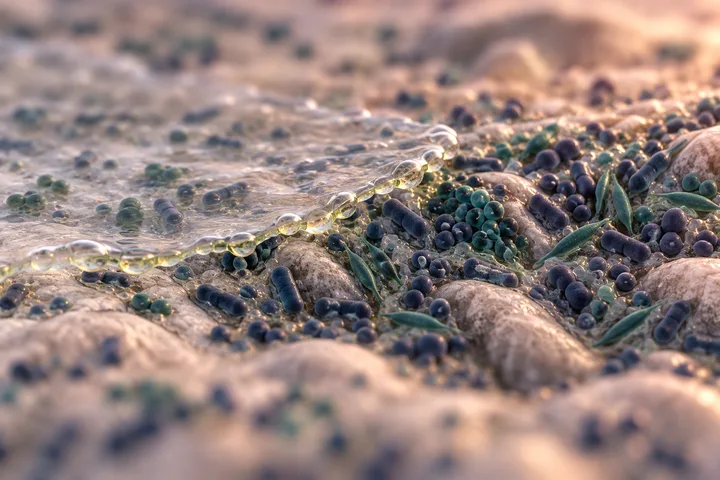
What a broad antiseptic does to the resident community in your mouth
Start with the most direct measurement. Bescos and colleagues, in Scientific Reports in 2020, had 36 healthy adults rinse for one minute twice a day for 7 days with a placebo, then repeat the identical schedule for another 7 days with 0.2 % chlorhexidine 1.
The community did not simply shrink. It tilted. Firmicutes and Proteobacteria became more abundant, while Bacteroidetes and Fusobacteria fell 1. And the mouth those survivors were left in was chemically different: saliva pH dropped, buffering capacity fell, and salivary lactate and glucose rose 1.
Read that last sentence slowly, because it inverts the promise. A more acidic mouth, with less buffering and more free sugar, is precisely the environment Streptococcus mutans is built for. A week of an antiseptic aimed at cavity bacteria left behind the chemistry that suits them.
The lane you are cutting: how bacteria on your tongue reach your arteries
Human cells cannot reduce nitrate to nitrite. Bacteria can. Hyde and colleagues scraped the tongues of six healthy volunteers, sequenced what lived there, and identified 14 candidate nitrate-reducing species — seven of which had not previously been thought to contribute at all 6. These organisms sit mostly on the back of the tongue, and they hand the body nitrite, which becomes nitric oxide, which relaxes blood vessels.
Kapil and colleagues tested what happens when that lane is closed. Nineteen healthy volunteers were measured through a 7-day control period, then rinsed with a chlorhexidine-based antiseptic for 7 days 2. Oral nitrite production fell by 90 % and plasma nitrite by 25 %. Systolic and diastolic blood pressure rose by 2–3.5 mmHg, and the size of each person's rise tracked the size of their own nitrite fall (r² = 0.56, p = 0.002). The effect appeared within one day of disrupting the flora and held for the week 2.
Two to three and a half millimetres of mercury is not a crisis in one person. Across a population it is not nothing either — and nobody set out to buy it with a mouthwash.
Where the evidence argues with itself
This is the part that usually gets left out, so let me say it plainly: the finding is real, and it is not unanimous.
In the Bescos study, systolic pressure did rise after chlorhexidine, but the rise was not statistically significant 1. And Sundqvist, Lundberg and Weitzberg ran a randomised, double-blind crossover in 17 healthy young women on a low-nitrate diet, rinsing three times daily for 3 days: the rinse did block oral nitrate-to-nitrite conversion, yet plasma nitrite, resting metabolic rate and 24-hour ambulatory blood pressure were all unchanged 3.
So the pathway is reliably disrupted. Whether that disruption reaches your arteries appears to depend on who is rinsing, for how long, and how much nitrate is in the food.
The epidemiology points the same way without proving cause. In the San Juan Overweight Adults Longitudinal Study, 945 adults aged 40–65 were followed for three years; those using over-the-counter mouthwash at least twice daily had a higher rate of developing pre-diabetes or diabetes than non-users, and no association appeared below twice a day 4. That is an observational association in overweight adults. It raises the question. It does not settle it.
When a rinse is genuinely the right tool
Now the other half of the honesty, because a myth check that only cuts one way is not a myth check. Antiseptic rinsing works — at what it works at.
The Cochrane review by James and colleagues pooled 51 studies and 5345 participants. Used as an adjunct to brushing, chlorhexidine mouthrinse produced a large reduction in dental plaque — a standardised mean difference of 1.45, from the 12 trials and 950 participants analysed at 4–6 weeks, with a similar large reduction again at six months, on high-quality evidence 5. That is a genuine effect, and it is why the rinse exists.
The same review is equally clear about the limits. The gingivitis benefit was 0.21 on the 0–3 Gingival Index in people with mild inflammation — a change the reviewers judged not clinically relevant 5. And it is not free: a large increase in extrinsic tooth staining, a standardised mean difference of 1.07, after 4–6 weeks, alongside taste disturbance, burning and mucosal soreness reported across the included trials 5. Fifty of the 51 studies were at high risk of bias 5.
Put together, that is the profile of a short-course drug: after periodontal surgery, during a spell when brushing is physically impossible, when someone has named the problem and named the end date. It is not the profile of a bottle you reach for every morning because your mouth feels ordinary.
What an ordinary mouth actually needs
A mouth is not a wound, and it is not a countertop. It is a colonised surface whose residents supply acid buffering, competitive pressure against the organisms you do not want, and the nitrite step your circulation cannot perform for itself 6.
Mechanical removal — brushing, and cleaning between the teeth — takes the biofilm off the tooth without sterilising the tongue. That distinction is the whole argument. The goal was never fewer bacteria. It was the right ones, in the right places, in the numbers they belong in.
Key facts
- In 36 healthy adults, 7 days of 0.2 % chlorhexidine rinsing shifted the salivary community — more Firmicutes and Proteobacteria, fewer Bacteroidetes and Fusobacteria.1
- After chlorhexidine, saliva pH and buffering capacity fell while salivary lactate and glucose rose — the chemistry that favours acid-producing bacteria.1
- Seven days of chlorhexidine rinsing cut oral nitrite production by 90 % and plasma nitrite by 25 %; systolic and diastolic blood pressure rose by 2–3.5 mmHg.2
- The effect is not universal — in 17 healthy young women rinsing three times daily for 3 days, nitrate conversion was blocked but plasma nitrite and 24-hour blood pressure did not change.3
- Chlorhexidine mouthrinse gives a large plaque reduction (SMD 1.45) but only a 0.21-point gingivitis reduction on the 0–3 index, plus a large increase in tooth staining.5
- Tongue scrapings from six healthy volunteers yielded 14 candidate nitrate-reducing species, seven of which had not previously been thought to contribute.6
Questions people ask
So is mouthwash bad for you?
That is the wrong shape of question. An antiseptic rinse is a drug with an indication. As an adjunct to brushing it produces a large reduction in dental plaque — high-quality evidence, pooled from 12 trials inside a 51-study Cochrane review [s5]. Used daily for years with no named problem, it disrupts a bacterial pathway your circulation uses [s2]. Same bottle, different verdict, depending on why it is in your hand.
Does mouthwash really raise blood pressure?
In one controlled study, yes, and modestly. Nineteen healthy volunteers rinsed with a chlorhexidine-based antiseptic for 7 days; systolic and diastolic pressure rose by 2–3.5 mmHg, and each person's rise tracked their own fall in circulating nitrite [s2]. But a randomised crossover in 17 young women found no change in 24-hour ambulatory pressure at all [s3], and in a 36-person study the rise was not statistically significant [s1]. The pathway is consistently disrupted; the downstream effect is not consistent.
Does this apply to every mouthwash?
The mechanism has been tested most rigorously with chlorhexidine, so that is what I can speak to with numbers [s1][s2][s3]. For over-the-counter rinses the evidence is weaker and observational: in 945 overweight adults followed for three years, using mouthwash at least twice daily was associated with a higher rate of pre-diabetes or diabetes than not using it [s4]. An association in one cohort is a reason to ask the question, not an answer to it.
When is an antiseptic rinse genuinely the right tool?
When a clinician has named the problem and named the end date — after periodontal surgery, or during a period when brushing is physically impossible. That is the profile the trial data supports: a large plaque effect over 4–6 weeks, a gingivitis effect the reviewers judged not clinically relevant, and a large increase in extrinsic tooth staining as the price [s5].
If I stop rinsing, do the bacteria come back?
I cannot give you a timeline, because none of the trials cited here followed the community after stopping. What is documented is how fast the loss appears: blood pressure moved within one day of disrupting the oral flora [s2]. A recovery number would need a study that measured recovery, and I do not have one to hand you.
Sources
- Bescos R. et al., Scientific Reports, 2020 — doi:10.1038/s41598-020-61912-4
- Kapil V. et al., Free Radical Biology & Medicine, 2013 — doi:10.1016/j.freeradbiomed.2012.11.013
- Sundqvist M. L., Lundberg J. O. & Weitzberg E., Nitric Oxide, 2016 — doi:10.1016/j.niox.2016.10.003
- Joshipura K. J. et al., Nitric Oxide, 2017 — doi:10.1016/j.niox.2017.09.004
- James P. et al., Cochrane Database of Systematic Reviews, 2017 — doi:10.1002/14651858.CD008676.pub2
- Hyde E. R. et al., PLoS ONE, 2014 — doi:10.1371/journal.pone.0088645
Related

The carcinogen your own mouth makes out of ordinary sugar
Mouth microbes from cancer patients turned sugar and alcohol into acetaldehyde — a carcinogen ranked with tobacco. Plaque hid the rest until enzymes opened it.
Bad breath isn’t dirt. It’s one bacterial gene doing its job
A 2026 lab-dish and rat study turned down the bacterial gene behind bad breath. Here is the mechanism, the numbers, and everything the study did not show.

Bacillus coagulans: a spore passing through, not a resident
Bacillus coagulans (also Heyndrickxia coagulans — one bug, two names): what this spore-forming probiotic does for mouth and gut, and where the evidence stops.