
Nine species still missing: what to eat after antibiotics
Fibre-rich plants, fermented foods and patience. Most of the community was back near baseline about 1.5 months after the 4-day antibiotic cocktail studied (Nature Microbiology, 2018), but nine common species were still undetectable in most men at 180 days. Probiotics cut antibiotic-associated diarrhoea, yet the one study of the gut lining found they delayed its rebuilding.
 Written by: Magnus Larsen · Microbiologist · Science bloggerPublished: Facts checked:
You finish the last capsule on a Tuesday morning and the question arrives with it: now what? The pharmacy shelf has an answer in a box, the internet has fourteen, and almost nobody starts where a microbiologist starts — with the shape of the damage and how fast it repairs itself.
The curve, measured: how fast it comes back
The cleanest picture comes from Copenhagen. Palleja and colleagues gave 12 healthy men a 4-day intervention with three last-resort antibiotics at once — meropenem, gentamicin and vancomycin — then followed their stool for 6 months 1. The early weeks looked bad: blooms of enterobacteria and other pathobionts including Enterococcus faecalis and Fusobacterium nucleatum, and depletion of Bifidobacterium species and the butyrate producers 1.
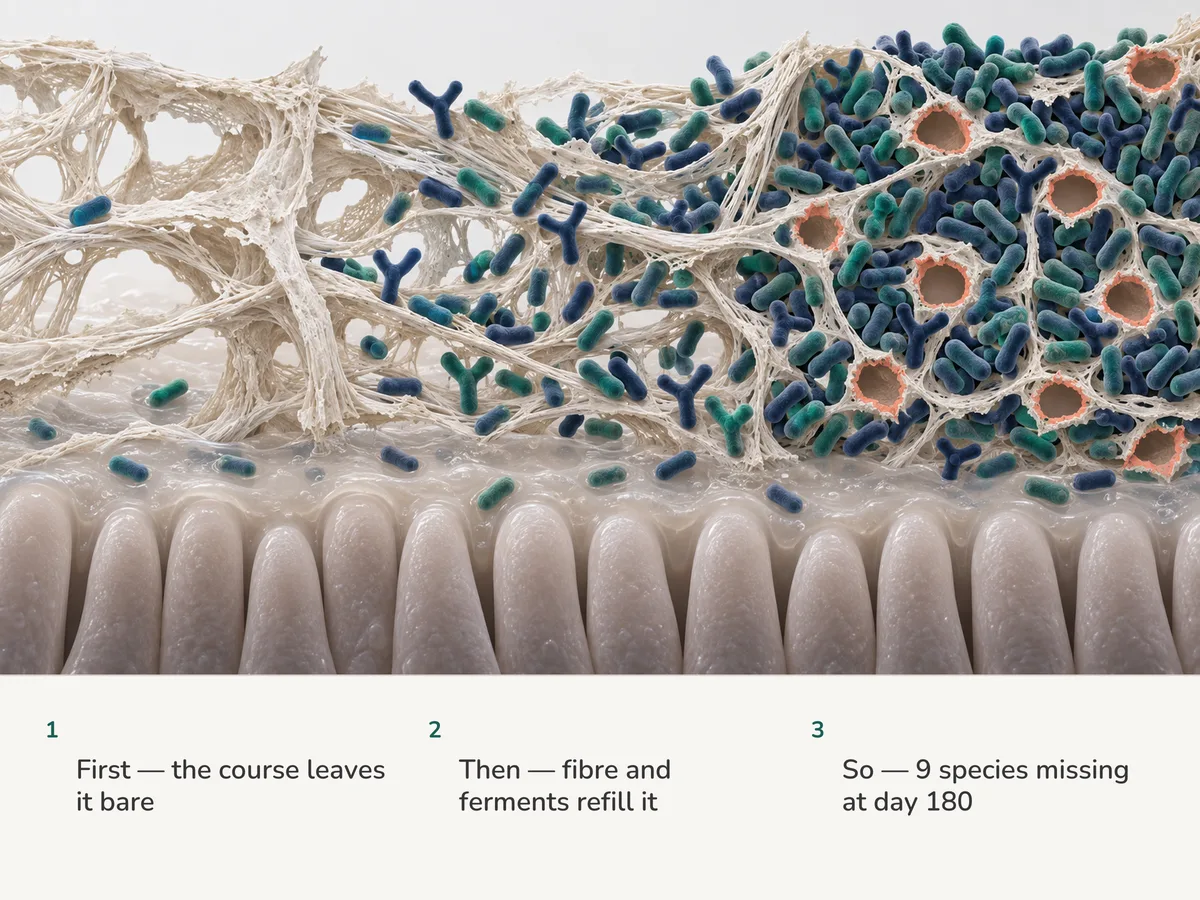
Then it came back. Composition returned to near baseline within 1.5 months 1. That is the number worth carrying: for most of the community, weeks, not years.
The tail is the other half. Nine common species, present in all 12 men beforehand, were still undetectable in most of them after 180 days 1. The authors call it resilience with a mild but long-lasting imprint 1.
An older study says the same in a different key. Dethlefsen and Relman followed three people for 10 months across two courses of ciprofloxacin, sequencing 52 to 56 stool samples each 2. Diversity fell within 3–4 days of the first dose 2. About a week after each course ended, communities began moving back — but the return was often incomplete, and the end state, while stable, was not the starting state 2.
So the honest curve is: a fast fall, bulk recovery over weeks, a slow tail over months, and a residue that may not return.
What the food evidence actually is
Here is the part most articles skip. No randomised trial has taken people finishing antibiotics, fed half of them a defined diet, and measured whose microbiome came back faster. That trial does not exist. What exists is adjacent, and deserves to be named as adjacent.
In mice, a fibre-deficient diet made the collapse worse and delayed recovery after antibiotics 8 — a mechanism shown in animals, not a human result.
In humans, Wastyk and colleagues ran a 17-week randomised trial in healthy adults with no antibiotics involved, 18 people per arm 7. One arm pushed fibre from 21.5 g a day to 45.1 g; the other pushed fermented food from 0.4 servings a day to 6.3 7. The fermented-food arm steadily gained microbiota diversity and 19 of its 93 inflammatory serum proteins fell, IL‑6 among them 7. The high-fibre arm did not gain diversity, though its glycan-degrading enzyme genes increased 7.
Put the two together and the logic is plain rather than proven: the groups antibiotics knock down first — bifidobacteria and the butyrate producers 1 — live on fermentable plant carbohydrate. Feed the survivors what they eat.
What that means on a Tuesday: what to put on the plate
Start now, not when the course ends. The fall begins within days of the first dose 2, so there is nothing to wait for.
Put fermentable plants on every plate: legumes, oats and barley, onions, leeks and garlic, apples and pears, potatoes or rice cooked and cooled. The arm that changed enzyme capacity reached 45.1 g of fibre a day 7, roughly double its 21.5 g starting point 7 — over a 4-week ramp before 6 weeks of holding 7. Ramping is not a nicety; it is how the arm was run.
Add a fermented food daily — yoghurt with live cultures, kefir, sauerkraut, kimchi, brined vegetables. The number that moved diversity was 6.3 servings a day 7, far more than most people will manage. One serving is a direction, not the dose that was tested.
The probiotic question, and the fight inside it
Now the argument, said out loud, because the literature disagrees. Across 17 randomised trials in 3,631 outpatients, antibiotic-associated diarrhoea hit 8.0 % of probiotic groups and 17.7 % of controls, a relative risk of 0.49 (95 % CI 0.36 to 0.66), with adverse events no different between arms 5. The Cochrane review of Clostridioides difficile diarrhoea pooled 31 trials and 8,672 patients and found 1.5 % versus 4.0 %, a relative risk of 0.40, moderate certainty, 42 people treated per prevented case 4. But it also found where that benefit lived: where baseline C. difficile risk was above 5 %, the rate was 3.1 % versus 11.6 % and the number needed was 12; at 5 % or below, no difference at all 4.
Then PLACIDE, the largest single trial: 2,941 hospital patients aged 65 and over, randomised to either two strains of lactobacilli and two of bifidobacteria — 6 × 10¹⁰ organisms daily for 21 days — or an identical placebo 6. Diarrhoea hit 10.8 % on probiotic and 10.4 % on placebo — a relative risk of 1.04 6. Nothing.
And then the study that changed the question. Suez and colleagues sampled the gut mucosa directly, not just stool. Compared with simply waiting, a multi-strain probiotic produced a markedly delayed and persistently incomplete reconstitution of the person's own microbiome and gene expression, while an autologous stool transplant — their own pre-antibiotic bacteria given back — restored things within days 3. In culture, Lactobacillus-secreted soluble factors inhibited the indigenous community 3.
The disagreement is real and is not resolved by picking a side. These studies measure different things over different timescales: loose stools over weeks, versus whose bacteria live in your gut over months. A capsule could plausibly do both — fewer bad days now, a slower return of your own species later. No trial has measured both endpoints in the same people, so anyone telling you probiotics after antibiotics are simply good, or simply bad, is choosing an endpoint and not telling you which.
What I would actually say
If you are at real risk of C. difficile — older, in hospital, on broad-spectrum drugs — the Cochrane high-risk subgroup is the strongest thing on the table 4, and that is a conversation with the doctor who prescribed, not a decision made at a shelf.
If you are an outpatient on a short course and your worry is loose stools, the outpatient meta-analysis is a genuine effect and the safety signal was clean 5.
If your goal is your own community back as fast as possible, the only study that measured that found probiotics made it slower 3, and nobody has repeated it.
The food is the low-risk half of all of this: direct human evidence for diversity and inflammation 7, mechanistic support from animals — the mechanism shown in mice, not yet in people — for recovery 8, and no cost beyond a few gassy days while your fermenters, the gut bacteria that live on plant fibre, get back to work.
Key facts
- In 12 healthy men given a 4-day cocktail of meropenem, gentamicin and vancomycin, the gut community returned to near-baseline composition within 1.5 months, but 9 common species present in everyone beforehand were still undetectable in most of them at 180 days.1
- Ciprofloxacin cut gut diversity within 3–4 days of the first dose; communities began returning about a week after each course ended, but the return was often incomplete and the final state was altered.2
- Across 17 randomised trials in 3,631 outpatients, antibiotic-associated diarrhoea occurred in 8.0 % of the probiotic group and 17.7 % of controls (RR 0.49, 95 % CI 0.36 to 0.66).5
- In the PLACIDE trial, 2,941 hospital patients aged 65 and over were randomised to 6 × 10¹⁰ organisms daily for 21 days or to placebo; diarrhoea occurred in 10.8 % on probiotic and 10.4 % on placebo (RR 1.04, 95 % CI 0.84 to 1.28).6
- Compared with spontaneous recovery, an 11-strain probiotic given after antibiotics produced a markedly delayed and persistently incomplete return of the person's own stool and mucosal microbiome, while autologous stool transplant restored it within days.3
- Healthy adults who raised fermented food from 0.4 to 6.3 servings a day over 17 weeks gained microbiota diversity and saw 19 of 93 inflammatory serum proteins fall, including IL‑6; a high-fibre arm reaching 45.1 g of fibre a day did not gain diversity.7
Questions people ask
How long until my gut is back to normal?
For most of the community, weeks. In the Copenhagen study of 12 healthy men on a 4-day intravenous cocktail of three last-resort antibiotics, composition was near baseline within 1.5 months. The tail is longer: nine species that every man carried before treatment were still undetectable in most of them at 180 days. A milder oral course is a smaller hit than that cocktail, but nobody has measured your particular course in your particular gut.
Should I take a probiotic during or after the course?
It depends on which question you are asking. If you want fewer loose stools, outpatient trials found 8.0 % on probiotic versus 17.7 % on control, and the Cochrane review found real protection against Clostridioides difficile diarrhoea in people whose baseline risk was above 5 %, but none in people below it. If you want your own species back faster, the only study that measured that found probiotics slowed the return. Those are different endpoints, and no trial has measured both in the same people.
Do I have to wait until the course is over to start eating well?
No. The disruption starts within days of the first dose, so the food does not need to wait for the last one. There is no trial testing when to start, so this is mechanism and common sense rather than measured benefit.
Is yoghurt a probiotic?
Not in the sense the trials mean. The trials tested defined strains at defined doses in capsules. Fermented foods were tested separately, as food, in healthy adults with no antibiotics involved. Both may help; they are not the same evidence and should not borrow each other's numbers.
What if the diarrhoea is severe or bloody, or starts after the course ends?
That is a doctor's question, not a diet question. Clostridioides difficile causes a minority of antibiotic-associated diarrhoea but the dangerous minority, and it is diagnosed with a stool test, not by guesswork.
Sources
- Palleja A. et al., Nature Microbiology, 2018 — doi:10.1038/s41564-018-0257-9
- Dethlefsen L. & Relman D. A., PNAS, 2011 — doi:10.1073/pnas.1000087107
- Suez J. et al., Cell, 2018 — doi:10.1016/j.cell.2018.08.047
- Goldenberg J. Z. et al., Cochrane Database of Systematic Reviews, 2017 — doi:10.1002/14651858.CD006095.pub4
- Blaabjerg S. et al., Antibiotics (Basel), 2017 — doi:10.3390/antibiotics6040021
- Allen S. J. et al., Health Technology Assessment, 2013 (PLACIDE) — doi:10.3310/hta17570
- Wastyk H. C. et al., Cell, 2021 — doi:10.1016/j.cell.2021.06.019
- Ng K. M. et al., Cell Host & Microbe, 2019 — doi:10.1016/j.chom.2019.10.011
Related

Same capsule, opposite result: what makes a probiotic work
120 overweight adults, 12 weeks: heat-killed L. plantarum did nothing on average. Only the least varied guts lost weight. Why that is a lead, not proof.
IBS pain is not in your head: enzymes poke the gut's nerves
Stool fluid from IBS patients made gut nerve networks fire far harder than fluid from healthy people, a 2026 Gut study found. What it shows — and does not.
Actinomycetota: the phylum that guards infants and causes TB
Actinomycetota, formerly Actinobacteria: the phylum of Bifidobacterium and of tuberculosis. Where it lives in your body, what it does for and against you.