
Carrying C. difficile can lower your risk of C. difficile
Clostridioides difficile is a spore-forming gut bacterium whose dormant spores outlive antibiotics; it causes severe diarrhoea once antibiotics strip away the microbial community holding it in check. Carriage is not illness: in pooled hospital studies, silent carriers — organism in the stool, no symptoms — developed C. difficile diarrhoea less often than patients carrying nothing.
 Written by: Magnus Larsen · Microbiologist · Science bloggerPublished: Facts checked:
- Species
- Clostridioides difficile
- Syn.
- Clostridium difficile, Peptoclostridium difficile
- NCBI
- txid1496
- Wikidata
- Q56290719
Almost every bacterium in this encyclopedia earns its entry by what it does for you. This one earns it by what it does to you. So the honest place to begin is with the finding that spoils the simple version of the story: when Shim and colleagues pooled four longitudinal hospital studies covering 810 patients, C. difficile diarrhoea developed in 22 of 618 patients who were carrying nothing (3.6 %) and in only 2 of 192 patients who were already quietly carrying the organism (1.0 %) 5. Carrying it went with less of the disease it causes, not more. That is not a reason to want the organism, and this is not the line to stop on: hold it in mind through the rest of this page, because the rest is grim.
What it is
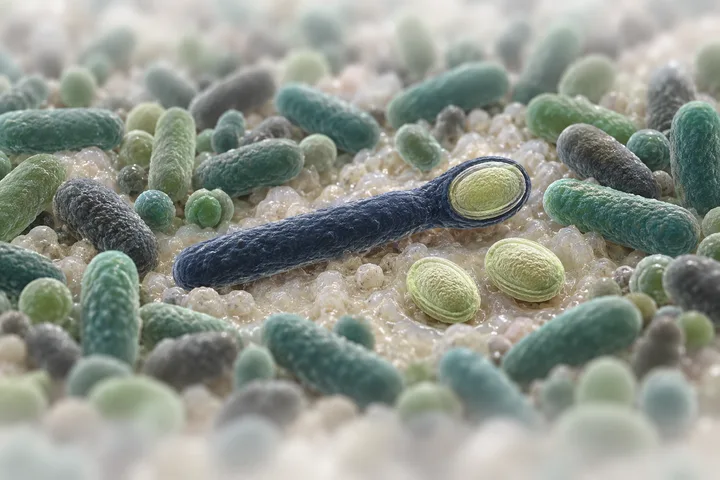
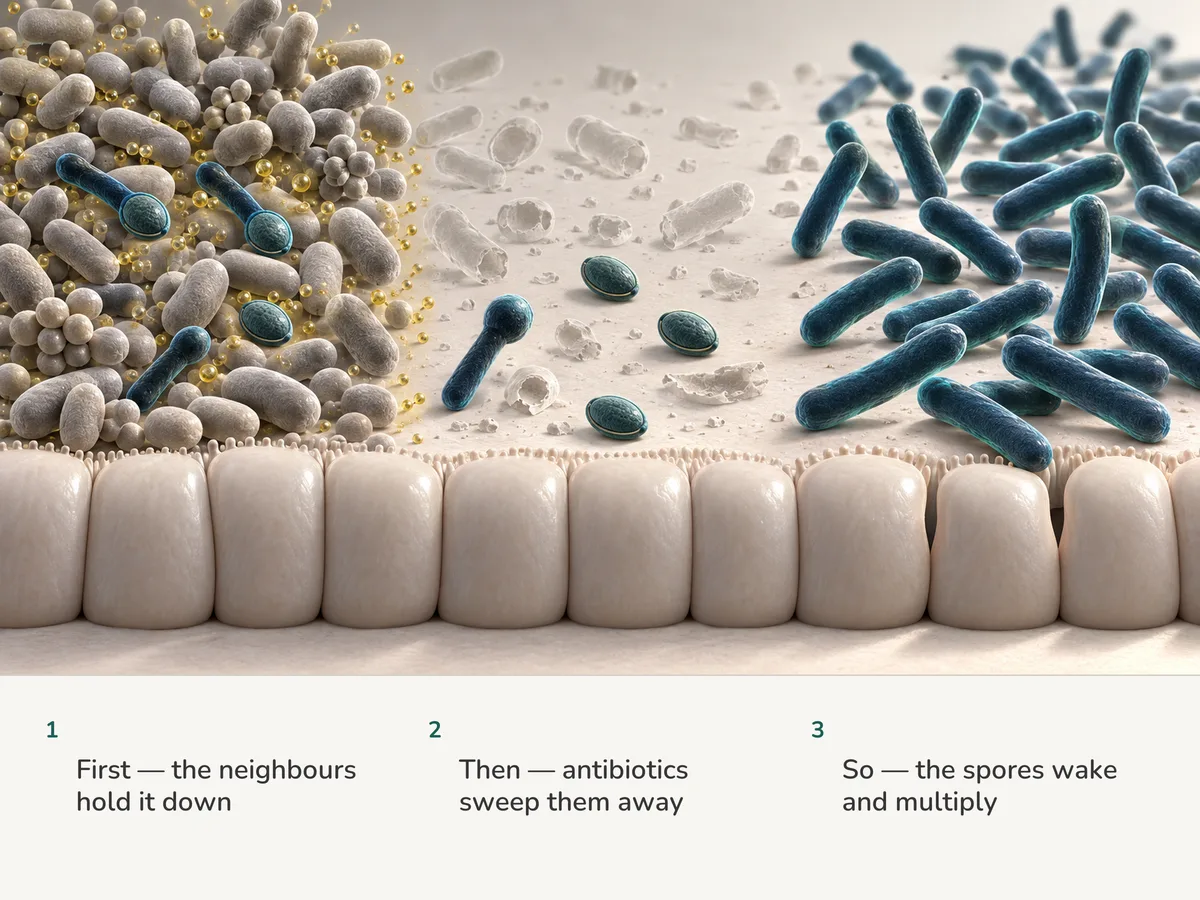
Clostridioides difficile is a Gram-positive, spore-forming, anaerobic bacterium of the large intestine — Gram-positive means it holds the standard laboratory stain, spore-forming means it can seal itself into a dormant, armoured copy that outlives antibiotics and disinfectant, anaerobic means it lives where there is no oxygen. It turns dangerous when the surrounding microbial community — the other gut residents that hold it in check — is disrupted, most often by antibiotics, and its toxins are released against the gut wall 2.
The reference review by Smits and colleagues in Nature Reviews Disease Primers lays out the machinery. Infection of the colon is potentially life-threatening, especially in elderly people and in patients whose gut microbiota has been thrown out of balance by antimicrobial drugs, and this organism is the leading cause of health-care-associated infectious diarrhoea 2. The damage is done by two large clostridial toxins, TcdA and TcdB, joined in some strains by a binary toxin, CDT 2.
How a toxin actually hurts you deserves a paragraph, because it explains everything downstream. Kroh and colleagues describe the sequence: the toxin binds a receptor on the intestinal cell, is taken inside, forms a pore — a hole punched through the membrane — at low pH, in acid, and delivers its enzymatic cargo: a glucosyltransferase domain, the part that sticks a sugar onto a target protein and jams it 12. What it jams are the host cell's GTPases, the molecular switches that tell the cell's internal skeleton what shape to hold. Disable them and the lining loses its shape and its seal, which is what produces the diarrhoea, inflammation and tissue death that make up the illness 2.
Two names, one species
If your lab report says Clostridium difficile and this page says Clostridioides difficile, nothing has changed but the label. In 2016 Lawson and colleagues showed that the organism does not belong among the true clostridia at all. Its nearest relative, Clostridium mangenotii — which they moved across into the new genus as Clostridioides mangenotii, and which NCBI Taxonomy now files under a further reclassification as Metaclostridioides mangenotii — shares only 94.7 % of its 16S rRNA gene sequence 1. That gene is the barcode microbiologists read to sort bacteria into families, and 94.7 % is a distant cousin, not a sibling. Both organisms sit in the family Peptostreptococcaceae, phylogenetically far from Clostridium butyricum and the rest of Clostridium sensu stricto — the clostridia in the strict sense, the ones that keep the old name 1. On that phylogenetic, chemotaxonomic and phenotypic evidence — the family tree, the cell chemistry, the behaviour in culture — they proposed the new genus Clostridioides, with this species as its type 1. NCBI Taxonomy lists the species under that name, and its taxon id sits in the entity block of this page. Clostridium difficile is still the name in most published papers, and Peptoclostridium difficile survives in some databases from a separate, earlier proposal — Yutin and Galperin placed the organism in the Peptostreptococcaceae in 2013 and suggested that name 15. All three mean this organism.
Where it lives in you
The colon — and not only in the sick. Kyne and colleagues followed 271 hospitalised patients receiving antibiotics: 37 of them (14 %) were already colonised on admission — colonised meaning the organism was living in the gut, ill or not — 18 with no symptoms, and a further 47 (17 %) picked the organism up in hospital, 19 of them silently 6.
Carriage tracks contact with health care. In a Malaysian study, 16 % of hospital inpatients were colonised with non-toxigenic C. difficile — non-toxigenic strains carry no toxin genes, so they have nothing to do the damage with — against 2 % of elderly community members who had little or no hospital contact; among inpatients with diarrhoea, 13 % had genuine infection 11.
The most striking reservoir is the youngest one. Kubota and colleagues followed 111 healthy Belgian infants from birth: 18 of them (16 %) carried toxigenic C. difficile — the kind that does carry the toxin genes — at some point in the first six months, at counts between 10⁴ and 10⁸ cells per gram of stool, two infants holding above 10⁸ cells per gram for weeks — and the commonest genotype was the same one found in adult patients with disease 10. A one-year Chinese follow-up found that 20 of 29 infants acquired the organism, with 111 of 437 stool samples positive (25.4 %), and 71.2 % of those isolates toxigenic 14. Healthy babies, hosting the thing that fills adult hospital wards.
What it does for us — every item with a caveat
Let us be exact: this is not a beneficial gut organism, and no honest page can turn it into one. What exists is a short list of documented useful things, each with its caveat attached.
Silent carriage goes with less disease. That is the Shim result above: 3.6 % versus 1.0 %, and among patients who received antibiotics, 4.5 % of non-carriers versus 1.1 % of carriers 5. The lower risk held for carriers of non-toxigenic and toxigenic strains. Said out loud, in the authors' own words: the mechanism is unknown 5.
A toxin-free strain works as a medicine. Gerding and colleagues ran a phase 2 randomised, double-blind, placebo-controlled trial of spores of non-toxigenic C. difficile strain M3 in 173 patients who had just recovered from infection 4. Recurrence occurred in 30 % of placebo patients and 11 % of those given the spores, falling to 5 % in the group taking 10⁷ spores per day for 7 days; the strain colonised 69 % of those who received it 4. The caveat is structural: the primary outcome of that trial was safety, and recurrence was an exploratory secondary endpoint 4. A 2019 systematic review of 38 randomised trials in 8,102 participants lists strain M3 among the effective non-antibiotic options, while placing faecal transplantation and monoclonal antibodies at the top for risk reduction 13.
Your antibody response decides which version you get. After colonisation, patients who stayed asymptomatic mounted significantly larger rises in serum IgG against toxin A than those who developed diarrhoea; at a serum level of 3.00 ELISA units or less — ELISA units are simply the laboratory's scale for how much of that antibody is in the blood — the adjusted odds ratio for diarrhoea was 48.0 6. An odds ratio of 48 means the odds of falling ill were forty-eight times higher in that group. And the same paper is honest about the limit of that: it found no evidence of immune protection against colonisation itself, only against becoming ill from it 6.
It taught medicine that the microbiome is a treatment. Van Nood and colleagues randomised patients with recurrent infection to donor-faeces infusion or vancomycin. The trial was stopped early after 13 of 16 patients (81 %) were cured by a single infusion, against 4 of 13 (31 %) on vancomycin alone and 3 of 13 (23 %) on vancomycin with bowel lavage 7. Working out why produced a mechanism: Buffie and colleagues identified Clostridium scindens, a bile-acid 7α-dehydroxylating gut bacterium — one of the residents that convert primary bile acids into the secondary ones that hold C. difficile down — as associated with resistance to infection in mice and in hospitalised patients, and showed that giving it enhanced resistance in a secondary-bile-acid-dependent way 8. Reed and colleagues then found that inhibition tracked with the production of roughly 2 mM deoxycholate, one of those secondary bile acids — and, honestly, that C. difficile outcompeted all four commensals tested in an in vitro co-culture system, the four grown together with it in a dish 9.
What it does against us
The scale is national. US surveillance estimated 476,400 cases in 2011 and 462,100 in 2017; after adjustment for more sensitive testing, the total burden fell by 24 % and the health-care-associated share by 36 %, while community-associated infection did not change and neither first recurrences nor in-hospital deaths fell significantly 3. Progress inside hospitals; a standstill outside them.
Recurrence is this organism's defining cruelty: 25 % to 30 % of patients relapse after treatment 4, and patients who have had one recurrence are more likely to have several 13.
The caveat that covers all of it
Carrying is not the same as having. Every number on this page separates those two states, and they point in opposite directions — colonisation without symptoms went with less subsequent diarrhoea 5, while the same organism, in a gut emptied of its bile-acid converters, is a leading cause of hospital diarrhoea and death 2. None of that is a reason to seek the bacterium out, and none of it is advice about your own test result.
The figures also come from particular populations: US surveillance sites, Belgian infants, one Malaysian hospital. They describe those settings, not your kitchen, and carriage rates differ substantially between countries and regions 14.
What has genuinely shifted is the direction of the work. The evidence that moved furthest was not about killing this bacterium harder. It was about restoring the community that used to hold it down 7 8.
Key facts
- The species was moved out of the genus Clostridium in 2016 and renamed Clostridioides difficile; its closest relative shares only 94.7 % of its 16S rRNA gene sequence.1
- In four pooled longitudinal hospital studies, C. difficile diarrhoea developed in 3.6 % of non-colonised patients but only 1.0 % of symptomless carriers.5
- In a phase 2 randomised trial, spores of a non-toxigenic C. difficile strain cut recurrence from 30 % on placebo to 11 %.4
- US surveillance estimated 476,400 cases in 2011 and 462,100 in 2017; the adjusted total burden fell by 24 %.3
- In a Belgian cohort, 16 % of healthy infants carried toxigenic C. difficile in their first six months, at 10⁴ to 10⁸ cells per gram of stool, without illness.10
- One donor-faeces infusion resolved recurrent infection in 81 % of patients, against 31 % for vancomycin alone.7
Questions people ask
Is Clostridioides difficile the same thing as Clostridium difficile?
Yes, the same species under a newer name. Lawson and colleagues moved it out of Clostridium in 2016, because it sits in a different family from the true clostridia and shares only 94.7 % of its 16S rRNA gene with its nearest relative. Papers and lab reports still use both names.
If it is in my stool, am I sick?
Not necessarily, and this is the central distinction. Studies of hospitalised patients and of healthy infants both find people who carry the organism, sometimes in large numbers, with no symptoms at all. Illness depends on toxin production, on the state of the surrounding microbiota and on the host antibody response.
Can C. difficile ever be useful?
In one narrow, tested sense. A strain that carries no toxin genes was given as spores to patients after treatment for infection, and reduced recurrence compared with placebo. Said out loud: that was a phase 2 trial in 173 patients whose primary outcome was safety, not a licensed therapy.
Why do antibiotics set it off?
Antibiotics remove the gut residents that convert primary bile acids into secondary ones. Those secondary bile acids block C. difficile from germinating and growing. Take the converters away and the brake comes off — which is why restoring the community, and not only killing the organism, is what stops recurrence.
Does a faecal transplant work?
In recurrent infection the evidence is strong: a randomised trial was stopped early because donor-faeces infusion beat vancomycin so clearly. Caveat: it enrolled 16 patients in the infusion arm, and a later review of 38 randomised trials places transplantation and monoclonal antibodies at the top, not any single product.
Sources
- Lawson P.A. et al., Anaerobe, 2016 — doi:10.1016/j.anaerobe.2016.06.008
- Smits W.K. et al., Nature Reviews Disease Primers, 2016 — doi:10.1038/nrdp.2016.20
- Guh A.Y. et al., New England Journal of Medicine, 2020 — doi:10.1056/NEJMoa1910215
- Gerding D.N. et al., JAMA, 2015 — doi:10.1001/jama.2015.3725
- Shim J.K. et al., The Lancet, 1998 — doi:10.1016/S0140-6736(97)08062-8
- Kyne L. et al., New England Journal of Medicine, 2000 — doi:10.1056/NEJM200002103420604
- van Nood E. et al., New England Journal of Medicine, 2013 — doi:10.1056/NEJMoa1205037
- Buffie C.G. et al., Nature, 2015 — doi:10.1038/nature13828
- Reed A.D. et al., Journal of Bacteriology, 2020 — doi:10.1128/JB.00039-20
- Kubota H. et al., Applied and Environmental Microbiology, 2016 — doi:10.1128/AEM.01540-16
- Zainul N.H. et al., Epidemiology and Infection, 2017 — doi:10.1017/S0950268817002011
- Kroh H.K. et al., Journal of Biological Chemistry, 2018 — doi:10.1074/jbc.M117.813428
- Madoff S.E. et al., Anaerobe, 2019 — doi:10.1016/j.anaerobe.2019.102098
- Cui Q.-Q. et al., Anaerobe, 2020 — doi:10.1016/j.anaerobe.2020.102295
- Yutin N. & Galperin M.Y., Environmental Microbiology, 2013 — doi:10.1111/1462-2920.12173
Related

Same capsule, opposite result: what makes a probiotic work
120 overweight adults, 12 weeks: heat-killed L. plantarum did nothing on average. Only the least varied guts lost weight. Why that is a lead, not proof.

IBS pain is not in your head: enzymes poke the gut's nerves
Stool fluid from IBS patients made gut nerve networks fire far harder than fluid from healthy people, a 2026 Gut study found. What it shows — and does not.
Actinomycetota: the phylum that guards infants and causes TB
Actinomycetota, formerly Actinobacteria: the phylum of Bifidobacterium and of tuberculosis. Where it lives in your body, what it does for and against you.